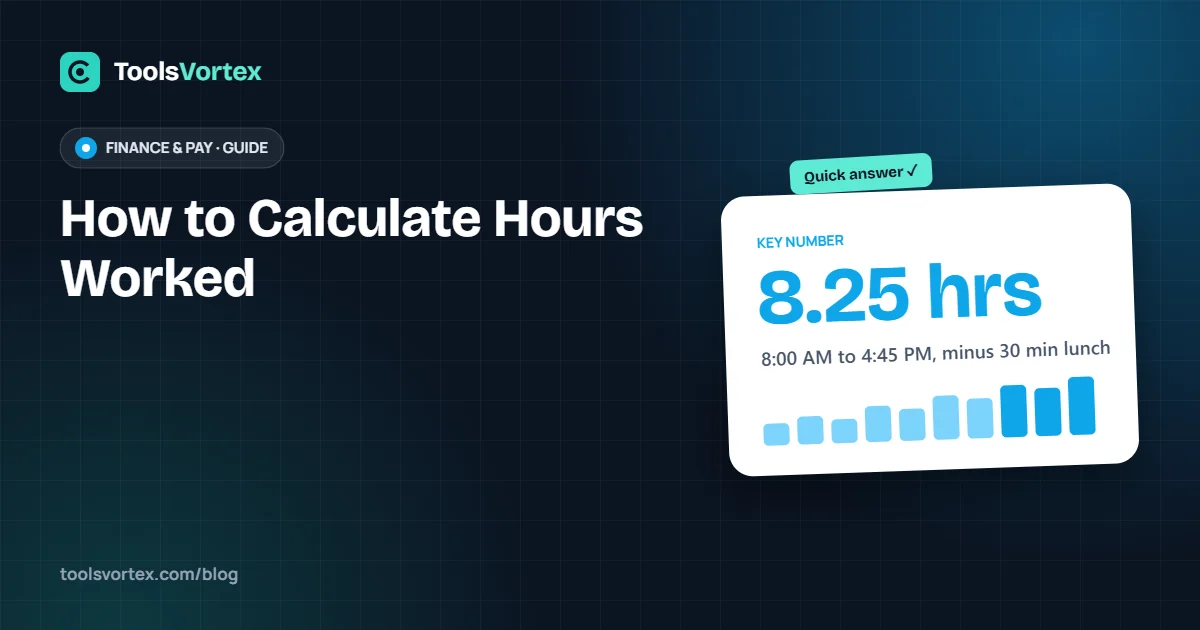
To calculate hours worked, convert start and end times to 24-hour time, subtract start from end, and remove unpaid meal breaks. Divide leftover minutes by 60 for decimal hours. For example, 8:00 AM to 4:45 PM with a 30-minute lunch is 8 hours 15 minutes, or 8.25 hours.

Your time card says you clocked in at 7:52 AM and out at 4:30 PM. How many hours is that, really? Knowing how to calculate hours worked helps you check your paycheck, fill out a timesheet, or run payroll for a small team without guessing.
This guide walks through the method step by step, with a minutes to decimal chart, overnight shifts, the federal rules on breaks and rounding, and a full week example. If you want the answer fast, the hours calculator does the subtraction for you.
How Do You Calculate Hours Worked?
You calculate hours worked by subtracting your start time from your end time, then taking out any unpaid meal break. Convert the leftover minutes to a decimal if your payroll uses decimal hours.
- Convert to 24-hour time. 4:45 PM becomes 16:45. Add 12 to any PM hour except 12 PM. The military time converter helps if you are unsure.
- Subtract start from end. 16:45 minus 8:00 = 8 hours 45 minutes.
- Remove unpaid breaks. Take out a 30-minute lunch: 8:45 minus 0:30 = 8:15.
- Convert minutes to decimal. 15 ÷ 60 = 0.25, so 8:15 = 8.25 hours.
Decimal hours = whole hours + (minutes ÷ 60)
Overnight shift = (end time + 24:00) minus start time minus unpaid breaks
When the end minutes are smaller than the start minutes, borrow an hour. For 7:52 to 16:30, change 16:30 to 15:90. Then 15:90 minus 7:52 = 8:38.
How Do You Convert Minutes to Decimal Hours?
To convert minutes to decimal hours, divide the minutes by 60. So 15 minutes is 0.25 hours, 30 minutes is 0.50, and 45 minutes is 0.75. Use this chart for common values, rounded to two decimals.
| Minutes | Decimal hours |
|---|---|
| 1 | 0.02 |
| 5 | 0.08 |
| 6 | 0.10 |
| 10 | 0.17 |
| 12 | 0.20 |
| 15 | 0.25 |
| 20 | 0.33 |
| 25 | 0.42 |
| 30 | 0.50 |
| 35 | 0.58 |
| 40 | 0.67 |
| 45 | 0.75 |
| 50 | 0.83 |
| 55 | 0.92 |
| 60 | 1.00 |
Values are minutes ÷ 60, rounded to two decimal places. Highlighted rows are the quarter hours most payroll systems use.
A common mistake is writing 8 hours 30 minutes as 8.30. It is 8.50. Writing 8.30 would cost you 12 minutes of pay. For any odd number, the minutes to hours converter gives the exact decimal.
How Do You Calculate Hours for a Shift That Crosses Midnight?
For a shift that crosses midnight, add 24 hours to the end time before you subtract. That stops you from getting a negative number.
Say you work 10:00 PM to 6:30 AM. In 24-hour time that is 22:00 to 6:30. Add 24 to the end time: 6:30 + 24:00 = 30:30. Then 30:30 minus 22:00 = 8 hours 30 minutes. Take out a 30-minute unpaid meal and you get 8:00, or 8.00 hours.
Another way is to split the shift at midnight. 22:00 to 24:00 is 2 hours, and 0:00 to 6:30 is 6.5 hours, for 8.5 hours in total. Splitting also helps when your workweek or a holiday starts at midnight, since some hours may fall on a different day. The time duration calculator handles times across two dates.
Do Breaks Count as Hours Worked?
Under federal law, short rest breaks count as paid hours worked, but real meal breaks usually do not. The US Department of Labor sets these rules under the Fair Labor Standards Act (FLSA).
- Rest breaks of 5 to about 20 minutes are paid work time under 29 CFR 785.18. Do not subtract them.
- Bona fide meal periods are not work time under 29 CFR 785.19. They are usually 30 minutes or more.
- You must be fully relieved of duty for a meal break to be unpaid. If you answer phones or watch a desk while eating, that time counts as work.
Federal law does not require employers to give lunch or coffee breaks at all, according to the Department of Labor. Many states do, and some set their own meal and rest rules. This is general information, and your state laws can add rules on top of the federal ones.
The practical rule: subtract only unpaid meal breaks of about 30 minutes or more when you work out your hours. Leave short breaks in.
Can Employers Round Time to the Nearest Quarter Hour?
Yes. Employers may round clock times to the nearest 5 minutes, tenth of an hour, or quarter hour, as long as it does not shortchange workers over time. That rule is in 29 CFR 785.48(b).
Quarter hour rounding is often called the 7-minute rule. Punches 1 to 7 minutes past a quarter hour round down. Punches 8 to 14 minutes past round up to the next quarter. The rounding must go both ways, so it evens out.
| Actual punch | Minutes past the quarter | Rounded time |
|---|---|---|
| 8:01 AM | 1 min past 8:00 | 8:00 AM |
| 8:04 AM | 4 min past 8:00 | 8:00 AM |
| 8:07 AM | 7 min past 8:00 | 8:00 AM |
| 8:08 AM | 8 min past 8:00 | 8:15 AM |
| 8:11 AM | 11 min past 8:00 | 8:15 AM |
| 8:14 AM | 14 min past 8:00 | 8:15 AM |
Example uses an 8:00 AM quarter hour. The same pattern repeats at :15, :30, and :45.
An edge case to watch: a policy that always rounds in the employer’s favor, such as rounding clock-ins up but clock-outs down, does not meet the federal standard. If your time card looks off, compare raw punches with the rounded times on a time card calculator.
What Are Common Mistakes When Calculating Hours Worked?
The most common mistakes are mixing up 12 AM and 12 PM, writing minutes as decimals, and subtracting breaks that should be paid. Each one can shift a paycheck by real money over a month.
- 12 AM and 12 PM. 12 PM is noon (12:00 in 24-hour time). 12 AM is midnight (0:00). A shift from 12 PM to 8 PM is 8 hours, not 20.
- Minutes written as decimals. 6 hours 45 minutes is 6.75, not 6.45.
- Subtracting paid breaks. Two 15-minute rest breaks stay in your hours. Only take out the unpaid meal.
- Split shifts. If you work 7:00 AM to 11:00 AM and 3:00 PM to 7:00 PM, total each block on its own: 4 + 4 = 8 hours. The gap is not work time if you are free to leave.
- Daylight saving time. On the night clocks move forward, a 10:00 PM to 6:00 AM shift lasts 7 real hours. On the night they fall back, it lasts 9. Check the actual time worked, not just the clock faces.
Keep raw punch times on file even if your employer rounds. They make it easy to spot errors later.
How Do You Calculate Total Hours Worked in a Week?
To total a week, find the hours for each day, add the hours and minutes together, and convert the final minutes to a decimal at the end. Converting at the end avoids small rounding errors.
Jordan works five shifts this week, with one overnight shift on Friday.
- Monday 8:00 AM to 4:45 PM: 8:45 minus a 30 min lunch = 8:15.
- Tuesday 7:52 AM to 4:30 PM: 8:38 minus 30 min = 8:08.
- Wednesday 8:05 AM to 5:10 PM: 9:05 minus a 45 min lunch = 8:20.
- Thursday 8:00 AM to 12:15 PM, no meal break: 4:15.
- Friday 10:00 PM to 6:30 AM: 8:30 minus 30 min = 8:00.
- Add the hours: 8 + 8 + 8 + 4 + 8 = 36. Add the minutes: 15 + 8 + 20 + 15 + 0 = 58.
- Total: 36 hours 58 minutes. 58 ÷ 60 = 0.97, so 36.97 hours.
Jordan worked 36.97 hours, which is under 40, so no federal overtime is due this week.
| Day | Shift | Unpaid meal | Hours:minutes | Decimal |
|---|---|---|---|---|
| Monday | 8:00 AM to 4:45 PM | 30 min | 8:15 | 8.25 |
| Tuesday | 7:52 AM to 4:30 PM | 30 min | 8:08 | 8.13 |
| Wednesday | 8:05 AM to 5:10 PM | 45 min | 8:20 | 8.33 |
| Thursday | 8:00 AM to 12:15 PM | 0 min | 4:15 | 4.25 |
| Friday (overnight) | 10:00 PM to 6:30 AM | 30 min | 8:00 | 8.00 |
| Total | 36:58 | 36.97 |
If you add the rounded daily decimals instead (8.25 + 8.13 + 8.33 + 4.25 + 8.00), you get 36.96. Add minutes first for the exact total.
If the total goes over 40 hours, the extra time is usually overtime. Our guide on how to calculate overtime pay covers that math. To check a week like this one quickly, enter each shift in the hours calculator.
Quick Recap
- Hours worked = end time minus start time minus unpaid meal breaks.
- Divide minutes by 60 for decimals: 15 min = 0.25, 30 min = 0.50, 45 min = 0.75.
- For overnight shifts, add 24 hours to the end time before subtracting.
- Rest breaks of 5 to about 20 minutes are paid; bona fide meal breaks of 30+ minutes usually are not.
- Add minutes for the whole week first, then convert to decimal once.
Frequently Asked Questions
How many hours is 8 AM to 5 PM?
8 AM to 5 PM is 9 hours. If you take an unpaid 30-minute lunch, you worked 8.5 hours. With an unpaid 1-hour lunch, you worked 8 hours. Short paid rest breaks are not subtracted.
How many hours is 9 AM to 5:30 PM?
9 AM to 5:30 PM is 8 hours 30 minutes, or 8.5 hours. Take out a 30-minute unpaid lunch and you have 8 hours. Take out a 1-hour lunch and you have 7.5 hours.
How do I write 7 hours and 45 minutes in decimal?
7 hours 45 minutes is 7.75 hours. Divide 45 by 60 to get 0.75, then add it to 7. Do not write 7.45, which would equal only 7 hours 27 minutes.
Is a 15-minute break paid?
Under federal rules, yes. The Department of Labor treats rest breaks of 5 to about 20 minutes as paid work time under 29 CFR 785.18. Your employer is not required to offer breaks, but if it does, short ones count.
What is the 7-minute rule for time clocks?
It is a common way to round to the nearest quarter hour. Punches 1 to 7 minutes past a quarter hour round down, and 8 to 14 minutes past round up. It must be neutral over time under 29 CFR 785.48(b).
How do I calculate hours worked for a night shift?
Add 24 hours to the end time, then subtract the start time. For 11:00 PM to 7:00 AM, that is 31:00 minus 23:00, or 8 hours. Then subtract any unpaid meal break.
Sources
- eCFR: 29 CFR Part 785, Hours Worked, rest periods (785.18), meal periods (785.19), rounding (785.48)
- U.S. Department of Labor: Fact Sheet #22, Hours Worked Under the FLSA, paid rest breaks and unpaid bona fide meal periods
- U.S. Department of Labor: Breaks and Meal Periods, federal law does not require lunch or coffee breaks