Estimate your one rep max (1RM) from any set of 2 to 12 reps, in kilograms or pounds. Compare seven published formulas and get a ready to use table of training weights, rounded to the plates in your gym.
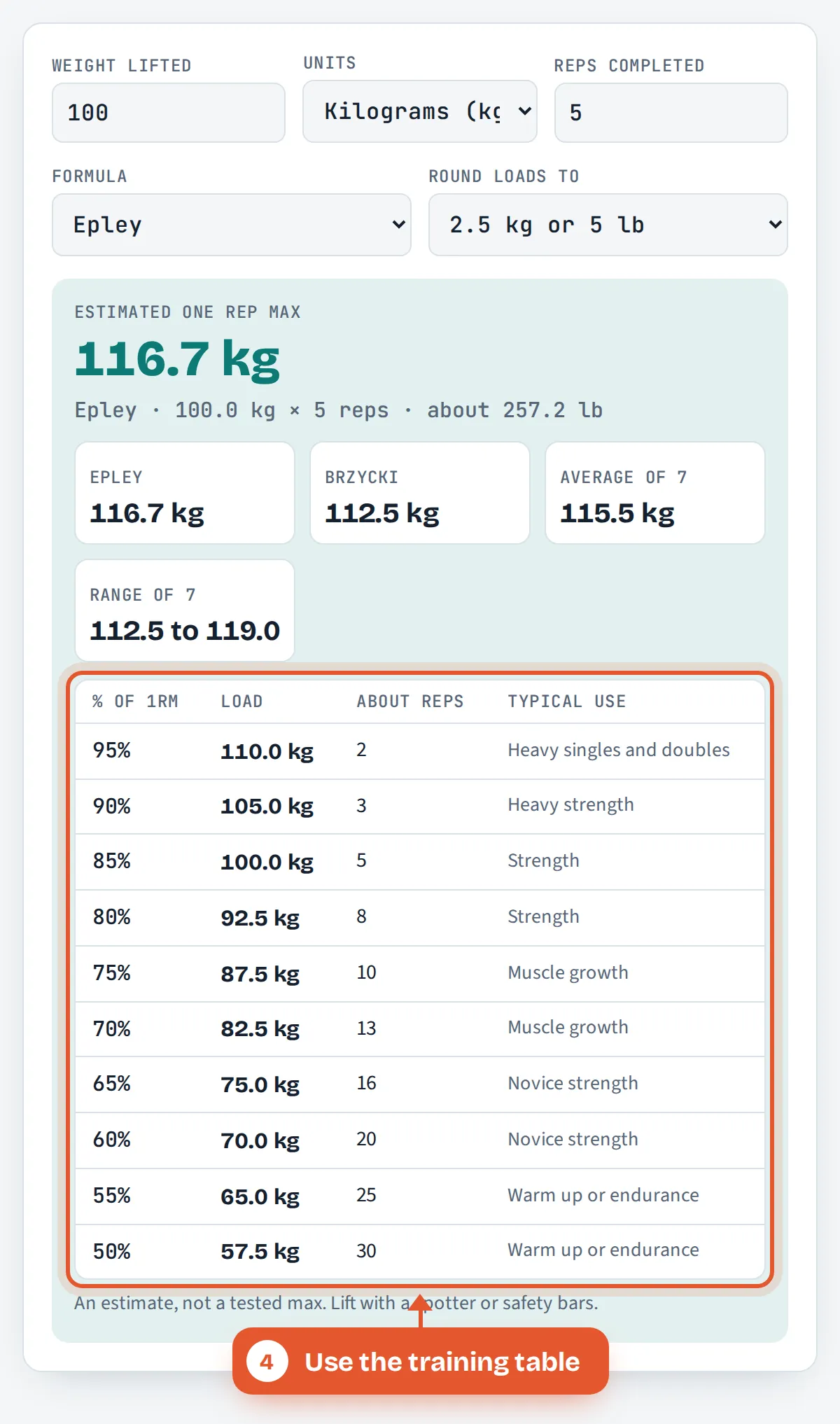
| % of 1RM | Load | About reps | Typical use |
|---|
An estimate, not a tested max.
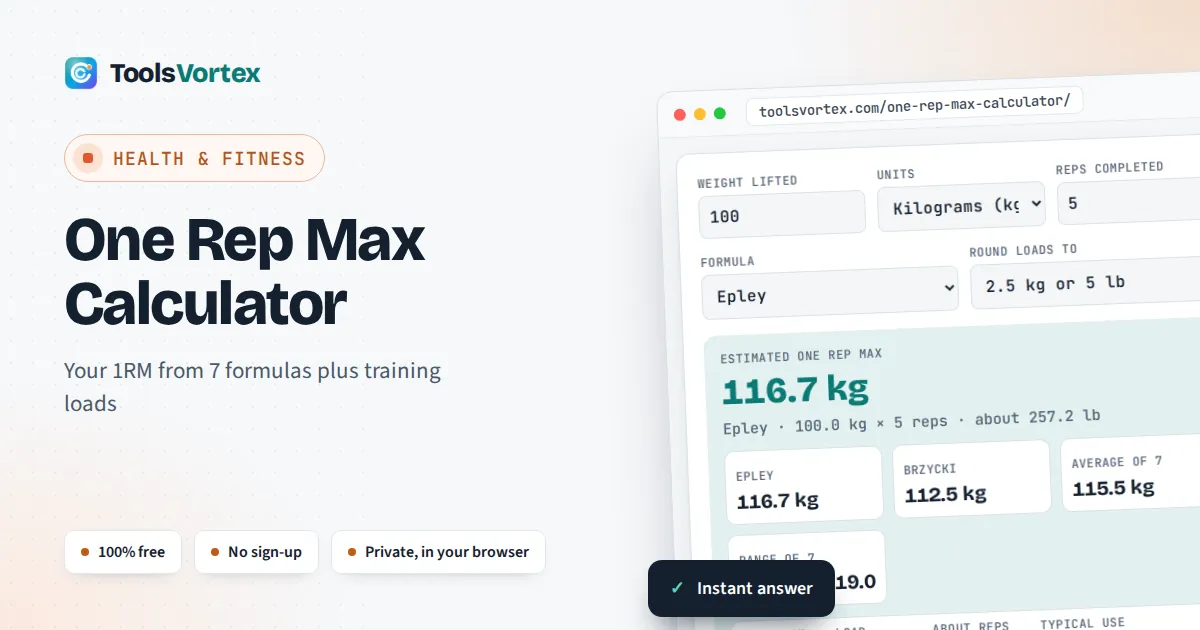
This one rep max calculator estimates the heaviest weight you could lift once from a set you have already done, for lifters who want percentage based training without the risk and fatigue of a true max test. Enter the weight and the number of clean reps you managed, and the tool shows your estimated 1RM from seven equations, how far they disagree, and a table of loads from 50 to 95% that you can take straight to the squat rack or bench.
How do you calculate your one rep max?
The most common method is the Epley formula: 1RM = weight × (1 + reps ÷ 30). A one rep max calculator applies it instantly. If you bench 100 kg for 5 clean reps, your estimated 1RM is 100 × (1 + 5 ÷ 30) = 116.7 kg. Estimates are most reliable from sets of fewer than 10 reps.
Which One Rep Max Formula Is Most Accurate?
No single formula is the most accurate for everyone, but all of them work best with fewer than 10 reps. A 2008 study by Mayhew and colleagues in the Journal of Strength and Conditioning Research found prediction equations for the bench press were more accurate when fewer than 10 repetitions to fatigue were used. Epley and Brzycki, the two most popular formulas, give identical results at exactly 10 reps. Below that, Epley gives a slightly higher estimate.
Brzycki: 1RM = w × 36 ÷ (37 − r)
Lombardi: 1RM = w × r0.10
O’Conner: 1RM = w × (1 + 0.025 × r)
Mayhew: 1RM = w ÷ (0.522 + 0.419 × e−0.055 × r)
Wathan: 1RM = w ÷ (0.488 + 0.538 × e−0.075 × r)
Lander: 1RM = w ÷ (1.013 − 0.0267123 × r)
w = weight lifted, r = reps completed
Because each equation was fitted on different lifters and exercises, an estimate can be 10% or more away from a real tested max. That is why the calculator shows the average and the full range of all seven: if they sit close together, you can trust the number more.
How Do the 1RM Formulas Compare at Different Reps?
This table shows the estimated 1RM for a lifter who moves 100 kg for a given number of reps. The same ratios apply to pounds or any other weight.
| Reps at 100 kg | Epley | Brzycki | Lombardi | Mayhew | O’Conner |
|---|---|---|---|---|---|
| 2 | 106.7 | 102.9 | 107.2 | 111.4 | 105.0 |
| 3 | 110.0 | 105.9 | 111.6 | 114.0 | 107.5 |
| 4 | 113.3 | 109.1 | 114.9 | 116.5 | 110.0 |
| 5 | 116.7 | 112.5 | 117.5 | 119.0 | 112.5 |
| 6 | 120.0 | 116.1 | 119.6 | 121.5 | 115.0 |
| 8 | 126.7 | 124.1 | 123.1 | 126.3 | 120.0 |
| 10 | 133.3 | 133.3 | 125.9 | 130.9 | 125.0 |
| 12 | 140.0 | 144.0 | 128.2 | 135.4 | 130.0 |
At 3 to 6 reps the seven formulas sit within about 8 kg of each other. By 12 reps the spread grows to about 16 kg, because each formula assumes a different link between reps and strength, and those assumptions pull apart as reps climb. For the best estimate, use a heavy set of 3 to 6 reps taken close to failure with good form.
What Percentage of Your 1RM Should You Train At?
For novice and intermediate lifters, the American College of Sports Medicine (ACSM) recommends loads of 60 to 70% of 1RM for 8 to 12 reps to build strength, and 70 to 85% for 8 to 12 reps per set for muscle growth. Advanced lifters cycle loads of 80 to 100% of 1RM for strength. For muscular endurance, ACSM suggests relatively light loads for 10 to 15 reps.
The table in the calculator turns these percentages into real loads, rounded to 2.5 kg for standard UK and European plates or 5 lb in imperial gyms. The “About reps” column is the Epley formula run backwards, so it is a guide to how many reps that load should allow, not a target.
Worked Example: What Is Aoife’s Squat 1RM?
Aoife trains at a gym in Cork and squats 80 kg for 6 clean reps, stopping with maybe one rep left. She wants a 1RM figure to plan a 12 week block.
- Epley: 80 × (1 + 6 ÷ 30) = 80 × 1.2 = 96 kg
- Brzycki: 80 × 36 ÷ (37 − 6) = 80 × 36 ÷ 31 = 92.9 kg
- Training at 75%: 96 × 0.75 = 72 kg, which rounds to 72.5 kg on 2.5 kg plates
Her two estimates are only about 3 kg apart, so a working 1RM of about 94 to 96 kg is a fair starting point. Using the lower Brzycki figure is the safer choice for heavy singles and doubles. If she trains in a gym with pound plates, the kg to lbs converter turns 96 kg into about 212 lb.
Is It Safe to Test Your True One Rep Max?
A true 1RM test is safe for most healthy, experienced lifters who warm up well, use a spotter or safety bars and stop the moment form breaks down, but it is rarely necessary. Estimating from a set of 3 to 6 reps gives you a number that is good enough for programming with far less fatigue. Beginners in their first months of training should build technique first, because their strength changes so quickly that any max is soon out of date.
This is an estimate for healthy adults, not medical advice: speak to your GP before heavy lifting if you have high blood pressure, a heart condition, a hernia or a recent injury, or if you are pregnant. The NHS recommends strengthening activities that work all the major muscle groups on at least 2 days a week, and eating enough protein supports that work, which the protein intake calculator can help you plan.
How Do You Use the One Rep Max Calculator?
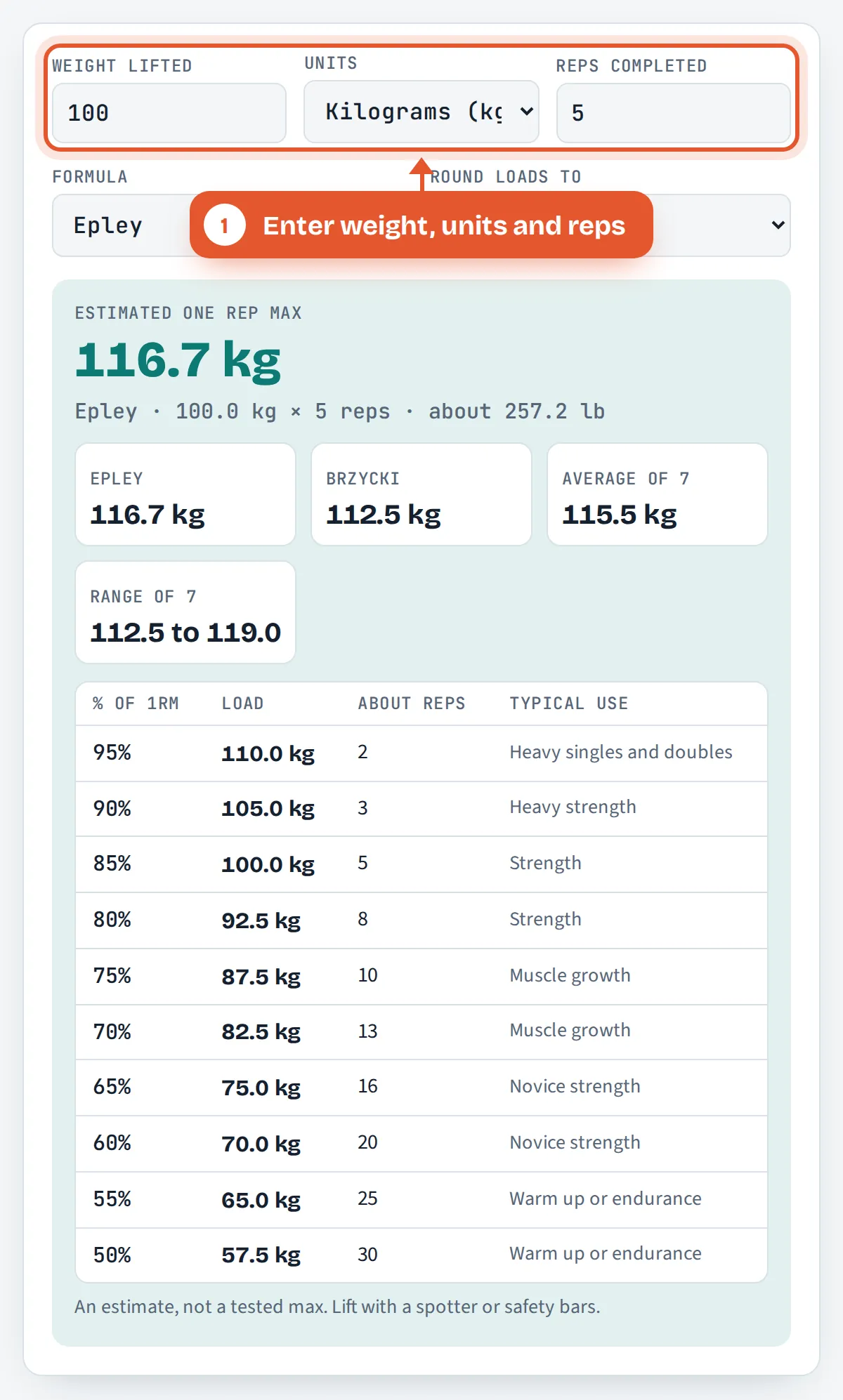
Enter weight, units and reps
Type the weight you lifted, choose kg or lb, and enter how many clean reps you completed.

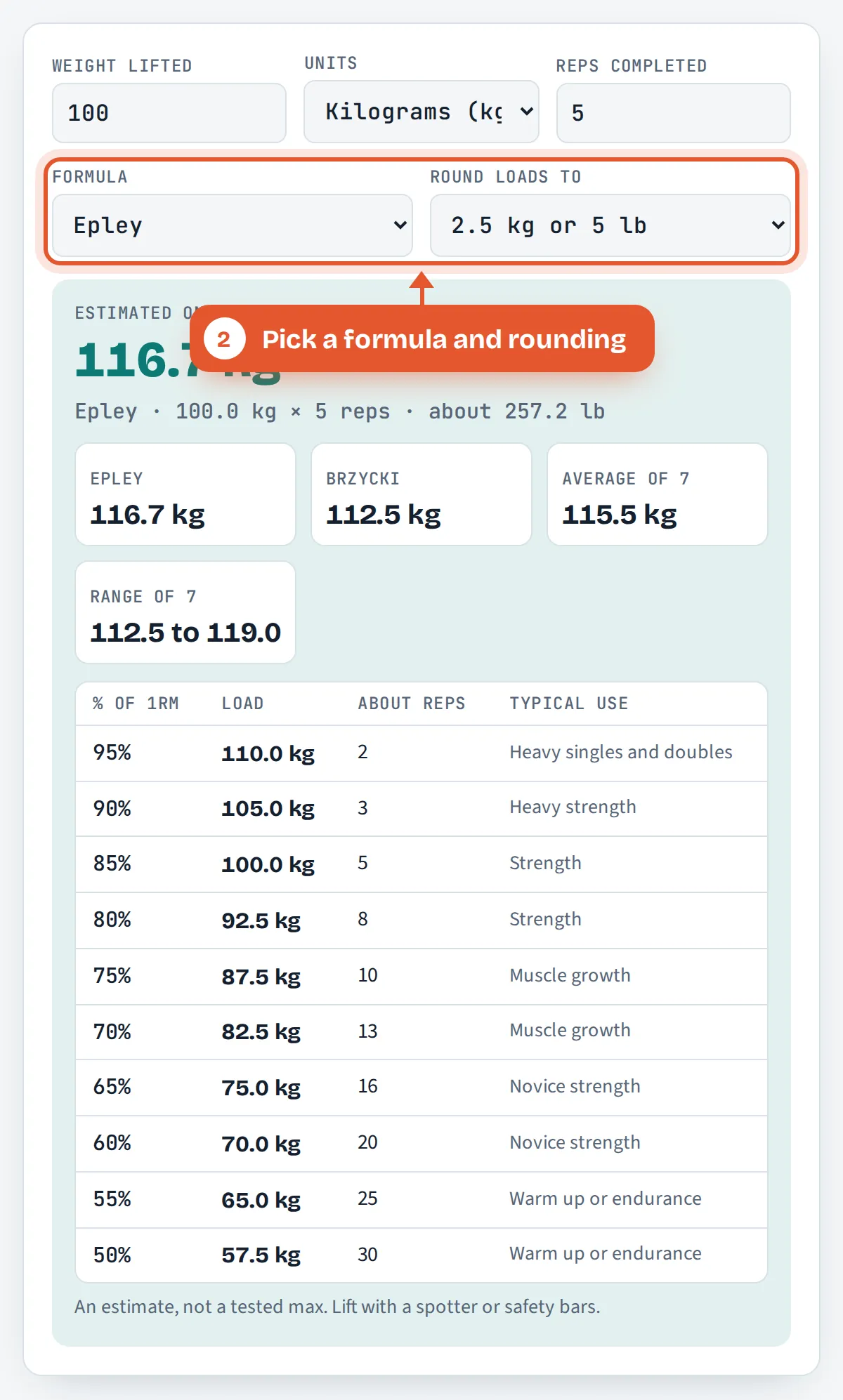
Pick a formula and rounding
Choose Epley, Brzycki, the average of all seven or another formula, then set how training loads are rounded.
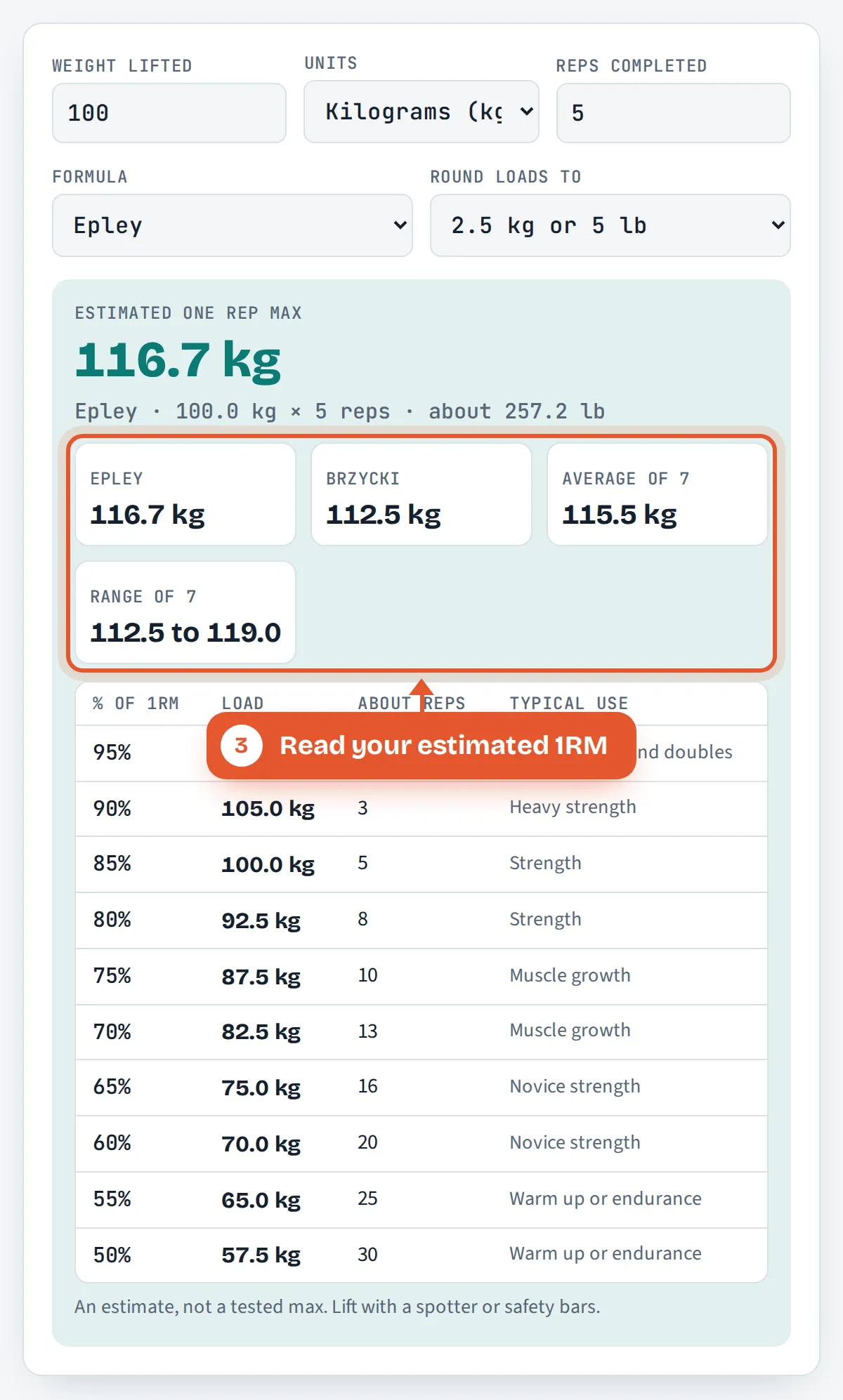
Read your estimated 1RM
Your one rep max shows in large text, with Epley, Brzycki, the average and the range of all formulas.
Use the training table
Pick a percentage from the table to see the load to put on the bar and about how many reps it allows.
Frequently Asked Questions
How accurate is a one rep max calculator?
For most people, an estimate from a set of fewer than 10 reps lands close to a true max, but it can be 10% or more out. Accuracy drops with higher reps, tired muscles and exercises the formulas were not built on. Comparing several formulas shows how much to trust the number.
What is a good one rep max for my body weight?
It depends on the lift, your sex, age and training history, so there is no single good number. A useful approach is to track your own estimated 1RM every few weeks. A rising estimate at the same body weight means you are getting stronger.
How many reps should I use to estimate my 1RM?
Use a set of 3 to 6 reps taken close to failure with good technique. Research shows prediction equations are more accurate with fewer than 10 reps, and at 3 to 6 reps the formulas agree closely with each other.
What is the difference between Epley and Brzycki?
Both estimate your 1RM from a submaximal set. Epley multiplies the weight by 1 plus reps divided by 30, while Brzycki multiplies by 36 divided by 37 minus reps. They agree exactly at 10 reps, and below that Epley gives a slightly higher number.
Does the calculator work for every exercise?
It works best for big barbell lifts such as the squat, bench press and deadlift. Machine exercises, dumbbells and bodyweight moves were not what most of the formulas were built on, so treat those estimates more loosely.
How often should I recalculate my one rep max?
Every 4 to 8 weeks, or at the end of each training block, is a practical rhythm. Beginners gain strength quickly and may need to update more often. Use a fresh heavy set of 3 to 6 reps rather than an old figure.
Sources and Further Reading
- One-repetition maximum, Wikipedia
- Mayhew JL et al. Accuracy of prediction equations for determining one repetition maximum bench press in women, J Strength Cond Res 2008 (SUNY)
- Physical activity guidelines for adults aged 19 to 64, NHS
Related Tools
Last reviewed: October 2026