Pick an activity, enter your weight and how long you did it, and see the calories you burned. You also get calories per minute, per hour and the net burn above rest.
Runs in your browser. Nothing you type is sent anywhere.
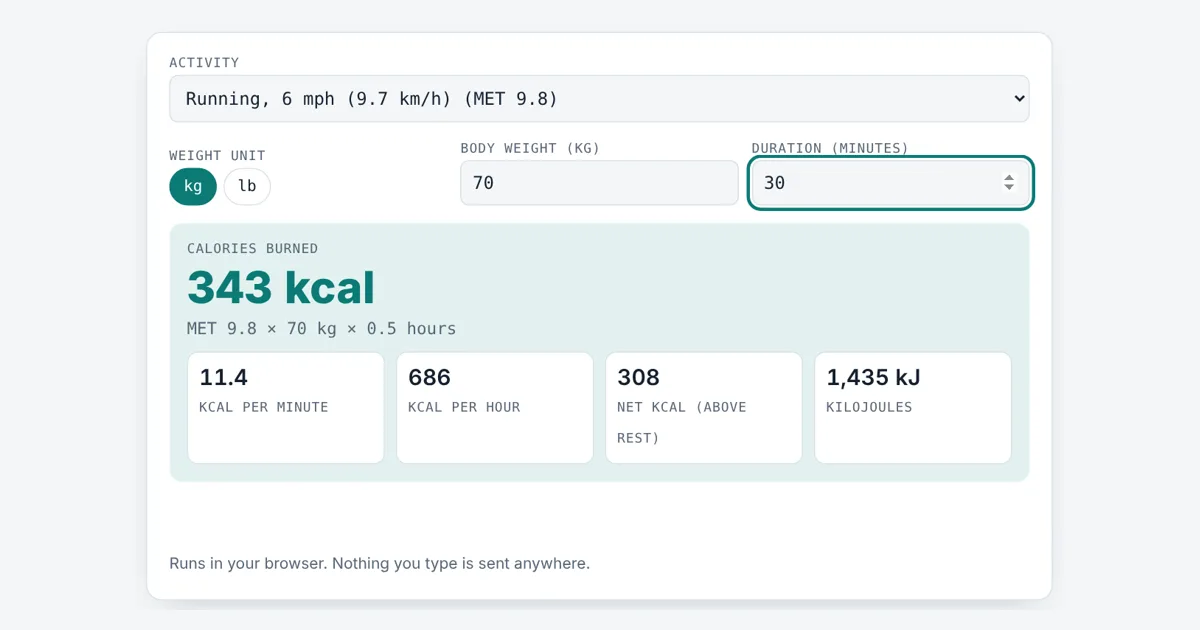
This calories burned calculator helps anyone who tracks food or training see what a workout, sport or chore really costs in energy. Choose from 32 common activities, each with its MET value from the Compendium of Physical Activities, and get gross calories, net calories and kilojoules.
How Many Calories Do You Burn Exercising?
Calories burned equal the activity MET value times your weight in kilograms times the hours. For example, a 70 kg person running at 6 mph (9.8 METs) for 30 minutes burns 9.8 × 70 × 0.5 = 343 kcal. Brisk walking at 3.5 mph (4.3 METs) for the same time burns about 151 kcal.
How Do You Calculate Calories Burned During Exercise?
You calculate calories burned by multiplying the activity’s MET value by your weight in kilograms and the time in hours.
net kcal = (MET − 1) × weight(kg) × hours
A MET (metabolic equivalent of task) compares an activity with sitting still. One MET is about 1 kcal per kilogram per hour, which equals an oxygen use of 3.5 ml per kg per minute. So an activity rated 8 METs burns about eight times as much energy as resting. Because one MET is your resting metabolic rate, the plain formula gives gross calories, which include what you would have burned anyway on the sofa. The net calories box takes that resting part away, which is the fairer number if you plan to eat back your exercise.
Where Do the MET Values Come From?
The MET values come from the Compendium of Physical Activities, a list of hundreds of activities with measured or estimated MET values, first published in 1993 and updated in 2000, 2011 and 2024. This tool uses the 2011 adult values led by Barbara Ainsworth, which are the ones most fitness research still quotes. Each activity has a code, for example running at 6 mph is code 12050 with 9.8 METs.
Calories Burned in 30 Minutes by Weight
Results from this tool for half an hour of activity at three body weights:
| Activity | MET | 60 kg | 75 kg | 90 kg |
|---|---|---|---|---|
| Yoga, hatha | 2.5 | 75 | 94 | 112 |
| Walking, 3.5 mph | 4.3 | 129 | 161 | 194 |
| Swimming laps, moderate | 5.8 | 174 | 218 | 261 |
| Cycling, 12 to 13.9 mph | 8.0 | 240 | 300 | 360 |
| Running, 6 mph | 9.8 | 294 | 368 | 441 |
| Jumping rope, moderate | 11.8 | 354 | 442 | 531 |
Why Do Heavier People Burn More Calories?
Heavier people burn more calories because moving a larger body takes more energy, so the formula scales directly with weight. A 90 kg person running for 30 minutes burns half as much again as a 60 kg person. For walking with your own pace and distance, the walking calories burned calculator goes into more detail, and to see how exercise fits your full day, use the calorie calculator. If you want to train at the right effort, the heart rate zone calculator shows your zones.
MET values are averages for adults. Fitness, technique, terrain and age can move your real burn up or down by 20% or more. This is an estimate, not medical advice. Check with a doctor before starting hard exercise if you have a heart or lung condition.
Worked Example
Maya weighs 70 kg and runs for 30 minutes at 6 mph. With Running, 6 mph picked, the tool shows 343 kcal, or 11.4 kcal per minute and 1,435 kJ. Taking away her resting burn gives a net 308 kcal. Her friend weighs 154 lb and walks briskly at 3.5 mph for an hour: switching to lb, the tool shows 300 kcal for that walk.
How Do You Use the Calories Burned Calculator?
Choose the activity
Open the Activity list and pick the closest match. The MET value is shown next to each one.
Enter your weight
Tap kg or lb and type your body weight. The number converts when you switch.
Add the duration
Type how many minutes you were active. Results update as you type.
Read the results
The big number is total calories. The boxes show per minute, per hour, net calories and kJ.

Frequently Asked Questions
How many calories does walking 10,000 steps burn?
10,000 steps is roughly 7 to 8 km and takes about 90 to 100 minutes at a moderate pace. At 3.5 METs, a 70 kg person burns about 370 to 410 kcal over that time, depending on speed and stride.
Is gross or net calories more accurate for eating back exercise?
Net calories are better for eating back exercise, because your daily calorie target already includes your resting burn. For a 30 minute run at 70 kg, gross is 343 kcal but net is 308 kcal, so eating back the gross figure would overshoot slightly.
Why does my fitness watch show a different number?
Watches use heart rate, motion and their own models, while this tool uses fixed MET averages. The two can differ by 10% to 30%. Neither is exact, so pick one method and use it consistently to track changes over time.
What is a MET value?
A MET, or metabolic equivalent of task, is how hard an activity is compared with sitting at rest. One MET is about 1 kcal per kg per hour. Yoga is about 2.5 METs, brisk walking 4.3 and running at 6 mph 9.8.
Does age or sex change calories burned?
The MET formula only uses weight and time, so age and sex are not included. In real life, older adults and women often have a slightly lower resting rate, so actual burns may be a little below the estimate.
How many calories do you burn in an hour of cycling?
At a moderate 12 to 13.9 mph (8 METs), a 70 kg rider burns about 560 kcal in an hour. A 90 kg rider at the same speed burns about 720 kcal. Hills, wind and bike type change the real figure.
Sources and Further Reading
- Ainsworth BE et al. 2011 Compendium of Physical Activities: a second update of codes and MET values (PubMed)
- Adult Compendium of Physical Activities: MET definition and unit conversions
- CDC: Measuring physical activity intensity
Related Tools
Last reviewed: October 2026