Find the lowest common multiple (LCM) of 2 to 10 whole numbers, or the lowest common denominator of a set of fractions. Pick a method and see the full working, step by step.
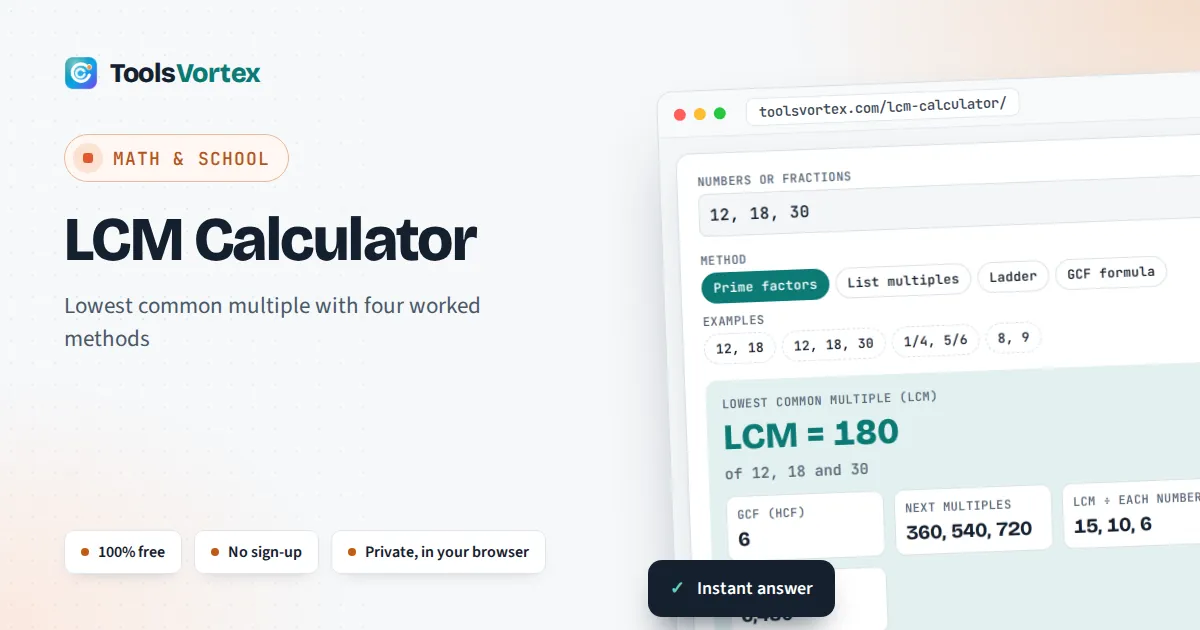
This LCM calculator finds the lowest common multiple for students, parents helping with homework and anyone lining up repeating schedules. Type whole numbers separated by commas or spaces, or fractions such as 1/4, 5/6, and it returns the LCM (or the lowest common denominator), the greatest common factor, the next common multiples and a worked solution using the method your teacher asks for.
How do you find the lowest common multiple?
The lowest common multiple (LCM) of two or more whole numbers is the smallest number they all divide into exactly. To find it with an LCM calculator or by hand, take every prime at its highest power: 12 = 2² × 3 and 18 = 2 × 3², so the LCM is 2² × 3² = 36.
How Does the LCM Calculator Work?
It works with exact whole numbers, so even 15 digit inputs give an exact answer. The core rule links the LCM to the greatest common factor (GCF), which Euclid’s algorithm finds in a few quick divisions.
LCM(a, b, c) = LCM(LCM(a, b), c)
Prime method: LCM = product of every prime at its highest power
For 12 and 18, the GCF is 6, so the LCM is 12 × 18 ÷ 6 = 216 ÷ 6 = 36. For three or more numbers, the calculator works in pairs: the LCM of 12 and 18 is 36, then the LCM of 36 and 30 is 180.
One common mistake: the shortcut GCF × LCM = a × b only holds for two numbers. For 2, 4 and 6, the product is 48 and the GCF is 2, but the LCM is 12, not 48 ÷ 2 = 24.
Which Method Should You Use to Find the LCM?
All four methods give the same answer. The best one depends on the size of the numbers and what your course expects.
| Method | Best for | Example: 12 and 18 |
|---|---|---|
| List multiples | Small numbers, mental maths | 12, 24, 36 and 18, 36: first match is 36 |
| Prime factors | Exams, three or more numbers | 2² × 3 and 2 × 3² give 2² × 3² = 36 |
| Ladder (division) | Several numbers at once | Divide by 2, then 3, leaving 2 and 3: 2 × 3 × 2 × 3 = 36 |
| GCF formula | Large numbers | 12 × 18 ÷ 6 = 36 |
LCM of common number sets
| Numbers | GCF | LCM |
|---|---|---|
| 4, 6 | 2 | 12 |
| 6, 8 | 2 | 24 |
| 8, 12 | 4 | 24 |
| 9, 12 | 3 | 36 |
| 12, 18 | 6 | 36 |
| 15, 20 | 5 | 60 |
| 8, 9 | 1 | 72 |
| 6, 10, 15 | 1 | 30 |
| 12, 18, 30 | 6 | 180 |
| 1 to 10 | 1 | 2,520 |
How Do You Find the Lowest Common Denominator of Fractions?
The lowest common denominator is the LCM of the denominators, and it lets you add, subtract or compare fractions with the smallest possible numbers. To add 1/21 and 1/6, find LCM(21, 6) = 42, rewrite them as 2/42 and 7/42, and add to get 9/42, which simplifies to 3/14. Type fractions into the calculator, separated by commas, and it rewrites each one over the common denominator and gives the sum. For more fraction arithmetic, use the fraction calculator, and to turn a decimal into a fraction first, try the decimal to fraction calculator.
Worked example: when do two buses leave together again?
Suppose route A leaves a bus station every 12 minutes and route B every 18 minutes, and both leave together at 07:00. They next leave together after LCM(12, 18) = 36 minutes, at 07:36, and again at 08:12. Add a third route every 30 minutes and the three line up every LCM(12, 18, 30) = 180 minutes, so at 10:00. The same idea tells you when gears realign or when repeating shifts fall on the same day.
What Is the Difference Between LCM and GCF?
The LCM is the smallest number that all your numbers divide into, while the GCF is the largest number that divides into all of them. The LCM is always at least as large as the biggest input, and the GCF is never larger than the smallest. For 12 and 18, the GCF is 6 and the LCM is 36.
The names change by country. UK and Irish schools say lowest common multiple and highest common factor (HCF), the terms used in the Department for Education’s GCSE maths content for England and in Ireland’s Junior Cycle maths specification. US textbooks say least common multiple and greatest common factor. In German the LCM is the kgV (kleinstes gemeinsames Vielfaches) and in French the PPCM (plus petit commun multiple).
Is the LCM Ever Just the Product of the Numbers?
Yes, the LCM of two numbers equals their product when they share no common factor other than 1, which is called being coprime. For 8 and 9, the GCF is 1, so the LCM is 8 × 9 = 72. As soon as the numbers share a factor, the LCM is smaller than the product: 12 × 18 = 216, but the LCM is only 36.
How Do You Use the LCM Calculator?
Enter your numbers
Type 2 to 10 whole numbers separated by commas or spaces, such as 12, 18, 30. For a common denominator, type fractions such as 1/4, 5/6.

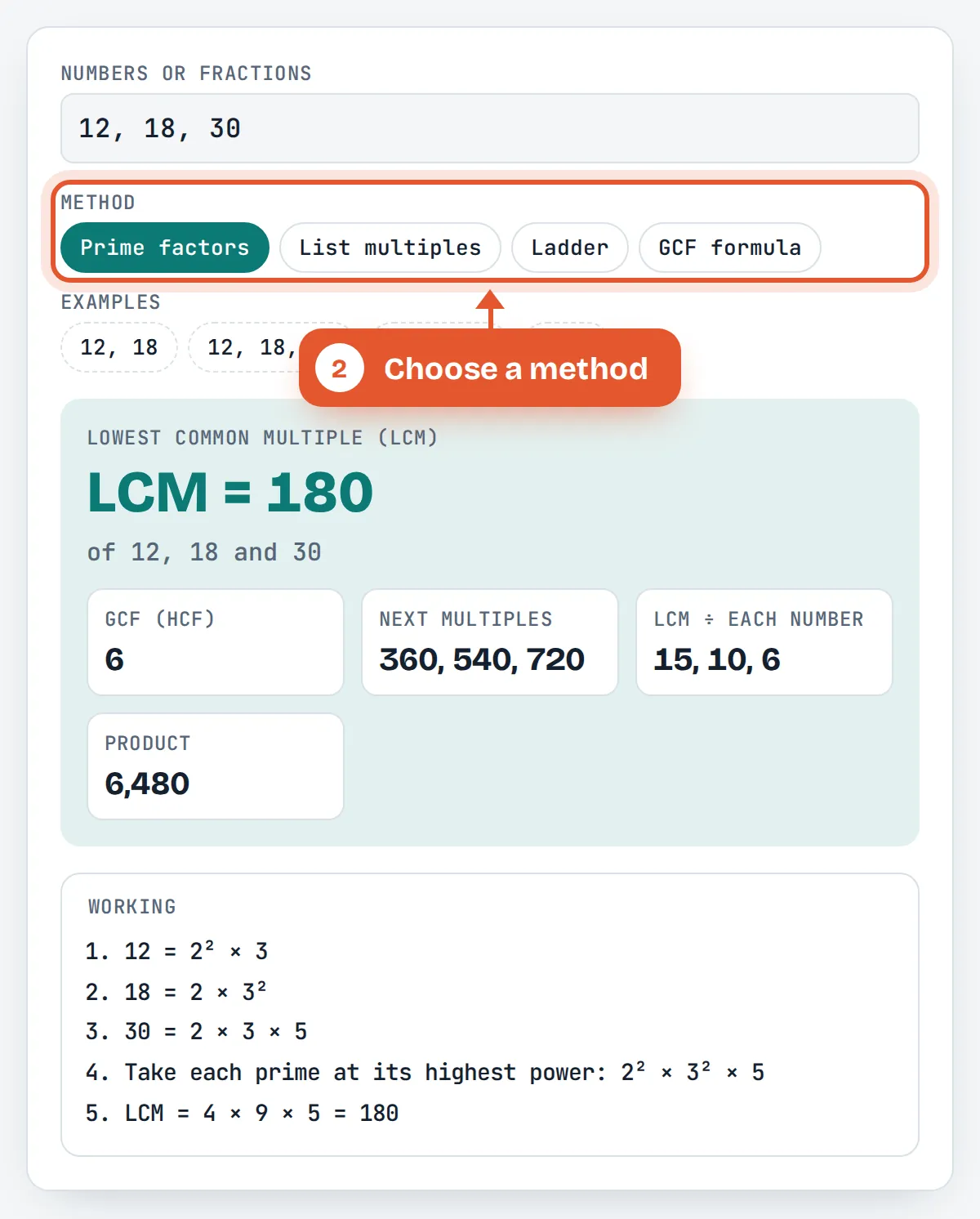
Choose a method
Pick prime factors, listing multiples, the ladder or the GCF formula. The answer stays the same and the working changes to match.
Read the LCM
The large figure is the LCM. Below it are the GCF, the next three common multiples, how many times each number fits into the LCM and the product of the numbers.
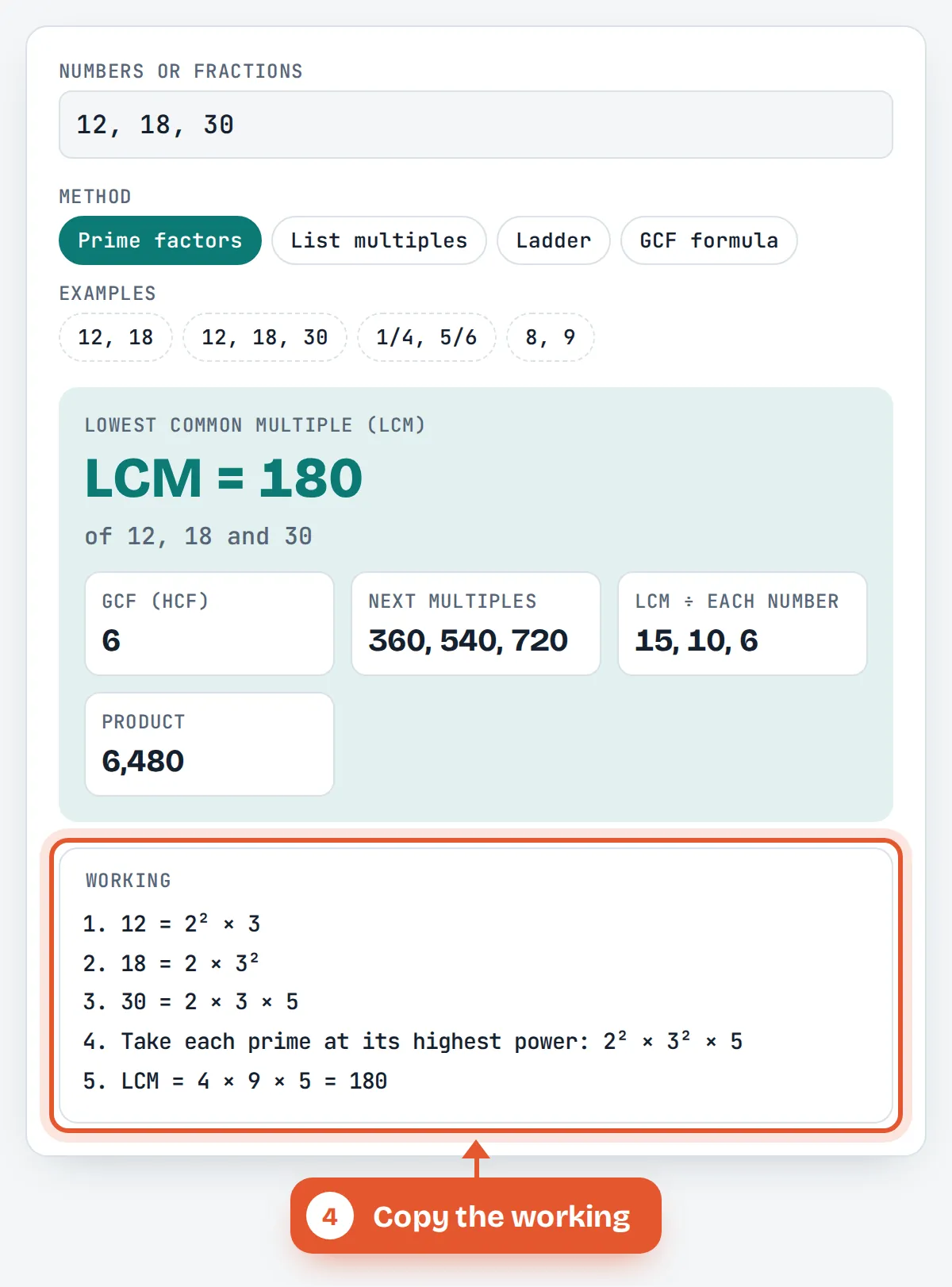
Copy the working
The working shows each step for your numbers, ready to copy into homework or check against your own answer.


Frequently Asked Questions
What is the LCM of 12 and 18?
The LCM of 12 and 18 is 36. In prime factors, 12 = 2² × 3 and 18 = 2 × 3², and the highest powers are 2² and 3², so 4 × 9 = 36. It is the first number in both times tables.
Is the lowest common multiple the same as the least common multiple?
Yes. Lowest common multiple is the usual term in the UK and Ireland and least common multiple is the usual US term. Both mean the smallest positive number that every number in the set divides into exactly, shortened to LCM.
Can I find the LCM of more than two numbers?
Yes. Find the LCM of the first two numbers, then the LCM of that result and the next number, and so on. With prime factors, take every prime that appears in any number at its highest power. This calculator accepts up to 10 numbers.
What is the LCM of 1 to 10?
The LCM of the numbers 1 to 10 is 2,520. It is 2³ × 3² × 5 × 7, because 8 needs 2³, 9 needs 3², and 5 and 7 are primes. It is the smallest number that every whole number from 1 to 10 divides into.
What is the LCM if one number is 0?
Zero is a multiple of every number, so most definitions only look for a positive common multiple and leave 0 out. Some authors define the LCM of any number and 0 as 0. Remove the 0 from your list to get a useful positive answer.
How is the LCM related to the GCF?
For two numbers, the LCM times the GCF equals the product of the numbers, so LCM = a × b ÷ GCF. For 12 and 18: 216 ÷ 6 = 36. This only works for two numbers at a time, not three or more.
Sources and Further Reading
- Least common multiple, Wikipedia
- Euclidean algorithm, Wikipedia
- GCSE mathematics: subject content and assessment objectives, Department for Education (GOV.UK)
Related Tools
Last reviewed: October 2026