Work out how much concrete you need in cubic metres and cubic yards, then how many 20 kg or 25 kg bags of premix (or 40, 60 and 80 lb bags) to buy, with a waste allowance and a bags versus ready mix cost check.
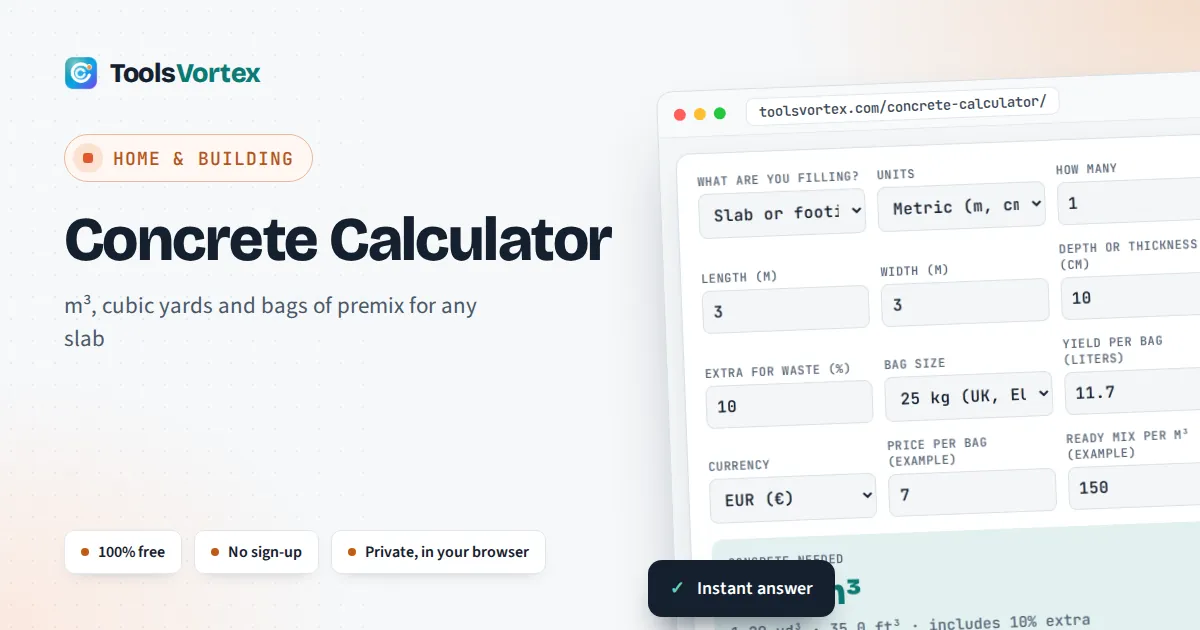
This concrete calculator tells DIYers and builders how much concrete a slab, shed base, path, footing or set of fence post holes needs, in cubic meters and cubic yards, and turns that into bags of premix or a ready mix order. It is metric first for the UK, Ireland and Europe, where bagged concrete comes in 20 kg and 25 kg sacks and ready mix is ordered by the cubic meter, and it also handles feet, inches and US pound bags.
How Do You Calculate How Much Concrete You Need?
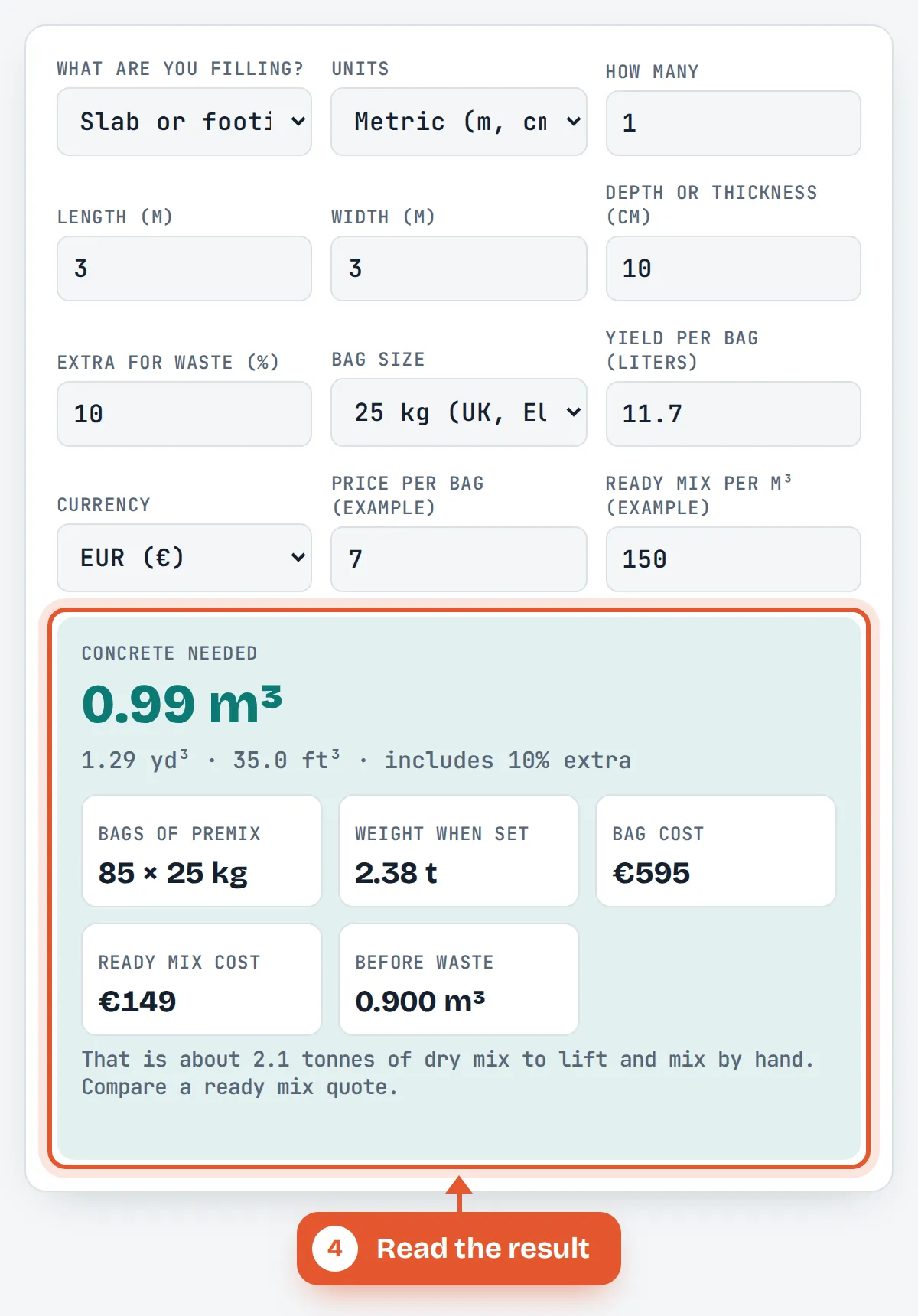
Multiply length by width by depth in meters to get cubic meters, then add 5 to 10% for waste. A 3 m by 3 m patio at 100 mm deep is 0.9 m³, or about 0.99 m³ with 10% extra. A concrete calculator converts that to roughly 1.29 cubic yards, or about 85 bags of 25 kg premix.
What Formula Does the Concrete Calculator Use?
Volume is area times depth, with every measurement in the same unit. For round holes the area is a circle, and if a post stands in the hole its own volume is taken off.
Round hole or column: V = π × (diameter ÷ 2)² × depth − post width² × depth
Order volume = V × number of items × (1 + waste % ÷ 100)
Bags = order volume in liters ÷ yield per bag, rounded up
1 m³ = 1,000 liters = 1.308 yd³ = 35.31 ft³
Convert millimeters and centimeters to meters before you multiply: 100 mm is 0.1 m and 75 mm is 0.075 m. Mixing units, such as meters for length and centimeters for depth, is the most common reason a hand calculation comes out 100 times too big. The tool takes length and width in meters (or feet) and depth in centimeters (or inches) and does the conversion for you.
How Many Bags of Concrete Are in a Cubic Meter?
About 86 bags of 25 kg premix or 107 bags of 20 kg premix make one cubic meter. The figures come from manufacturer yields: an 80 lb bag of concrete mix yields 0.6 cubic feet, which works out at roughly 2,136 kg of dry mix for every cubic meter of placed concrete. Use the yield printed on your own bag if it differs, by typing it into the “Yield per bag” box.
| Bag size | Yield per bag | Bags per m³ | Bags per yd³ |
|---|---|---|---|
| 20 kg | 9.4 liters | 107 | 82 |
| 25 kg | 11.7 liters | 86 | 66 |
| 40 lb (18.1 kg) | 0.30 ft³ (8.5 liters) | 118 | 90 |
| 60 lb (27.2 kg) | 0.45 ft³ (12.7 liters) | 79 | 60 |
| 80 lb (36.3 kg) | 0.60 ft³ (17.0 liters) | 59 | 45 |
Several UK calculators divide by 2,400 kg per m³, the density of set concrete, and get 96 bags of 25 kg per cubic meter. That density includes the mixing water you add on site, so it overstates the dry bags you need. Always round up to whole bags and keep the receipt for any unopened spares.
How Much Concrete Do Common Jobs Need?
The table includes 10% for waste. Change the depth in the calculator to match your own design, which for anything structural should come from a building control officer or engineer.
| Job | Order volume | Cubic yards | 25 kg bags | 20 kg bags |
|---|---|---|---|---|
| 1 × 1 m pad, 100 mm | 0.11 m³ | 0.14 | 10 | 12 |
| 2.4 × 1.8 m shed base, 100 mm | 0.48 m³ | 0.62 | 41 | 51 |
| 10 × 0.9 m path, 75 mm | 0.74 m³ | 0.97 | 64 | 79 |
| 3 × 3 m patio, 100 mm | 0.99 m³ | 1.29 | 85 | 106 |
| 5 × 4 m garage floor, 125 mm | 2.75 m³ | 3.60 | 235 | 293 |
| 3 × 6 m driveway, 150 mm | 2.97 m³ | 3.88 | 254 | 316 |
In US terms a standard residential slab is 4 inches (about 100 mm) thick, and garage or heavy duty slabs are usually 5 to 6 inches (125 to 150 mm). To measure an awkward floor area first, the square footage calculator works in square meters too, and the cubic yard calculator covers gravel, soil and mulch for the sub base.
Should You Use Bags or Ready Mix Concrete?
Bags suit small jobs such as posts, pads and shed bases, and ready mix suits anything near a cubic meter or more. One cubic meter is about 86 bags of 25 kg, more than two tonnes of dry mix to carry, mix and pour before the first batch starts to stiffen, so a single truck delivery usually gives a stronger, more even slab.
The calculator shows both costs side by side: enter your local bag price and a ready mix quote per m³ (or per yd³ in imperial mode), because prices vary by country, supplier and delivery distance. Ready mix suppliers in the UK, Ireland and the rest of Europe quote and deliver by the cubic meter, often with a minimum load or a part load charge, so ask about that when you compare.
How Much Extra Concrete Should You Order?
Order 5 to 10% more than the measured volume. Ground is never perfectly level, formwork bows slightly when filled and some concrete is always left in the mixer or barrow. Use 5% for a neat, formed slab on a compacted, level base and 10% or more for dug holes, trenches and uneven ground. Running short mid pour leaves a weak cold joint, which costs far more to fix than a few spare bags.
Worked Example: A Shed Base and Fence Posts in Bristol
Tom in Bristol is building a 2.4 × 1.8 m shed base, 100 mm thick. The volume is 2.4 × 1.8 × 0.1 = 0.432 m³. With 10% extra he needs 0.48 m³ (0.62 yd³), which is 41 bags of 25 kg premix. Set, the slab weighs about 1.1 tonnes at 2,400 kg per m³.
He also sets 10 fence posts, each 10 cm square, in holes 30 cm across and 60 cm deep. Each hole holds π × 0.15² × 0.6 = 0.0424 m³, minus the post (0.1 × 0.1 × 0.6 = 0.006 m³), leaving 0.0364 m³. Ten holes plus 10% is 0.40 m³, or 35 bags of 25 kg. Without subtracting the posts he would have bought 6 bags too many.
Is Wet Concrete Dangerous to Handle?
Yes, wet concrete and cement can burn skin, so treat them with care. The UK Health and Safety Executive warns that wet cement is strongly alkaline, that a serious burn can develop quickly if it is trapped against the skin, for example inside a boot or glove, and that it can also cause dermatitis and eye burns. Wear waterproof gloves, long sleeves, boots and eye protection, and wash any splashes off straight away. If you are also painting the finished walls of an outbuilding, the paint calculator sizes that job.
How Do You Use the Concrete Calculator?
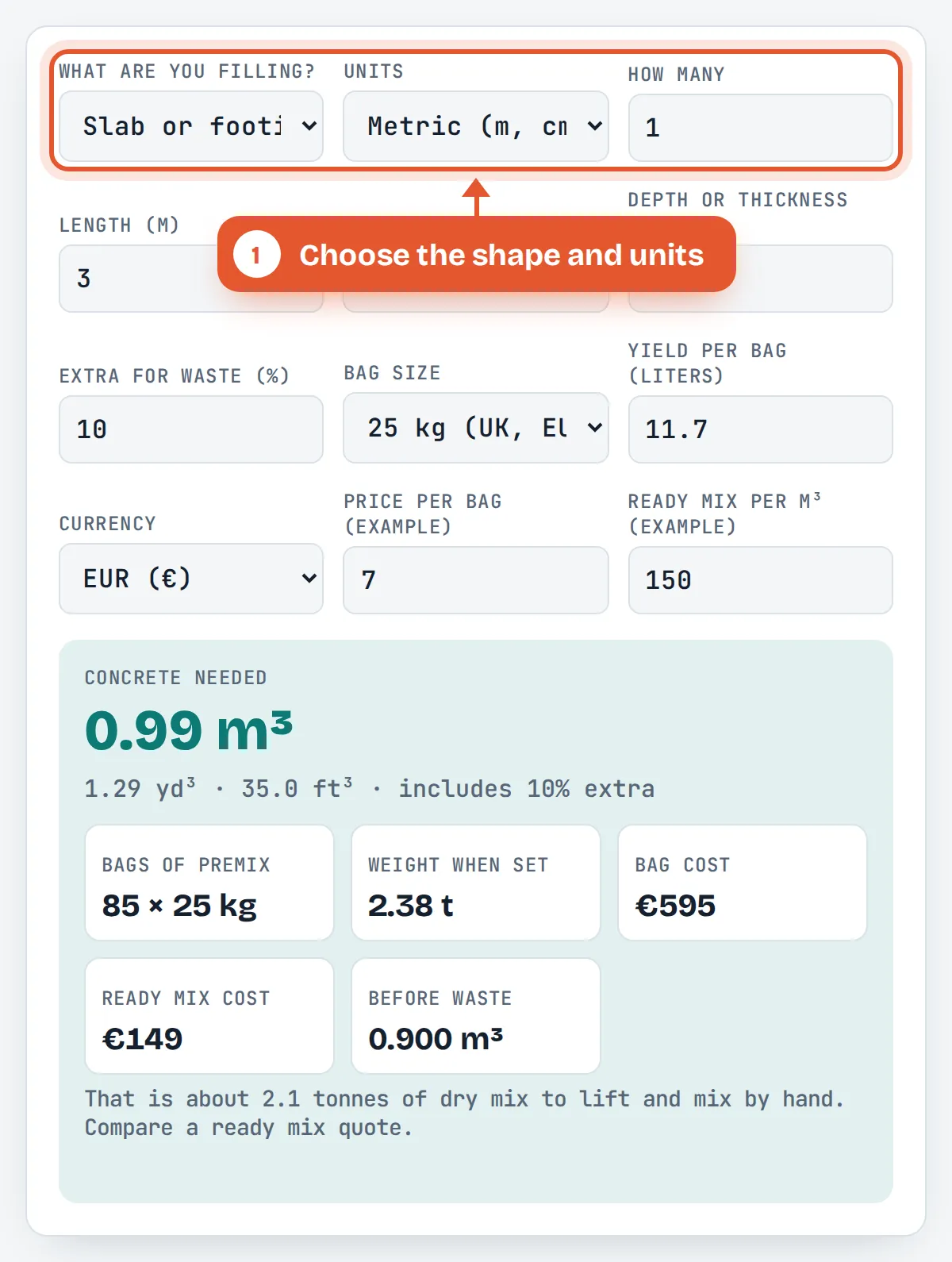
Choose the shape and units
Pick a slab, base, footing or wall, or a round hole, post or column. Choose metric or imperial units and how many identical items you are filling.

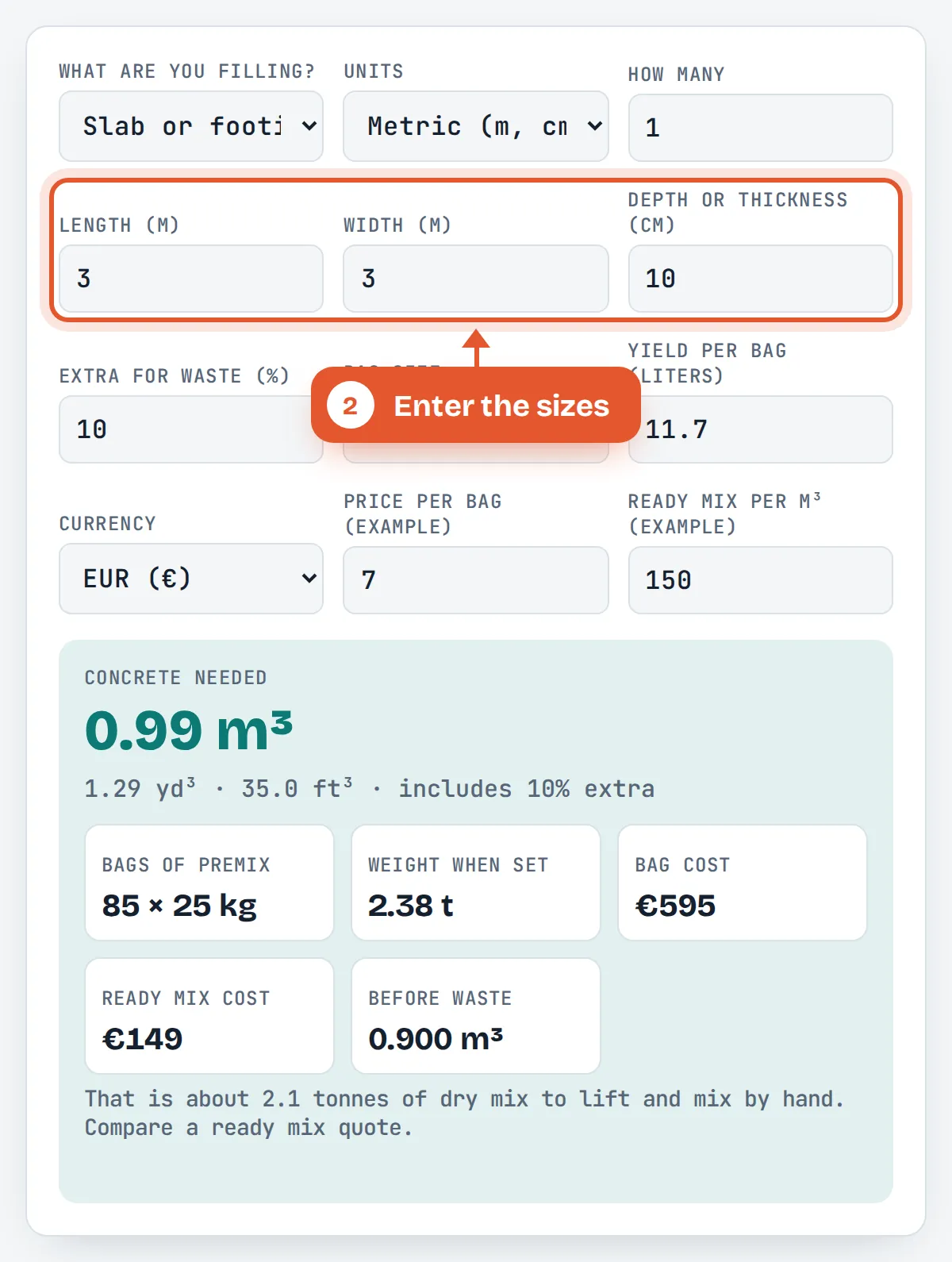
Enter the sizes
Type the length and width, or the hole diameter and post width, and the depth. Depth is in centimeters or inches so you do not need to convert.
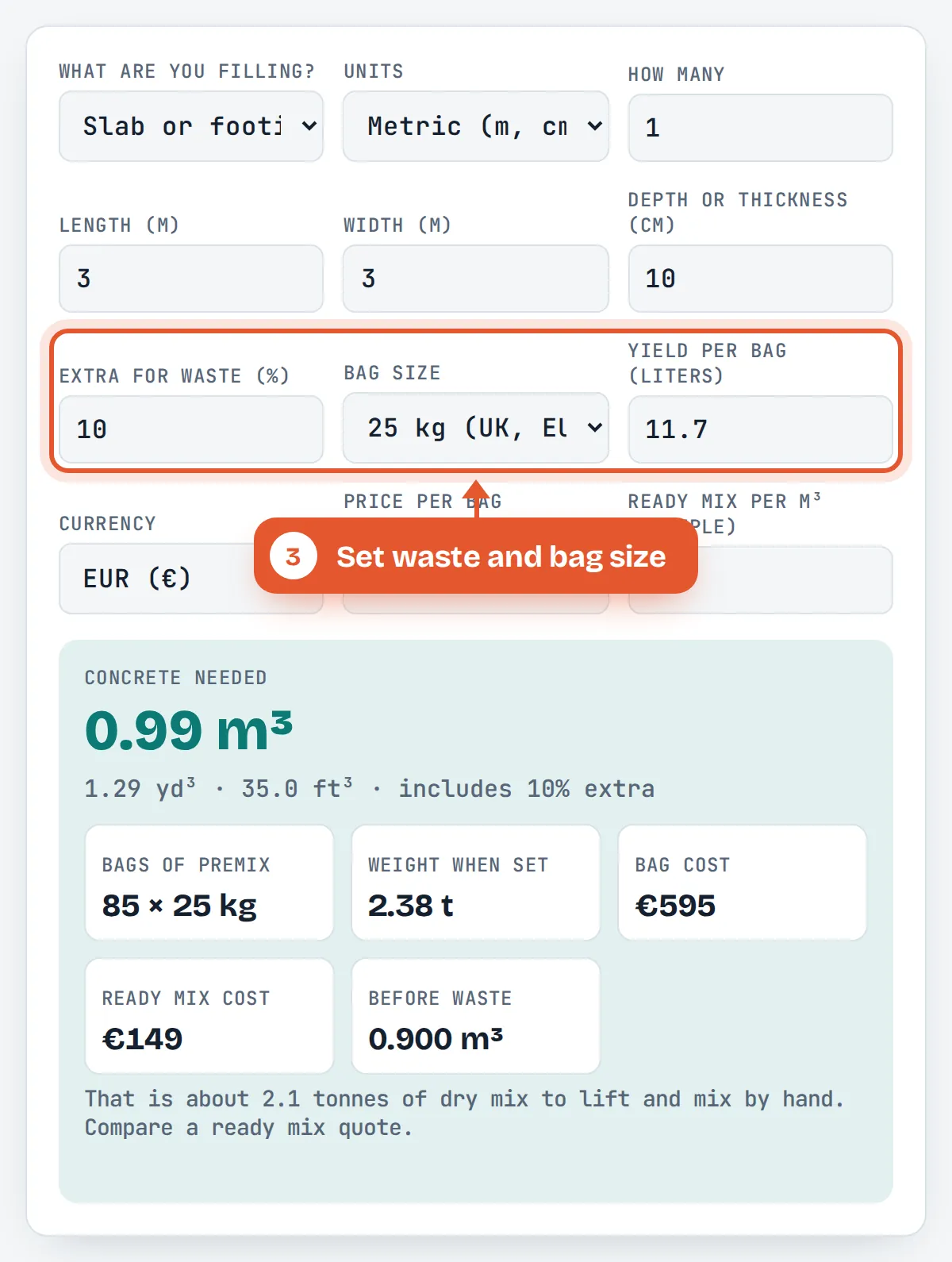
Set waste and bag size
Keep 10% extra or change it, then choose 20 kg, 25 kg or a US pound bag. If your bag lists a different yield, enter it in liters.
Read the result
The volume to order appears in large text in m³ or yd³, with the number of bags, the weight and the cost as bags or ready mix.
Frequently Asked Questions
How many 25 kg bags of concrete make 1 cubic meter?
About 86 bags of 25 kg premix make one cubic meter, based on a yield of roughly 11.7 liters per bag. For 20 kg bags you need about 107. Add 5 to 10% for waste and always round up to whole bags.
How many cubic yards are in a cubic meter?
One cubic meter is 1.308 cubic yards, and one cubic yard is 0.7646 cubic meters, or 27 cubic feet. So 2 m³ of concrete is about 2.62 yd³, and a 3 yd³ order is about 2.29 m³.
How much concrete do I need for a 3 × 3 m slab?
At 100 mm thick a 3 × 3 m slab is 0.9 m³, or 0.99 m³ with 10% extra for waste. That is about 1.29 cubic yards, 85 bags of 25 kg premix or 106 bags of 20 kg premix.
How much concrete do I need for a fence post?
A 30 cm wide, 60 cm deep hole around a 10 cm square post needs about 0.036 m³, which is 3 to 4 bags of 25 kg premix. Choose “Round hole or post” in the calculator and enter your own hole and post sizes.
How much does a cubic meter of concrete weigh?
Normal concrete weighs about 2,400 kg per cubic meter, roughly 2.4 tonnes. A cubic yard weighs about 1.8 tonnes, or close to 4,000 lb. Check this before you load a trailer, van or skip.
Why does my bag count differ from other calculators?
Some calculators divide by 2,400 kg per m³, the density of set concrete including water, which gives about 96 bags of 25 kg per m³. This tool uses manufacturer bag yields, about 86 bags, and lets you enter the yield printed on your bag.
Sources and Further Reading
- Construction hazardous substances: Cement, Health and Safety Executive (UK)
- Properties of concrete, Wikipedia
- Cubic yard, Wikipedia
Related Tools
Last reviewed: October 2026