Type the length, width and depth of the area you want to cover. You get the topsoil volume in cubic yards and cubic meters, its weight in tons and tonnes, and how many bags that would take.
Runs in your browser. Nothing you type is sent anywhere.
This topsoil calculator is for homeowners and landscapers ordering soil for a new lawn, a garden bed, a raised bed or leveling a yard. It multiplies area by depth, adds an allowance for settling, and converts the volume to weight with a density you can match to your supplier, plus a bag count for small jobs.
How Much Topsoil Do I Need?
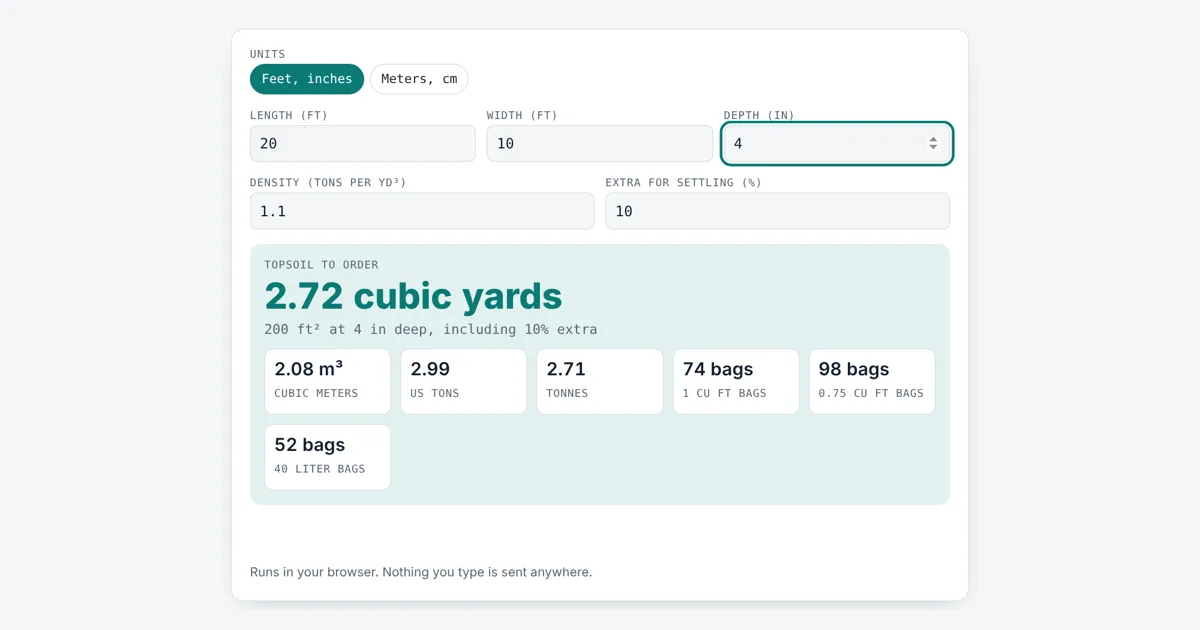
Multiply length by width by depth to get the volume, then add about 10% for settling. A 20 by 10 ft area 4 inches deep is 66.7 cubic feet, or 2.47 cubic yards. With 10% extra that is 2.72 cubic yards, which weighs about 2.99 US tons at 1.1 tons per cubic yard.
What Is the Formula for Topsoil?
The topsoil formula is volume = length × width × depth, with the depth converted to the same unit as the length and width first.
cubic yards = cubic feet ÷ 27
cubic meters = length (m) × width (m) × depth (cm) ÷ 100
weight = volume × density
A cubic yard holds 27 cubic feet, or 0.7646 cubic meters. Landscape yards in the US sell topsoil by the cubic yard or by the ton, while UK and European suppliers sell by the cubic meter, the tonne or in bulk bags. If you are covering a lawn or bed that is not a rectangle, find the area first with the square footage calculator, then enter it here as a length with a width of 1.
How Deep Should Topsoil Be?
Most new lawns need at least 4 inches (10 cm) of topsoil, and 6 inches (15 cm) is better for strong roots. A Tennessee stormwater best practice guide notes that grass typically needs at least 4 inches, and 6 to 12 inches where the ground has been dug down to rock.
| Use | Typical depth | Cubic yards per 100 ft² |
|---|---|---|
| Top dressing an existing lawn | 0.25 to 0.5 in (0.6 to 1.3 cm) | 0.08 to 0.15 |
| Filling low spots, overseeding | 1 to 2 in (2.5 to 5 cm) | 0.31 to 0.62 |
| New lawn from seed or sod | 4 to 6 in (10 to 15 cm) | 1.23 to 1.85 |
| Flower and vegetable beds | 8 to 12 in (20 to 30 cm) | 2.47 to 3.70 |
| Raised beds | 12 in (30 cm) or more | 3.70 |
How Much Does a Cubic Yard of Topsoil Weigh?
A cubic yard of dry, loose topsoil weighs roughly 1 to 1.4 US tons, and wet soil can weigh much more. This tool starts at 1.1 tons per cubic yard, which is about 1.3 tonnes per cubic meter. Weight per volume is called bulk density, and it changes with soil texture, moisture and how loose the soil is. Soil rich in organic matter, the decayed plant material that compost adds, is lighter than sandy or clay fill. USDA NRCS gives about 1.33 g/cm³ as ideal for a medium textured soil, and above about 1.47 to 1.8, depending on texture, roots struggle, so do not pack topsoil down hard. Ask your supplier for their figure and type it in.
Why Order Extra Topsoil?
Order about 10 to 15% extra because loose topsoil settles as it is raked, rolled, watered and rained on. This is a form of compaction, and fluffy screened soil can lose even more height in the first few weeks. Bare soil is also easier to grade with a little spare. If you plan to cover the beds afterwards, the mulch calculator works out the next layer, and the gravel calculator handles paths and edging between them.
Worked Example
Priya is building a new lawn on an area 20 ft long and 10 ft wide and wants 4 inches of topsoil. The area is 200 square feet and the volume is 200 × 4 ÷ 12 = 66.7 cubic feet, or 2.47 cubic yards. With 10% extra, the tool shows 2.72 cubic yards (2.08 m³), which is about 2.99 US tons or 2.71 tonnes at 1.1 tons per cubic yard. In bags, that is 74 bags of 1 cu ft or 98 bags of 0.75 cu ft, so bulk delivery makes more sense. In metric, a 5 m by 4 m bed 10 cm deep with 10% extra needs 2.2 m³, about 2.86 tonnes.
How Do You Use the Topsoil Calculator?
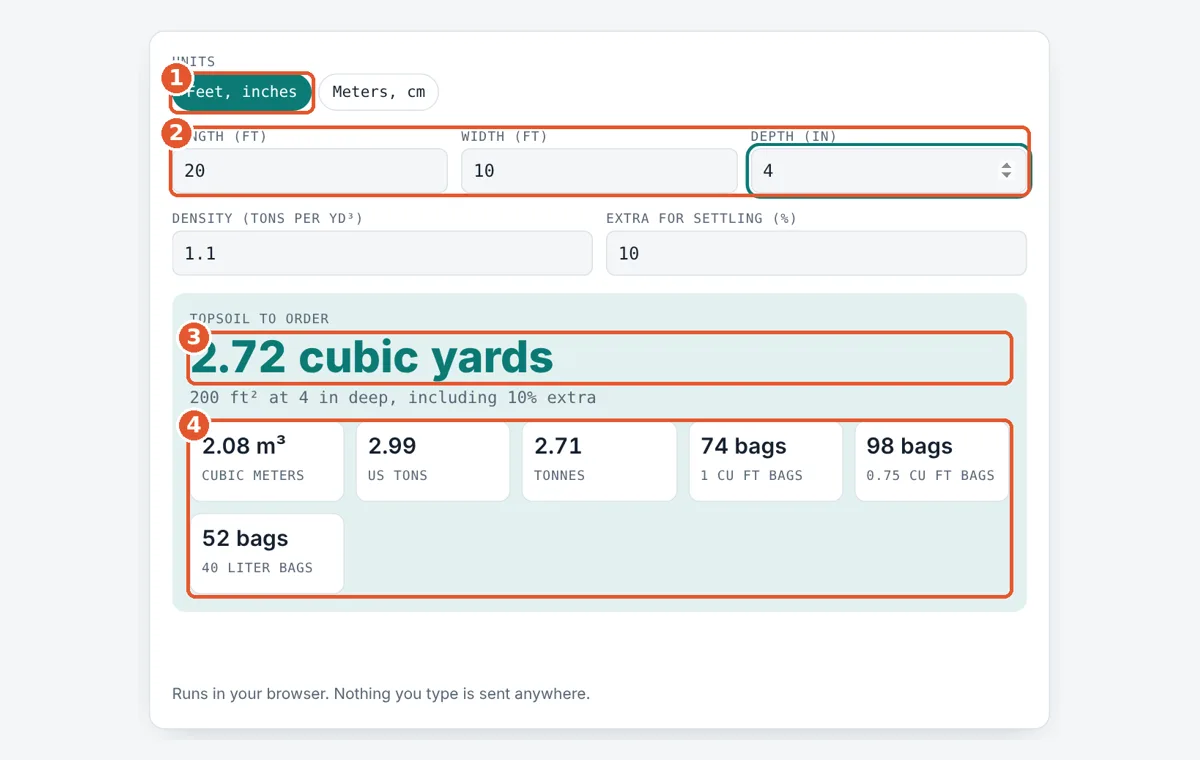
Pick your units
Tap Feet, inches for US sizes or Meters, cm for metric sizes.
Enter the size and depth
Type the length, width and depth of soil you want to spread.
Read the volume
The big number is the topsoil volume to order, including the extra.
Check weight and bags
The boxes show cubic meters, tons, tonnes and the number of bags.
Frequently Asked Questions
How much area does a cubic yard of topsoil cover?
One cubic yard covers about 81 square feet at 4 inches deep, 162 square feet at 2 inches, or 324 square feet at 1 inch. At 6 inches deep it covers 54 square feet. Add 10% extra for settling.
How many bags of topsoil make a cubic yard?
A cubic yard is 27 cubic feet, so it takes 27 bags of 1 cu ft or 36 bags of 0.75 cu ft. In metric, a cubic meter fills 25 bags of 40 liters. Bulk delivery is usually cheaper above about 1 cubic yard.
How many tons of topsoil do I need for 1,000 square feet?
At 4 inches deep, 1,000 square feet needs 12.35 cubic yards. At 1.1 tons per cubic yard that is about 13.6 tons, or 14.9 tons with 10% extra. At 6 inches, you need about 18.5 cubic yards before the extra.
Should I mix topsoil with compost?
Many gardeners blend in compost, often around a quarter to a third by volume for beds, to add organic matter. Organic matter lowers bulk density and helps water soak in. For a lawn, a screened topsoil with some compost mixed in works well.
What is the difference between topsoil and garden soil?
Topsoil is the upper layer of natural soil, usually screened to remove stones and roots. Bagged garden soil or planting mix is topsoil with added compost or other organic matter, which makes it lighter and richer for beds.
Do I need to remove grass before adding topsoil?
For more than about 2 inches of new soil, yes. Strip or kill the old turf first, then loosen the ground a few inches so the new soil bonds with the subsoil. Thin top dressing under half an inch can go straight over grass.
Sources and Further Reading
- USDA NRCS: Soil Quality Indicators, Bulk Density
- Hamilton County, Tennessee: BMP 5.13 Topsoiling
- NIST Office of Weights and Measures: Unit conversion
Related Tools
Last reviewed: October 2026