Enter the total rise and total run of your staircase and get the number of steps, exact riser height, tread depth, stringer length and stair angle, with a live check against US and UK code limits.
Meets IRC: riser 7 3/4 in max, tread 10 in min.
Runs in your browser. Nothing you type is sent anywhere.
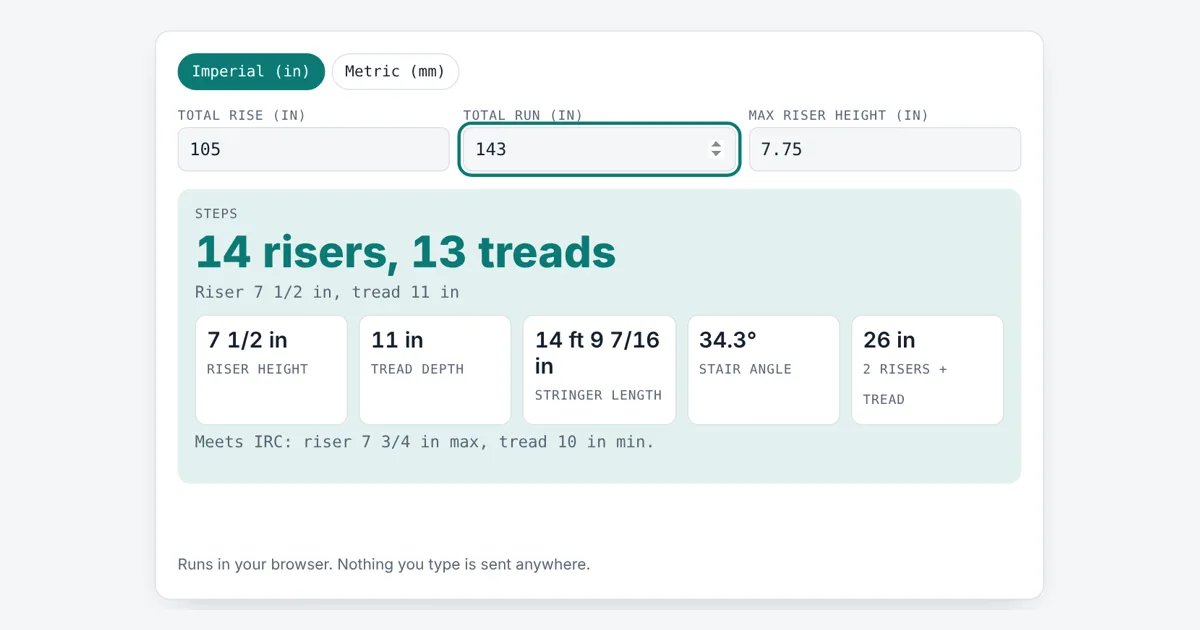
This stair calculator is for homeowners, carpenters and DIY builders planning a straight staircase or deck steps. You get the number of risers and treads, the exact riser height and tread depth, the stringer length and the angle, in inches or millimetres, plus a check against the US IRC or UK Approved Document K.
How Do You Calculate Stair Steps From Total Rise?
Divide the total rise by the maximum riser height and round up to get the risers. For a 105 inch rise and a 7 3/4 inch limit, 105 ÷ 7.75 = 13.5, so use 14 risers of 7 1/2 inches. You get 13 treads, so a 143 inch run gives 11 inch treads.
How Do You Calculate Stairs?
To calculate stairs, divide the total rise by your maximum riser height and round up to get the number of risers, then divide the total rise by that whole number to get the exact riser height.
riser height = total rise ÷ risers
treads = risers − 1
tread depth = total run ÷ treads
angle = arctan(riser ÷ tread)
stringer = √(total rise² + total run²)
The total rise is the vertical height from the finished floor at the bottom to the finished floor at the top. The total run is the horizontal length covered by the treads. There is always one tread fewer than risers, because the top floor acts as the last step. The stringer is the sloped board that carries the steps, and the length shown here is the straight diagonal from the foot of the first riser to the edge of the upper floor. Treat it as a rough cut length and buy a board about a foot longer so you have room for the plumb and level cuts.
What Is the Maximum Riser Height and Minimum Tread Depth?
Under the International Residential Code (IRC), used for homes in most US states, the maximum riser height is 7 3/4 inches and the minimum tread depth is 10 inches.
The IRC also says the tallest riser and the deepest tread in a flight must not differ from the smallest by more than 3/8 inch, and a single flight cannot rise more than 151 inches (12 ft 7 in) without a landing. Headroom must be at least 6 ft 8 in. In England, Approved Document K sets a private stair rise of 150 to 220 mm, a going (the UK word for tread depth) of 220 to 300 mm, and a maximum pitch of 42°. Local codes can differ, so check with your building department.
| Rule | US IRC (homes) | UK private stair |
|---|---|---|
| Max riser | 7 3/4 in (197 mm) | 220 mm |
| Min tread / going | 10 in (254 mm) | 220 mm |
| Max angle | Set by riser and tread | 42° |
| Max variation in a flight | 3/8 in | Rise and going must be even |
| Max rise per flight | 151 in | Turn after 36 risers in a row |
| Headroom | 6 ft 8 in | 2.0 m |
What Is a Comfortable Stair Angle?
Most comfortable home stairs sit between about 30° and 37°, which is what you get with a riser near 7 inches and a tread near 11 inches.
A common comfort check is the 2R + G rule: twice the riser plus the tread should land between 550 and 700 mm, which is about 21 5/8 to 27 1/2 inches. Many US carpenters aim for 24 to 26 inches, close to a normal walking stride. If your stair comes out steeper, you need more total run. To measure the floor area the stairwell will take, the square footage calculator helps, and if you are pouring outdoor steps, our concrete calculator gives the volume to order.
How Many Stairs Do I Need for a 9 Foot Ceiling?
A 9 foot ceiling usually gives a total rise of about 117 to 121 inches once you add the floor joists and flooring above, which needs 16 risers and 15 treads at the 7 3/4 inch limit.
Always measure the real rise on site, finished floor to finished floor, because joist depth and floor coverings change the number. If your plans are in metric, the mm to inches converter turns drawing sizes into inches for the IRC check.
Worked Example
A builder in Ohio measures a basement stair: 105 inches of total rise from the slab to the finished floor above, and 143 inches of total run. With the IRC limit of 7.75 inches in the max riser box, the tool shows 14 risers, 13 treads, each riser 7 1/2 in and each tread 11 in. The stringer length is 14 ft 9 7/16 in, the angle is 34.3° and 2 risers plus a tread is 26 in, a comfortable stride. Squeezing the run down to 100 inches with a 100 inch rise gives 13 risers of 7 11/16 in and treads of only 8 5/16 in, and the tool warns that the treads are under the 10 inch minimum and you need at least 120 inches of run.
How Do You Use the Stair Calculator?
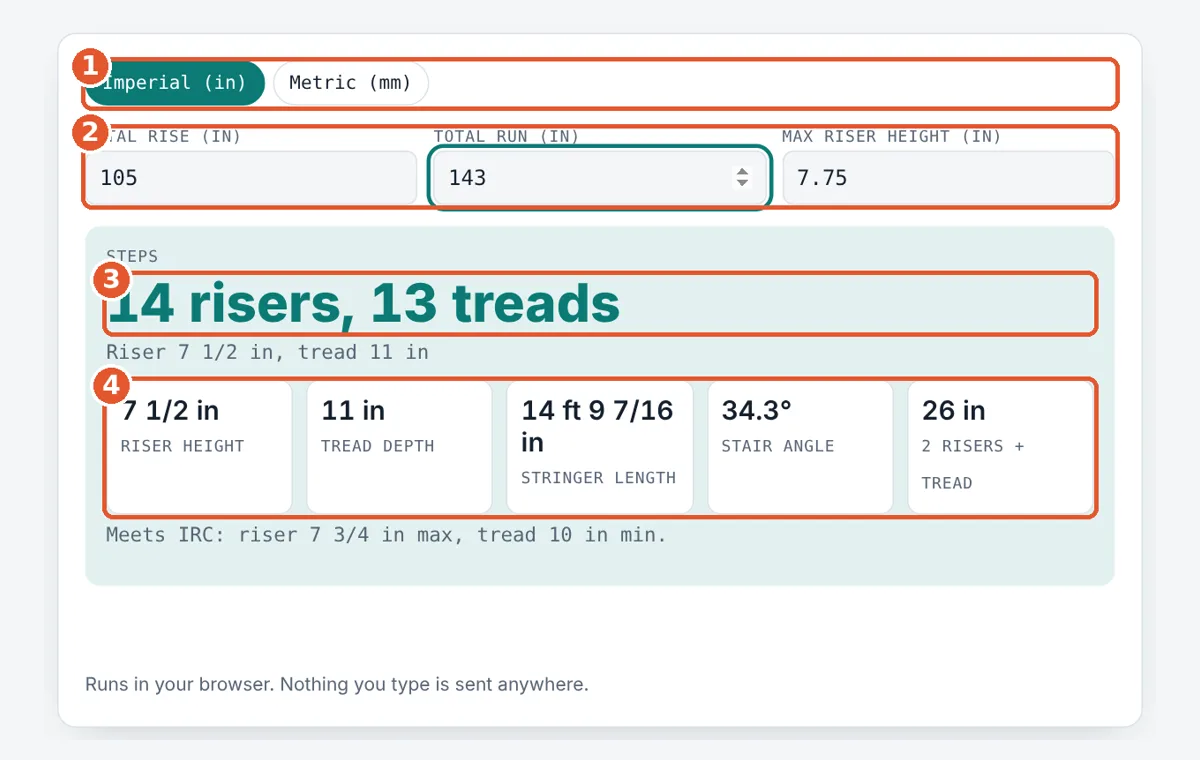
Pick your units
Tap Imperial (in) or Metric (mm). Values you typed are converted.
Enter rise, run and max riser
Type the total rise, the total run and the tallest riser your code allows.
Read the step count
The big line shows how many risers and treads you need, with exact sizes.
Check stringer, angle and code
The boxes show stringer length, angle and 2R + tread, and the line below flags code problems.
Frequently Asked Questions
How many steps do I need for an 8 foot rise?
An 8 foot (96 inch) rise needs 13 risers at the IRC limit of 7 3/4 inches, because 96 ÷ 7.75 = 12.4, rounded up to 13. Each riser is then about 7 3/8 inches, and you get 12 treads.
Is the top floor counted as a step?
No. The top floor is not a tread, so a stair always has one tread fewer than risers. A stair with 14 risers has 13 treads. Forgetting this is the most common mistake when cutting stringers.
How long should a stair stringer be?
Use the square root of total rise squared plus total run squared. A 105 inch rise and 143 inch run give about 177.4 inches, or 14 ft 9 7/16 in. Buy the next board length up, such as 16 feet, to leave room for the cuts.
What is the best riser and tread size?
A riser near 7 inches with a tread near 11 inches is a common comfortable pair. It gives an angle of about 32.5°, and 2 × 7 + 11 = 25 inches, which sits inside the 2R + G comfort range of 550 to 700 mm.
Does tread depth include the nosing?
In the IRC, tread depth is measured horizontally between the leading edges of next treads, so the nosing is not added on top. Treads under 11 inches usually need a nosing of 3/4 to 1 1/4 inches.
Can I use this calculator for deck stairs?
Yes. Measure the total rise from the ground or landing pad to the top of the deck boards, and enter the run you have. Many towns apply the same IRC riser and tread limits to deck stairs.
Sources and Further Reading
- International Code Council: 2021 International Residential Code, Chapter 3
- GOV.UK: Approved Document K, protection from falling, collision and impact
Related Tools
Last reviewed: October 2026