Enter a savings or CD rate and how often it compounds to get the annual percentage yield, plus the interest and ending balance for your deposit over the term you choose.
Runs in your browser. Nothing you type is sent anywhere. Estimates only: your bank’s disclosed APY and fees decide what you earn.
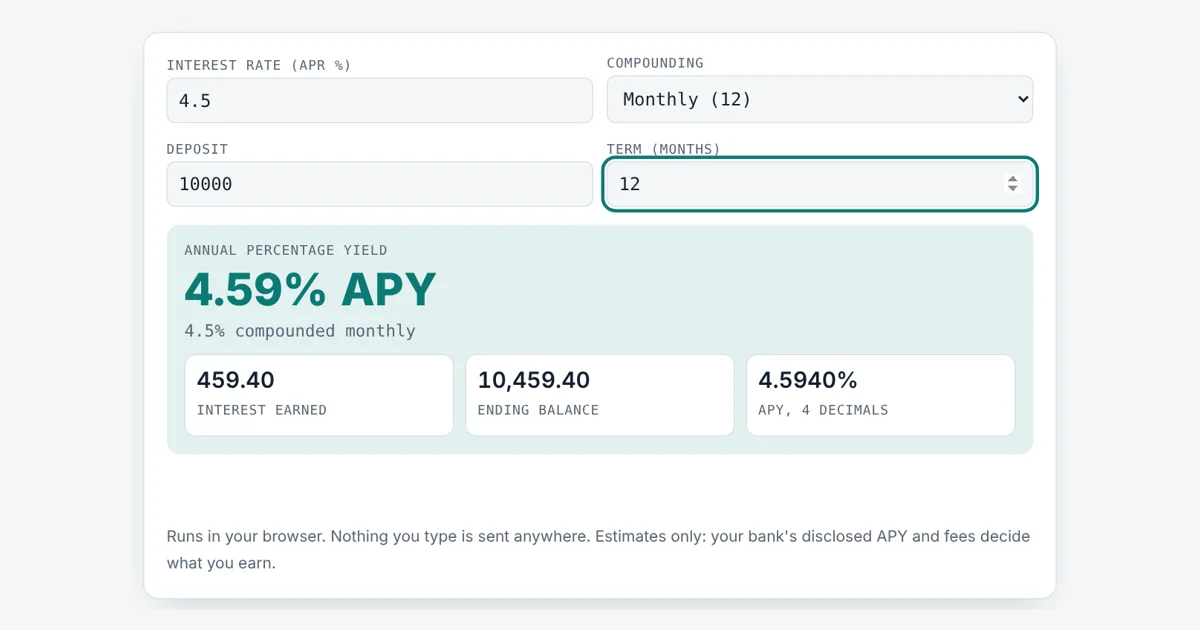
This apy calculator helps savers compare savings accounts, money market accounts and certificates of deposit on equal terms. It turns a stated rate into the yield you really earn in a year once interest compounds, and shows the dollars a deposit earns over a set number of months.
How Do You Calculate APY From an Interest Rate?
APY = (1 + r ÷ n)^n − 1, where r is the yearly interest rate as a decimal and n is the number of times interest compounds per year. For example, 4.5% compounded monthly gives (1 + 0.045 ÷ 12)^12 − 1 = 4.59% APY, so 10,000 earns about 459.40 in a year.
What Is the Difference Between APR and APY?
APR is the simple yearly interest rate, while APY is the yearly return after interest earns interest, so APY is higher whenever interest compounds more than once a year.
APR stands for annual percentage rate, sometimes called the nominal rate. APY stands for annual percentage yield, also known as the effective annual rate. Compound interest is the reason they differ: each month’s interest is added to the balance and earns interest itself. To see growth over many years with regular deposits, use our compound interest calculator.
What Is the APY Formula?
The APY formula is APY = (1 + r/n)^n − 1 for compounding n times a year, and APY = e^r − 1 for continuous compounding.
continuous: APY = e^r − 1
balance after t years = P × (1 + r ÷ n)^(n × t)
Here e is Euler’s number, about 2.71828. In the United States the Truth in Savings Act and its rule, Regulation DD (12 CFR 1030), define APY as a percentage rate reflecting the total interest paid on an account, based on the interest rate and how often it compounds over a 365-day period. Banks must show it rounded to two decimal places.
How Much Does Compounding Frequency Change APY?
Compounding frequency changes APY only a little: at 5%, going from yearly to daily compounding lifts APY from 5% to about 5.13%.
| APR | Monthly APY | Daily APY |
|---|---|---|
| 1% | 1.00% | 1.01% |
| 2% | 2.02% | 2.02% |
| 3% | 3.04% | 3.05% |
| 4% | 4.07% | 4.08% |
| 4.5% | 4.59% | 4.60% |
| 5% | 5.12% | 5.13% |
| 6% | 6.17% | 6.18% |
| 8% | 8.30% | 8.33% |
| 10% | 10.47% | 10.52% |
The rate matters far more than the compounding schedule. A 4.5% account compounded monthly beats a 4% account compounded daily. The simple interest calculator shows what you would earn with no compounding at all.
Is a Higher APY Always Better?
A higher APY is better only when the other terms match, so also check fees, minimum balances, rate changes and early withdrawal penalties.
Savings account rates are usually variable and can change after you open the account. A CD locks the rate for the term. In the US, deposits at insured banks are covered by the FDIC up to 250,000 per depositor, per bank, per ownership category. To plan how long a goal will take at a given yield, try the savings goal calculator.
Worked Example
A saver has 10,000 and sees a high yield account paying 4.5% compounded monthly. Enter 4.5, pick Monthly and set the term to 12 months. The tool shows 4.59% APY, interest of 459.40 and an ending balance of 10,459.40. Change the term to 6 months and the interest is 227.12. Switch to Continuous and the APY rises only to 4.60%.
How Do You Use the APY Calculator?
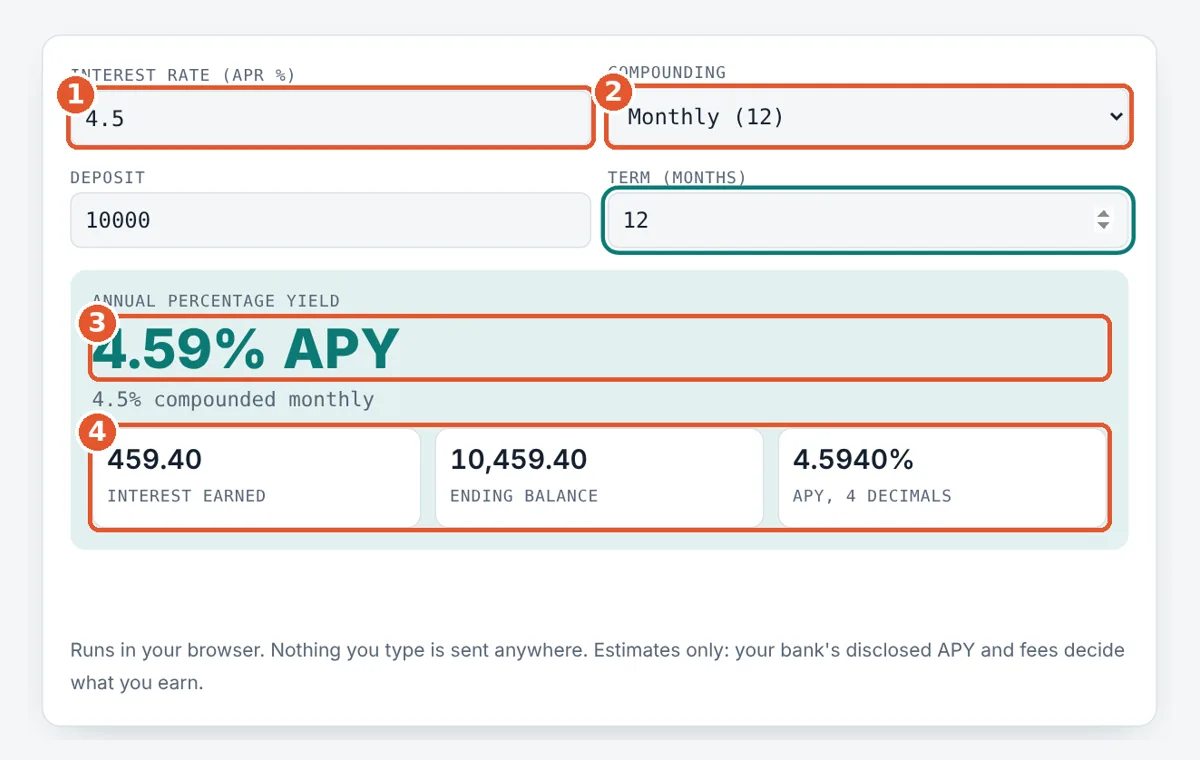
Enter the interest rate
Type the stated yearly rate (APR) your bank quotes, for example 4.5.
Pick the compounding
Choose how often interest is added: yearly, monthly, daily or continuous.
Read the APY
The big number is the annual percentage yield, rounded to two decimals like a bank disclosure.
See interest on your deposit
Add a deposit and term in months to see interest earned and the ending balance.
Frequently Asked Questions
What is 5% APR compounded daily as an APY?
5% compounded daily over 365 days is about 5.13% APY. The formula is (1 + 0.05 ÷ 365)^365 − 1 = 0.05127. Compounded monthly, the same 5% rate gives 5.12% APY.
How much interest does 10,000 earn at 4.5% APY?
At 4.5% APY, 10,000 earns 450 in one year, because APY already includes compounding. A 4.5% rate compounded monthly is a different case: it is 4.59% APY and earns about 459.40.
Is APY the same as interest rate?
No. The interest rate is the stated yearly rate before compounding. APY includes compounding, so it is equal to the rate only when interest is paid once a year and higher in every other case.
Why do banks show APY instead of APR on savings?
US banks must disclose APY on deposit accounts under the Truth in Savings Act. It gives savers one standard number to compare accounts that compound on different schedules, such as daily versus quarterly.
What is continuous compounding?
Continuous compounding is the limit as interest is added infinitely often. APY is e^r − 1, so 4.5% becomes about 4.60%. Daily compounding gives almost exactly the same result, so it is mostly used in finance math.
Does APY include fees?
No. APY reflects interest and compounding only. A monthly maintenance fee of 5 on a 1,000 balance would wipe out about 60 a year, which is more than the interest at most rates, so check fees separately.
Sources and Further Reading
- CFPB: Regulation DD 12 CFR 1030.2 Definitions
- CFPB: Regulation DD Appendix A, Annual Percentage Yield Calculation
- Investor.gov (SEC): Compound interest calculator
- FDIC: Deposit insurance
Related Tools
Last reviewed: October 2026