Enter your cost and a markup percent to get the selling price and profit, or enter cost and price to find the markup and gross margin you are really making.
Runs in your browser. Nothing you type is sent anywhere.
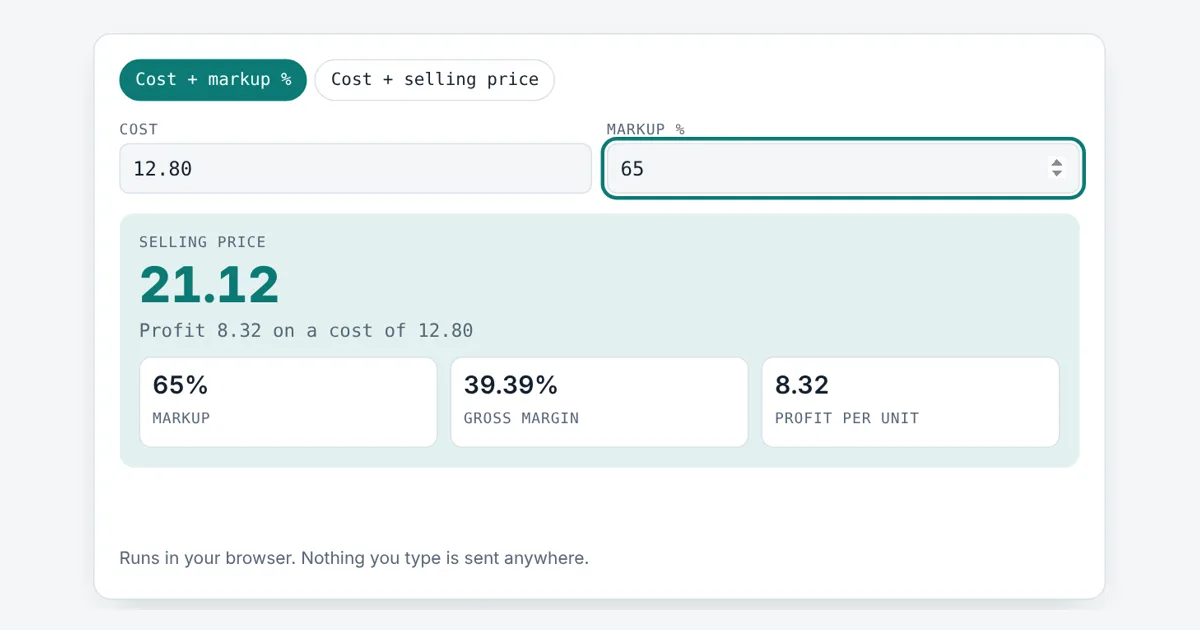
This markup calculator is for shop owners, resellers, freelancers and anyone pricing a product. Give it your unit cost and a markup percent and it returns the selling price, profit per unit and gross margin. Switch modes to work backwards from a price you already charge.
How Do You Calculate Markup?
Markup is profit divided by cost, times 100. Selling price is cost × (1 + markup ÷ 100). For example, an item that costs 12.80 with a 65% markup sells for 12.80 × 1.65 = 21.12. The profit is 8.32, which is a 65% markup on cost but only a 39.39% margin on the price.
What Is the Difference Between Markup and Margin?
Markup compares profit with cost, while margin compares the same profit with the selling price, so markup is always the bigger number for a profitable sale.
gross margin % = (price − cost) ÷ price × 100
selling price = cost × (1 + markup ÷ 100)
Cost here means what one unit costs you to buy or make, the figure accountants call the cost of goods sold (COGS) per unit. Gross profit is selling price minus that cost. Gross margin is the share of each sale you keep as gross profit. If you already think in margins, our profit margin calculator starts from the margin side instead.
How Do You Convert Markup to Margin?
To convert markup to margin, divide the markup by 100 plus the markup: margin = markup ÷ (100 + markup) × 100.
So a 50% markup is a 50 ÷ 150 = 33.33% margin. Going the other way, markup = margin ÷ (100 − margin) × 100. The table shows common pairs.
| Markup | Gross margin | Price on a cost of 100 |
|---|---|---|
| 10% | 9.09% | 110 |
| 20% | 16.67% | 120 |
| 25% | 20% | 125 |
| 33.33% | 25% | 133.33 |
| 50% | 33.33% | 150 |
| 75% | 42.86% | 175 |
| 100% | 50% | 200 |
| 150% | 60% | 250 |
| 200% | 66.67% | 300 |
| 300% | 75% | 400 |
What Is Keystone Pricing?
Keystone pricing is a retail rule of thumb where the selling price is double the wholesale cost, which is a 100% markup and a 50% gross margin.
It is common in clothing and gift shops. It is only a starting point: your price must also cover rent, staff, shipping and card fees, which are not part of unit cost. The US Small Business Administration (SBA) business guide asks owners to set out a clear pricing strategy, and that strategy should cover overheads as well as unit cost. If you offer sales, check the final price with the discount calculator so a promotion does not push you below cost.
Why Can Margin Never Reach 100%?
Margin can never reach 100% because that would need a cost of zero, while markup has no upper limit.
A 300% markup still gives only a 75% margin. This is why a business that sets a 40% margin target needs a markup of about 66.67%, not 40%. Mixing the two up is a common pricing mistake that quietly cuts profit. For prices that include tax, add VAT after the markup with the VAT calculator.
Worked Example
A candle maker spends 12.80 on wax, wick, jar and label for one candle and wants a 65% markup. Enter 12.80 and 65 in the tool: it shows a selling price of 21.12, a profit of 8.32 per candle and a gross margin of 39.39%. A wholesaler then offers 32.50 for a product that costs 25. In cost and selling price mode the tool shows a 30% markup, a profit of 7.50 and a 23.08% margin.
How Do You Use the Markup Calculator?
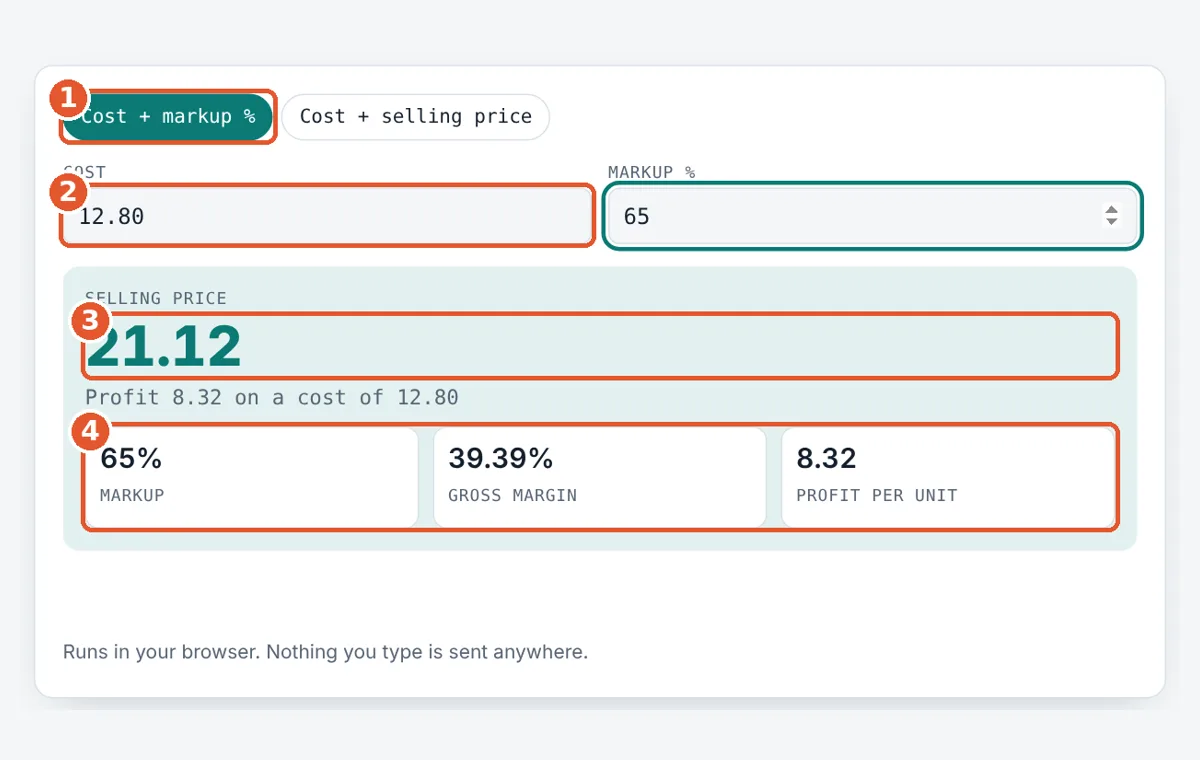
Pick what you know
Choose Cost + markup % to find a price, or Cost + selling price to find your markup.
Enter cost and markup or price
Type the unit cost, then the markup percent or the price you charge.
Read the main result
The big number is the selling price, or the markup percent in the second mode.
Check margin and profit
The boxes show markup, gross margin and profit per unit side by side.
Frequently Asked Questions
What is a 50% markup on 20?
A 50% markup on a cost of 20 gives a selling price of 30. The profit is 10, which is 50% of the cost. As a share of the 30 selling price, that profit is a 33.33% gross margin.
What markup do I need for a 40% margin?
You need a markup of about 66.67% to get a 40% gross margin. Use markup = margin ÷ (100 − margin) × 100, so 40 ÷ 60 × 100 = 66.67%. A cost of 30 would then sell for 50.
Can markup be more than 100%?
Yes. Markup has no upper limit because it is measured against cost. A 200% markup on a cost of 5 gives a price of 15. Margin is different and always stays below 100%.
Does markup include overheads like rent?
No. Markup in this tool uses unit cost only, such as stock or materials. Rent, wages and marketing are overheads. Set a markup big enough that the total gross profit covers those costs and still leaves net profit.
What does a negative markup mean?
A negative markup means you sell below cost and lose money on each unit. For example, a cost of 40 and a price of 30 is a minus 25% markup, a loss of 10 per item.
Is markup the same as profit percentage?
Some people use profit percentage to mean markup on cost and others mean margin on price. Always check which base is used. On a cost of 80 and a price of 100, markup is 25% but margin is 20%.
Sources and Further Reading
- U.S. Small Business Administration: Manage your finances
- Wikipedia: Markup (business)
- IRS Publication 334: Tax Guide for Small Business (cost of goods sold)
Related Tools
Last reviewed: October 2026