Enter your measured value and the true value to get the percent error, along with the absolute error, relative error and whether your result was high or low.
Runs in your browser. Nothing you type is sent anywhere.
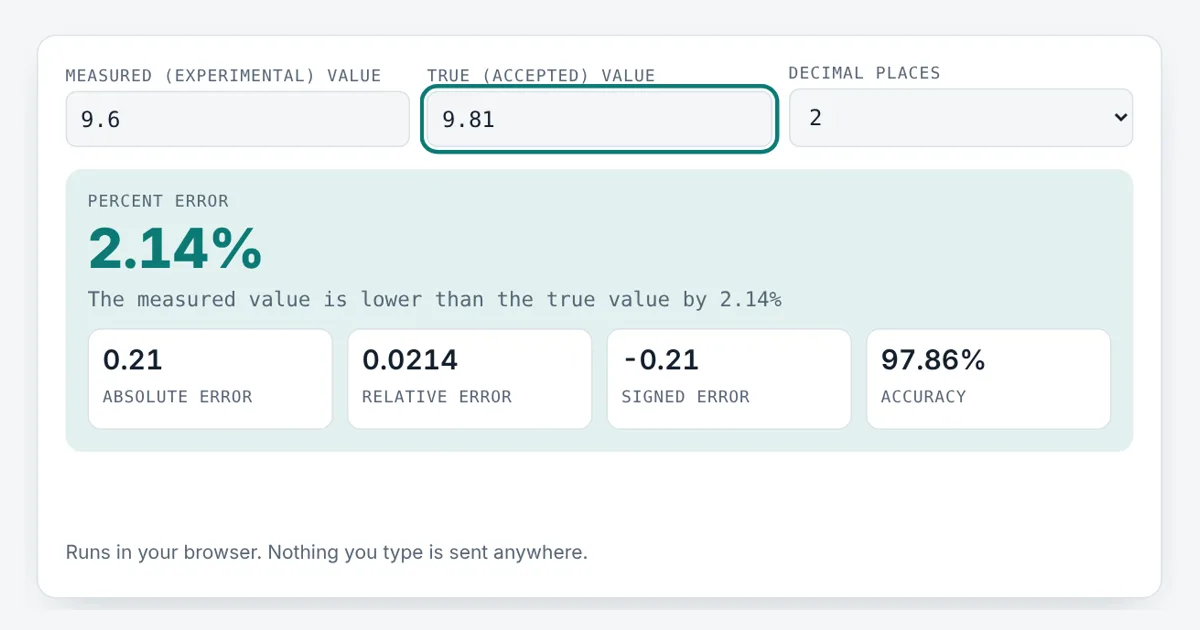
This percent error calculator is for science students writing lab reports, and for anyone checking how close an estimate or measurement came to a known value. It shows the percent error, the absolute and relative error, the signed error and a simple accuracy figure, and it warns you when the true value is 0.
How Do You Calculate Percent Error?
Percent error equals the absolute value of measured minus true, divided by the absolute value of the true value, times 100. For example, if you measure gravity as 9.6 m/s² and the accepted value is 9.81 m/s², the error is 0.21 ÷ 9.81 × 100 = 2.14%.
What Is the Percent Error Formula?
The percent error formula is |measured − true| ÷ |true| × 100, which gives the size of the error as a percentage of the true value.
relative error = absolute error ÷ |true|
percent error = relative error × 100
The measured value is what you got in your experiment. The true value, also called the accepted or reference value, is the known correct answer, often taken from a reference such as the CODATA constants published by NIST. The vertical bars mean absolute value, so the result is never negative. The percent error formula is the same idea as a percentage change, which you can also work out with the percentage increase calculator.
What Is the Difference Between Absolute Error and Relative Error?
Absolute error is the plain size of the miss in the same units as the measurement, while relative error divides that miss by the true value so you can compare errors on different scales. Being 2 cm off on a 50 cm table is a 4% error, but 2 cm off on a 100 m track is only 0.02%. Relative error is written as a decimal, and percent error is the same number times 100.
| Measured | True | Absolute error | Percent error |
|---|---|---|---|
| 9.6 | 9.81 | 0.21 | 2.14% |
| 52 | 50 | 2 | 4% |
| 98 | 100 | 2 | 2% |
| 1.2 | 0.95 | 0.25 | 26.32% |
| -4.1 | -4 | 0.1 | 2.5% |
| 0.5 | 0 | 0.5 | Undefined |
Can Percent Error Be Negative?
The standard percent error is never negative, because the formula uses absolute values. Some teachers ask for a signed percent error, (measured − true) ÷ true × 100, where a minus sign means the measurement was too low. The tool shows the signed error separately so you can report either. Percent error also cannot be worked out when the true value is 0, since you cannot divide by zero. In that case report the absolute error, or use the percentage calculator to compare against a different base.
What Is a Good Percent Error?
There is no single cut-off. In many school labs an error under about 5% is treated as good, while precise lab work aims far lower. Whether an error is acceptable depends on the measurement uncertainty of your equipment, which NIST describes in its guidance on evaluating and expressing uncertainty.
Worked Example
A student times a pendulum and works out the acceleration due to gravity as 9.6 m/s². The accepted value is 9.81 m/s². Enter 9.6 as measured and 9.81 as true: the tool shows a percent error of 2.14%, an absolute error of 0.21 m/s² and a relative error of 0.0214. The signed error is -0.21, so the result was low. In a second trial the student gets 9.81 exactly and the tool shows 0%.
How Do You Use the Percent Error Calculator?
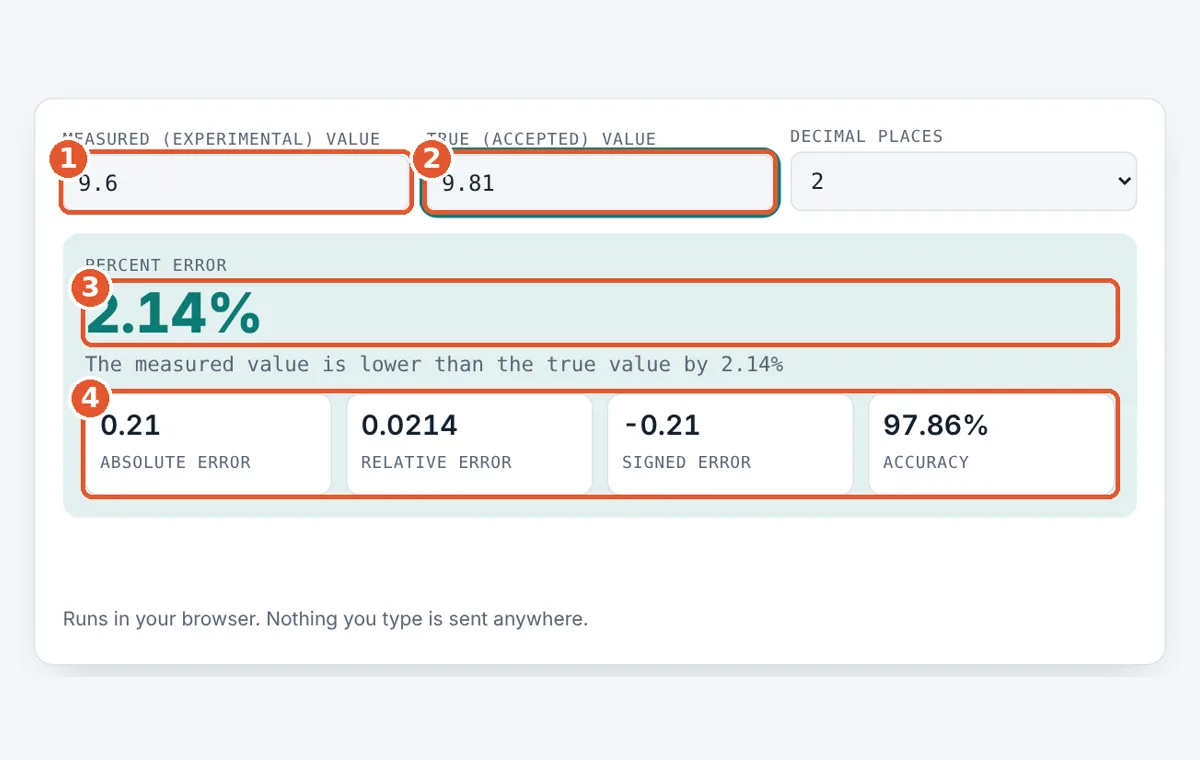
Enter the measured value
Type the value you got from your experiment or estimate.
Enter the true value
Type the accepted or known correct value. It cannot be 0.
Read the percent error
The big number is the percent error. The line below says if you were high or low.
Check the other errors
The boxes show absolute error, relative error, signed error and accuracy.
Frequently Asked Questions
What is the percent error if I measured 52 and the true value is 50?
The percent error is 4%. The absolute error is |52 − 50| = 2. Divide 2 by 50 to get a relative error of 0.04, then multiply by 100 to get 4%. The measurement was 4% too high.
Why can't I find the percent error when the true value is 0?
Percent error divides by the true value, and division by 0 is undefined. With a true value of 0 the tool still shows the absolute error, for example 0.5 for a measurement of 0.5, which is the best way to report the miss.
Is percent error the same as percent difference?
No. Percent error compares a result to a known true value. Percent difference compares two measurements when neither is known to be correct, and divides by their average instead. For 52 and 50 the percent error is 4%, but the percent difference is about 3.92%.
Can percent error be more than 100%?
Yes. If the measured value is more than double the true value, the error is over 100%. Measuring 25 when the true value is 10 gives |25 − 10| ÷ 10 × 100 = 150%. The accuracy box then shows 0%.
Which value goes on the bottom of the percent error formula?
The true or accepted value always goes on the bottom. Using the measured value instead gives a different answer. For a measured 9.6 and a true 9.81, dividing by 9.81 gives 2.14%, while dividing by 9.6 would wrongly give 2.19%.
How many decimal places should I give for percent error?
Most lab reports give percent error to 2 or 3 significant figures, such as 2.14%. Match the precision of your data. The tool lets you choose 1 to 4 decimal places, and the default of 2 suits most school work.
Sources and Further Reading
- NIST: Fundamental physical constants (CODATA), standard acceleration of gravity
- NIST: Essentials of expressing measurement uncertainty
- Wikipedia: Approximation error
Related Tools
Last reviewed: October 2026