Enter two endpoints to get the exact midpoint, or switch modes to find a missing endpoint from the midpoint and the other end. Each step of the formula is shown.
Runs in your browser. Nothing you type is sent anywhere.
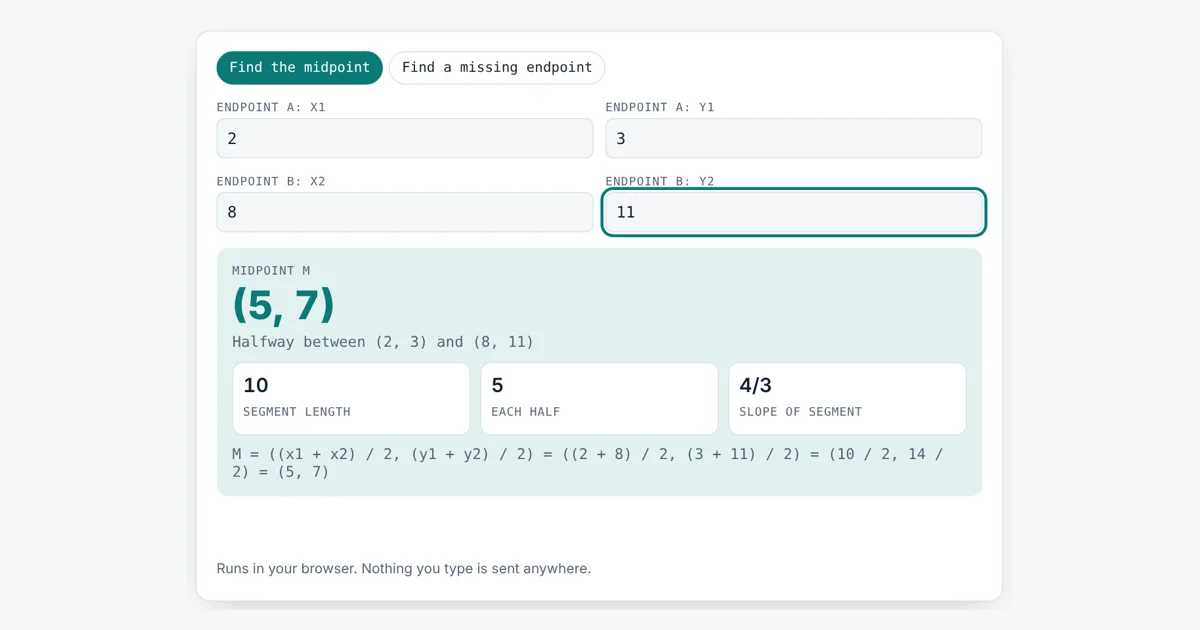
This midpoint calculator is for geometry students, teachers and anyone who needs the exact centre of a line segment, such as placing a post halfway between two corners on a plan. You get the midpoint, the length of the segment and each half, its slope, and the working. A second mode works backwards to a missing endpoint.
How Do You Find the Midpoint of Two Points?
To find the midpoint, average the x coordinates and average the y coordinates: M = ((x1 + x2) / 2, (y1 + y2) / 2). For example, the midpoint of (2, 3) and (8, 11) is ((2 + 8) / 2, (3 + 11) / 2) = (5, 7). Each half of the segment is then 5 units long.
What Is the Midpoint Formula?
The midpoint formula is M = ((x1 + x2) / 2, (y1 + y2) / 2), which takes the arithmetic mean of the x values and of the y values. The result is the point on a line segment that is the same distance from both ends, written in Cartesian coordinates.
missing endpoint: x2 = 2 × Mx − x1, y2 = 2 × My − y1
It works because moving halfway in x and halfway in y lands you halfway along the straight line. Negative numbers and decimals work the same way: the midpoint of (−4, 7) and (6, −1) is (2 / 2, 6 / 2) = (1, 3). To find the average of more than two numbers, use the average calculator.
How Do You Find an Endpoint From the Midpoint?
You find a missing endpoint by doubling the midpoint and subtracting the known endpoint, so x2 = 2Mx − x1 and y2 = 2My − y1. If the midpoint is (1, 3) and one end is (−4, 7), the other end is (2 − (−4), 6 − 7) = (6, −1). Think of it as taking the same step from the known end to the midpoint, then taking it again. Choose “Find a missing endpoint” in the tool and the second row becomes the midpoint.
| Endpoint A | Endpoint B | Midpoint | Length |
|---|---|---|---|
| (0, 0) | (10, 0) | (5, 0) | 10 |
| (2, 3) | (8, 11) | (5, 7) | 10 |
| (−4, 7) | (6, −1) | (1, 3) | 12.8062 |
| (1.5, 2) | (4.5, −3) | (3, −0.5) | 5.831 |
| (−6, −2) | (−2, −8) | (−4, −5) | 7.2111 |
| (3, −5) | (3, 9) | (3, 2) | 14 |
How Is the Midpoint Used With Slope and Distance?
The midpoint, slope and distance together describe a segment fully, and the midpoint is the key to the perpendicular bisector, the line that cuts a segment in half at a right angle. To build it, take the midpoint and use the negative reciprocal of the segment’s slope. For (2, 3) and (8, 11), the slope is 4/3, so the bisector passes through (5, 7) with slope −3/4. The slope calculator gives the line equation, and the length shown here uses the same rule as the Pythagorean theorem calculator.
Worked Example
A gardener marks two corners of a bed on a plan in metres at (2, 3) and (8, 11) and wants a sprinkler exactly in the middle. Enter both points and the tool shows (5, 7). The working reads ((2 + 8) / 2, (3 + 11) / 2) = (10 / 2, 14 / 2) = (5, 7). The segment is 10 m long, so the sprinkler is 5 m from each corner, and the slope is 4/3. Switch to “Find a missing endpoint”, keep A at (2, 3) and enter a midpoint of (5, 7): the tool gives B = (8, 11), which confirms the answer.
How Do You Use the Midpoint Calculator?
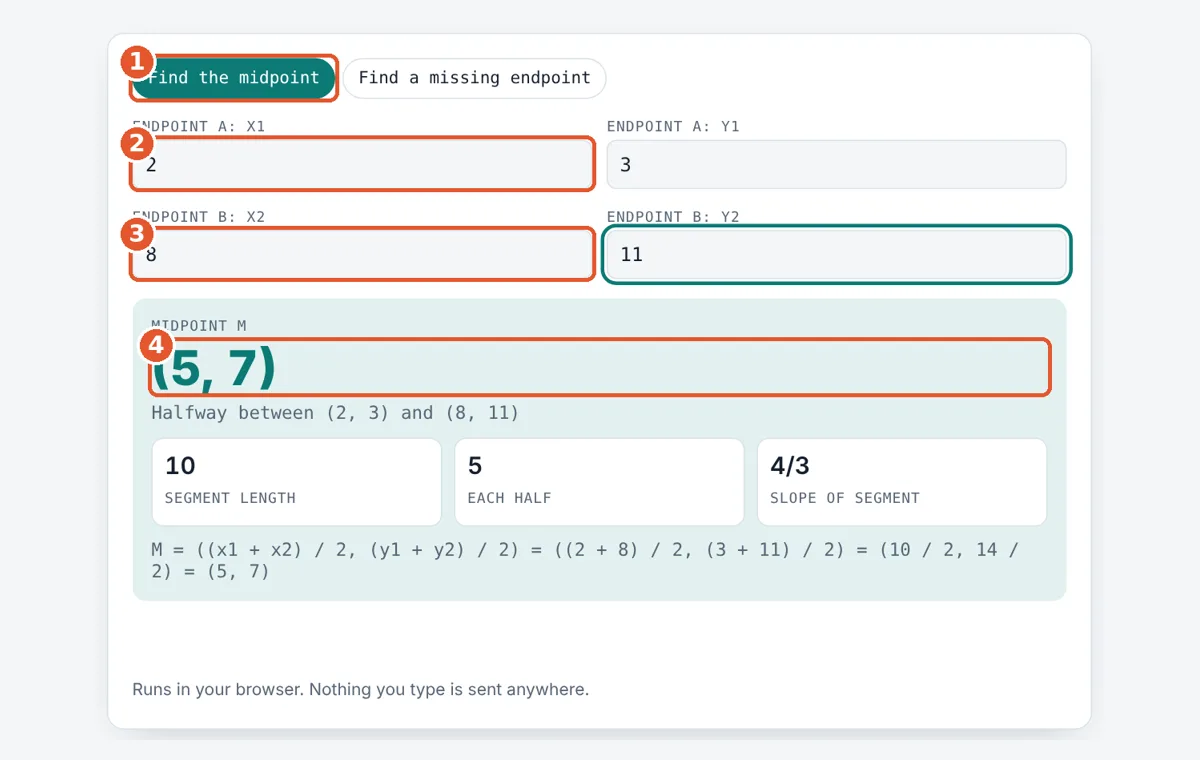
Choose what to find
Pick Find the midpoint, or Find a missing endpoint if you know the middle and one end.
Enter endpoint A
Type x1 and y1 for the first end of the segment.
Enter endpoint B or the midpoint
Type the second endpoint, or the midpoint in endpoint mode. Results update as you type.
Read the answer
The big result is the midpoint or missing endpoint; the boxes give the length, each half and the slope.
Frequently Asked Questions
What is the midpoint of (−4, 7) and (6, −1)?
The midpoint is (1, 3). Add the x values, −4 + 6 = 2, and halve it to get 1. Add the y values, 7 + (−1) = 6, and halve it to get 3.
Can a midpoint have decimal coordinates?
Yes. If the sum of the coordinates is odd, the midpoint ends in .5. The midpoint of (1, 2) and (4, 7) is (2.5, 4.5). The tool keeps up to 4 decimal places.
How do I find the midpoint in 3D?
Average each of the three coordinates. For (1, 2, 3) and (5, 8, −1), the midpoint is (3, 5, 1). This tool works in 2D, so run x and y here and average the z values by hand.
Is the midpoint the same as the average?
Yes, for each coordinate. The midpoint's x is the mean of the two x values and its y is the mean of the two y values. That is why the formula divides each sum by 2.
How far is the midpoint from each endpoint?
Exactly half the segment length. For (2, 3) and (8, 11), the length is √(36 + 64) = 10, so the midpoint (5, 7) is 5 units from each end.
What if the midpoint and the known endpoint are the same?
Then the missing endpoint is the same point too, since 2 × M − A = A when M = A. The segment has a length of 0, which is a single point, not a real segment.
Sources and Further Reading
Related Tools
Last reviewed: October 2026