Type a year to see whether it is a leap year and why. You also get the next and previous leap year and a full list of leap years between any two years.
Runs in your browser. Nothing you type is sent anywhere.
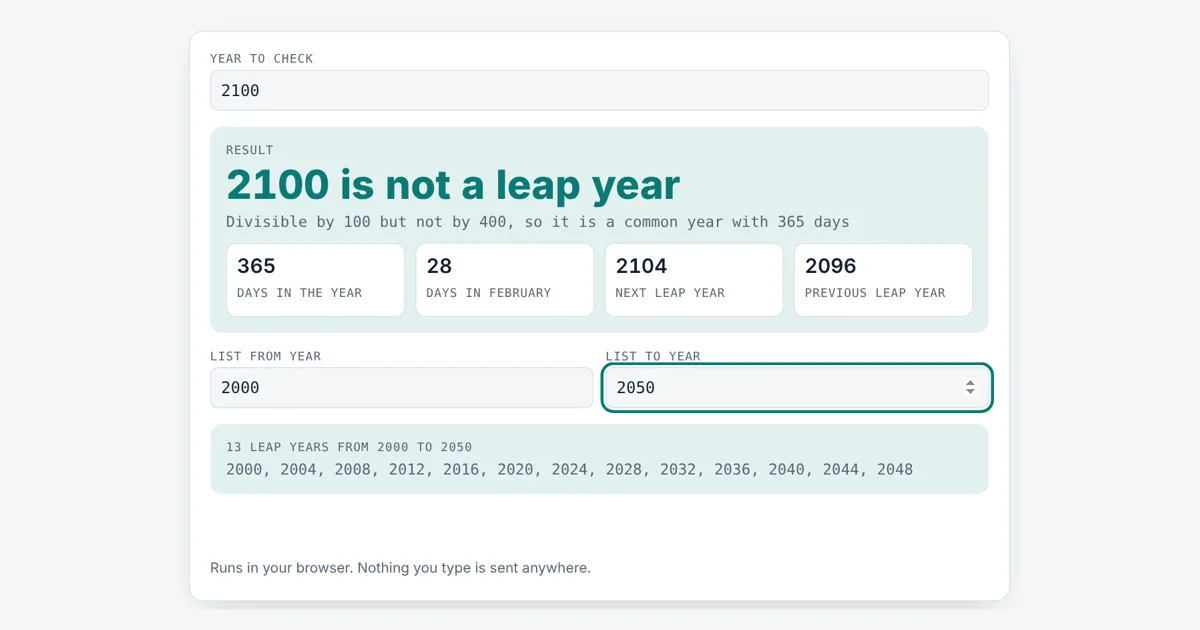
This leap year calculator is for students, teachers, programmers and planners who need a quick, reliable answer. It applies the Gregorian divide by 4, 100 and 400 rule, explains which part of the rule decided the result, and lists every leap year in a range you choose.
How Do You Know if a Year Is a Leap Year?
A year is a leap year if it divides evenly by 4, unless it divides by 100, in which case it must also divide by 400. So 2024 and 2028 are leap years, 1900 and 2100 are not, and 2000 and 2400 are. A leap year has 366 days, with 29 days in February.
What Is the Rule for a Leap Year?
In the Gregorian calendar a year is a leap year if it divides evenly by 4, except century years, which are leap years only if they also divide evenly by 400.
OR year ÷ 400 has no remainder
A leap year has 366 days because it adds a leap day, 29 February. A normal or common year has 365 days. The Gregorian calendar, introduced in 1582 by Pope Gregory XIII and now the civil calendar almost everywhere, uses this 4, 100, 400 rule. The older Julian calendar added a leap day every 4 years with no exceptions, which slowly drifted against the seasons.
Why Do We Have Leap Years?
We have leap years because the Earth takes about 365.2422 days to go round the Sun and return to the same season, not a whole 365.
That length is the tropical year. Adding one day every 4 years gives an average of 365.25 days, which is slightly too long. Dropping 3 leap days every 400 years, in century years like 1700, 1800 and 1900, brings the Gregorian average to 365.2425 days, since 97 of every 400 years are leap years. The error left over is about 1 day every 3,000 years or so. Without leap years at all, the calendar would slip by about 24 days every century, and summer months would slowly move into spring.
Is 2100 a Leap Year?
No, 2100 is not a leap year, because it divides by 100 but not by 400.
| Year | ÷4 | ÷100 | ÷400 | Leap year? |
|---|---|---|---|---|
| 2024 | yes | no | no | Yes |
| 2026 | no | no | no | No |
| 2028 | yes | no | no | Yes |
| 1900 | yes | yes | no | No |
| 2000 | yes | yes | yes | Yes |
| 2100 | yes | yes | no | No |
| 2400 | yes | yes | yes | Yes |
Leap years change day counts, so they matter when you count the gap between dates with the days between dates calculator or work out an exact age with the age calculator. They also explain why the day of the week calculator shows your birthday moving two weekdays after 29 February.
Worked Example
A student wants to know if 2100 is a leap year. Type 2100 in the year box. The tool shows 2100 is not a leap year, because it is divisible by 100 but not by 400, so it has 365 days and February has 28. The next leap year after it is 2104 and the one before is 2096. Leave the range at 2000 to 2050 and the tool lists 13 leap years: 2000, 2004 and every fourth year up to 2048. From 1890 to 1910 it lists only 1892, 1896, 1904 and 1908, because 1900 is skipped.
How Do You Use the Leap Year Calculator?
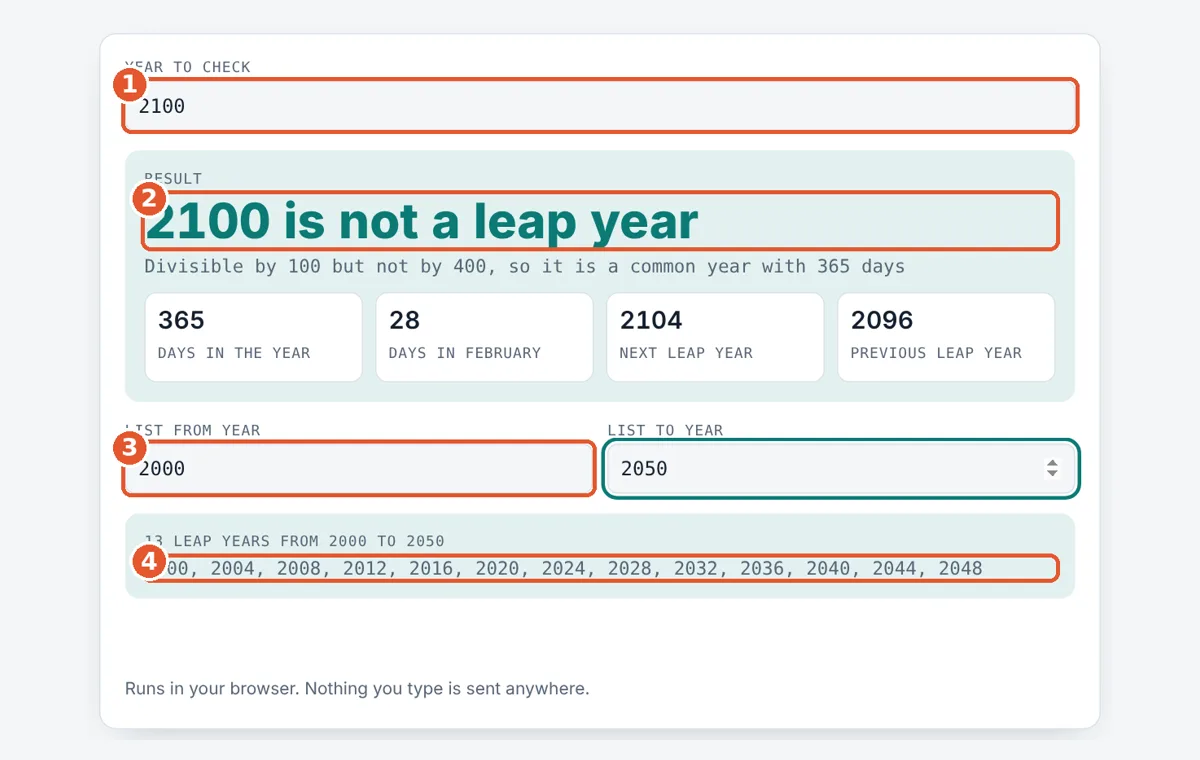
Enter a year
Type any year from 1 to 99999 in the Year to check box.
Read the answer
See if it is a leap year and which part of the rule decided it.
Check nearby leap years
See the days in the year, days in February and the next and previous leap years.
List a range
Type a from and to year to list every leap year between them.
Frequently Asked Questions
Is 2026 a leap year?
No. 2026 is not a leap year because it does not divide evenly by 4. It has 365 days and February has 28 days. The next leap year is 2028, and the one before was 2024.
When is the next leap year?
After 2026 the next leap year is 2028, then 2032 and 2036. There are 18 leap years from 2026 to 2100, because 2100 itself is skipped by the century rule.
Was 1900 a leap year?
No. 1900 divides by 4 and by 100 but not by 400, so it was a common year with 365 days. That is why the leap years around it run 1892, 1896, 1904 and 1908.
How many leap years are in 400 years?
There are 97 leap years in every 400 year cycle of the Gregorian calendar. That gives an average year of 365.2425 days, very close to the tropical year of about 365.2422 days.
How many days are in a leap year?
A leap year has 366 days instead of 365. The extra day is 29 February, called the leap day. Leap years have 52 weeks and 2 days, while common years have 52 weeks and 1 day.
Does this tool work for years before 1582?
It applies the Gregorian rule to any year from 1 onwards, which is called the proleptic Gregorian calendar. Before 1582 most of Europe used the Julian calendar, where every fourth year was a leap year, so historic records may differ.
Sources and Further Reading
Related Tools
Last reviewed: October 2026