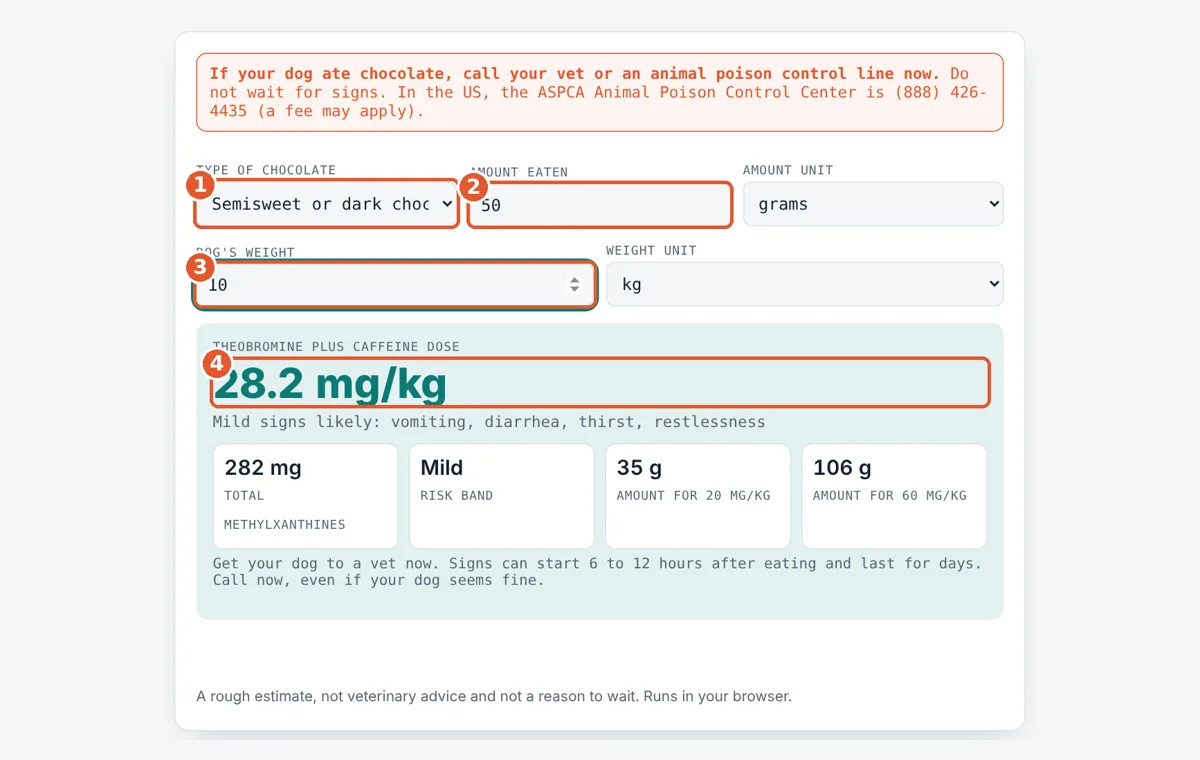
Pick the chocolate, enter how much was eaten and your dog’s weight, and see the estimated toxic dose in mg per kg with the signs to expect. If your dog ate chocolate, call your vet now.
If your dog ate chocolate, call your vet or an animal poison control line now. Do not wait for signs. In the US, the ASPCA Animal Poison Control Center is (888) 426-4435 (a fee may apply).
Signs can start 6 to 12 hours after eating and last for days. Call now, even if your dog seems fine.
A rough estimate, not veterinary advice and not a reason to wait. Runs in your browser.

This dog chocolate toxicity calculator is for dog owners who have just found an empty wrapper and need a fast idea of how serious it is. It estimates the dose of the two toxic compounds in chocolate, per kilogram of your dog’s weight, and compares it with veterinary thresholds. It is not a reason to wait: call your vet or an animal poison control line straight away.
How Much Chocolate Is Toxic to a Dog?
Mild signs of chocolate poisoning in dogs start at about 20 mg of theobromine plus caffeine per kg of body weight, heart effects at 40 to 50 mg/kg, and seizures at 60 mg/kg or more. A 10 kg dog that eats 50 g of dark chocolate gets about 28 mg/kg, enough for vomiting and diarrhea.
Why Is Chocolate Toxic to Dogs?
Chocolate is toxic to dogs because it contains theobromine and caffeine, stimulants that dogs break down much more slowly than people do. Both belong to a group of chemicals called methylxanthines. They speed up the heart, stimulate the nervous system and make the body lose water. Theobromine is the main problem: chocolate has 3 to 10 times more theobromine than caffeine, and in dogs it stays in the blood for many hours. Signs usually begin 6 to 12 hours after eating and include vomiting, diarrhea, thirst, restlessness, a racing heart, tremors and, at high doses, seizures.
How Is Dog Chocolate Toxicity Calculated?
The tool multiplies the amount eaten by the methylxanthine content of that chocolate, then divides by your dog’s weight.
1 oz = 28.35 g, 1 lb = 0.4536 kg
The mg per ounce values and the dose thresholds come from the Merck Veterinary Manual: about 20 mg/kg for mild signs, 40 to 50 mg/kg for heart effects and 60 mg/kg for seizures. The table shows content per serving and how much would reach each threshold for a 10 kg (22 lb) dog:
| Chocolate | mg per oz | mg per g | 20 mg/kg | 40 mg/kg | 60 mg/kg |
|---|---|---|---|---|---|
| White chocolate | 1.1 mg | 0.04 mg | 5,154 g | 10,309 g | 15,463 g |
| Milk chocolate | 64 mg | 2.3 mg | 89 g | 177 g | 266 g |
| Semisweet or dark chocolate | 160 mg | 5.6 mg | 35 g | 71 g | 106 g |
| Unsweetened baking chocolate | 440 mg | 15.5 mg | 13 g | 26 g | 39 g |
| Dry cocoa powder | 807 mg | 28.5 mg | 7 g | 14 g | 21 g |
The darker and more bitter the chocolate, the more dangerous it is. A few grams of cocoa powder or baking chocolate can matter for a small dog, while white chocolate holds very little theobromine, though its fat and sugar can still cause stomach upset or pancreatitis. Real products vary, so treat the result as a rough guide.
What Should You Do If Your Dog Ate Chocolate?
Call your vet, an emergency vet or an animal poison control service straight away, even if your dog seems fine. In the US, the ASPCA Animal Poison Control Center is (888) 426-4435. Have the wrapper, the amount, the time and your dog’s weight ready. Do not make your dog vomit unless a vet tells you to, since some home methods are harmful. A vet may give a drug to cause vomiting, then activated charcoal, fluids and heart monitoring. If you are not sure of your dog’s weight in kilograms, the kg to lbs converter helps, and for puppies the puppy weight calculator gives a sense of expected size. Many dogs recover fully with fast treatment.
Worked Example
Bella is a 10 kg dog who ate 50 g of a dark chocolate bar. With dark chocolate at 160 mg per ounce, 50 g is 1.76 oz, so she took in about 282 mg of theobromine plus caffeine, or 28.2 mg/kg, in the mild band. The tool shows that 35 g would reach 20 mg/kg and 106 g would reach the 60 mg/kg seizure level. A 20 lb dog that ate 3 oz of milk chocolate gets about 21.2 mg/kg. A 10 kg dog that ate 1 oz of baking chocolate gets 44 mg/kg, in the severe band. In every case, the next step is a call to the vet.
How Do You Use the Dog Chocolate Toxicity Calculator?
Pick the chocolate type
Choose white, milk, dark, baking chocolate or cocoa powder. Darker means more dangerous.
Enter the amount eaten
Type how much was eaten and pick grams or ounces. Guess high if unsure.
Enter your dog's weight
Type the weight and pick kg or lb.
Read the dose and call your vet
See the dose in mg/kg and the risk band, then phone your vet or poison control.
Frequently Asked Questions
How long after eating chocolate will a dog get sick?
Signs usually appear 6 to 12 hours after eating, though they can start sooner with large amounts. They can last up to three days because dogs clear theobromine slowly. Call your vet as soon as you know, before signs appear.
Will one chocolate chip hurt my dog?
A single milk chocolate chip in a medium or large dog is very unlikely to cause poisoning, because the dose is tiny. Many chips, darker chocolate, or a very small dog change that. Enter the amount here and call your vet if unsure.
Is white chocolate safe for dogs?
It has very little theobromine, about 1.1 mg per ounce, so poisoning from white chocolate is rare. It is still high in fat and sugar, which can cause vomiting, diarrhea or pancreatitis. It is not a safe treat.
How much dark chocolate can kill a dog?
The lethal dose of theobromine and caffeine is reported as 100 to 200 mg/kg, but deaths can happen lower. For a 10 kg dog, about 177 g of dark chocolate reaches 100 mg/kg. Severe signs start far below that, so treat any amount seriously.
Should I make my dog throw up after eating chocolate?
Only if your vet or poison control tells you to. Some home methods, such as salt, can poison a dog. A vet can give a safe drug to cause vomiting, usually within the first few hours after eating.
What foods with chocolate are dangerous?
Brownies, cakes, cookies, hot cocoa mix and cocoa powder can all be risky. Baked goods made with baking chocolate or cocoa can be strong. Some sugar free products also contain xylitol, which is very toxic to dogs. Tell your vet the exact product.
Sources and Further Reading
Related Tools
Last reviewed: October 2026