Estimate how heavy your puppy will be as an adult from its weight, age and breed size. You get a central estimate, a realistic range, how much of its adult weight it has reached and roughly when it will stop growing.
An estimate from average growth curves. Individual puppies vary, so ask your vet to check growth at each visit.
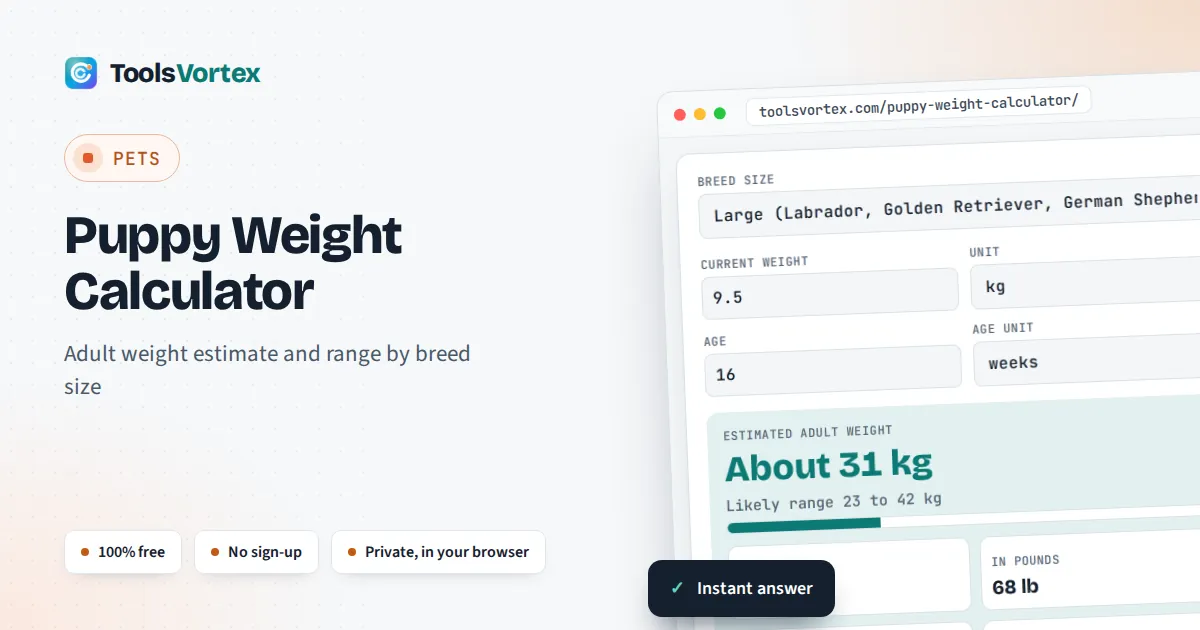
This puppy weight calculator helps new owners estimate how big their puppy will be once fully grown, which matters for choosing a crate, a bed, a harness and the right growth food. Instead of a single magic number, it uses published growth curves for small, medium and large breeds, shows a range that reflects real differences between dogs, and tells you how far through growth your puppy probably is.
How big will my puppy get?
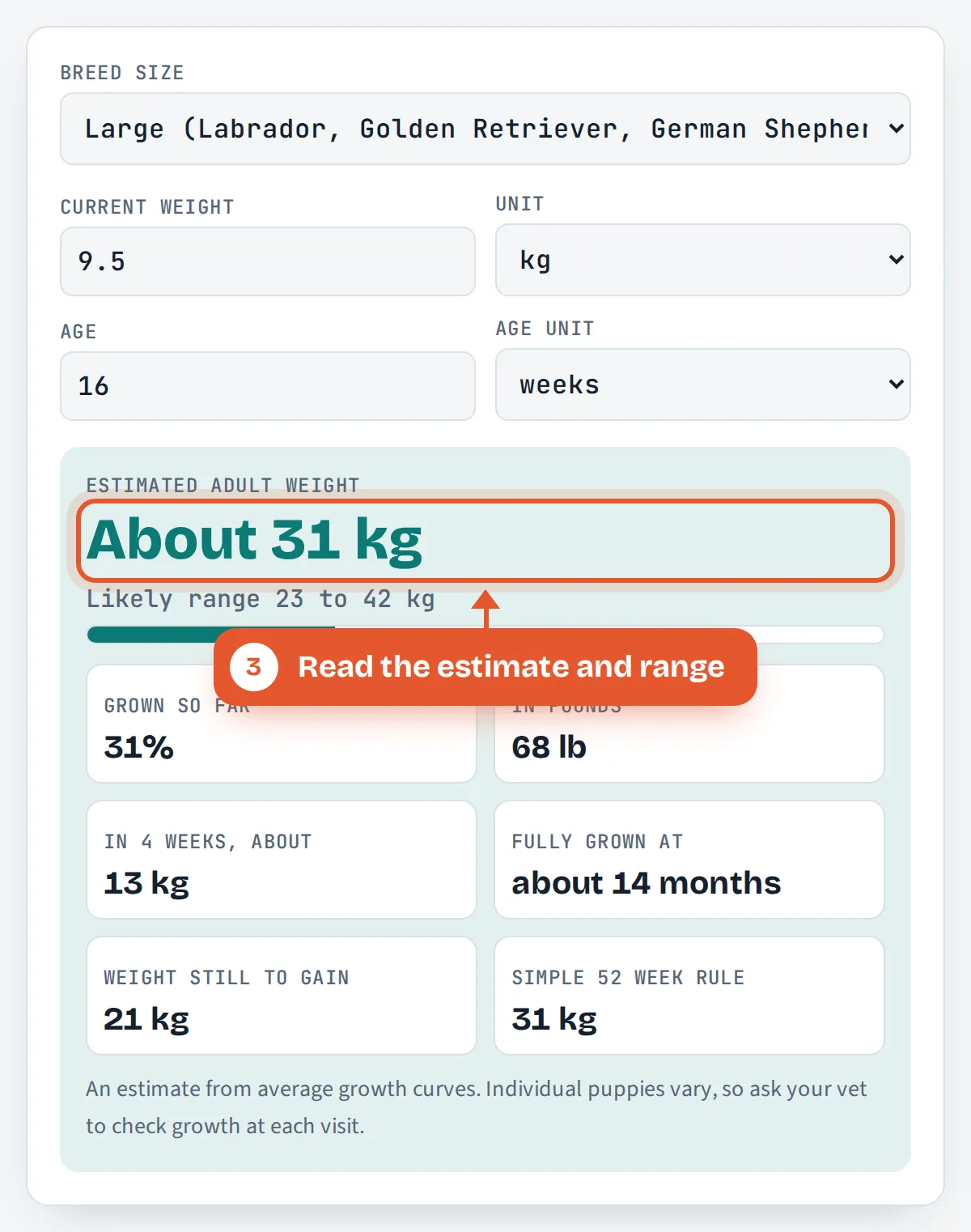
Divide your puppy’s weight by the share of adult weight it should have reached at its age. A large breed puppy is about 31% grown at 16 weeks, so a Labrador weighing 9.5 kg should reach roughly 31 kg. A puppy weight calculator also shows a range, here about 23 to 42 kg, because puppies grow at different speeds.
How Does the Puppy Weight Calculator Work?
It uses a logistic growth model, an S shaped curve that rises slowly, speeds up and then levels off at adult weight. Researchers in Colombia fitted this model to the growth records of 21 puppies from 10 breeds, published in Revista MVZ Córdoba in 2014, and reported two figures for each size group: the age at which puppies reach half their adult weight, and the age at which they reach 99%.
b = (T99 − x0) ÷ ln(99)
Adult weight = current weight ÷ share grown
Small: x0 = 3.49 months, T99 = 9.46 months
Medium: x0 = 4.21 months, T99 = 12.52 months
Large: x0 = 5.27 months, T99 = 14.37 months
The range comes from the spread of the half weight age between dogs in the study (plus or minus 0.42 months for medium and 0.86 months for large breeds). Only three small dogs were studied, so for small breeds the calculator uses the medium group’s spread rather than a falsely narrow band. If you are unsure of the breed size, choose the compare option and you will see the estimate for each curve.
What Percentage of Adult Weight Is a Puppy at Each Age?
Share of adult weight reached, from the growth model above. Use it to read your puppy’s progress in either direction.
| Age | Small breeds | Medium breeds | Large breeds |
|---|---|---|---|
| 8 weeks | 22% | 21% | 15% |
| 12 weeks | 36% | 31% | 22% |
| 16 weeks | 54% | 43% | 31% |
| 20 weeks | 70% | 55% | 42% |
| 26 weeks (6 months) | 87% | 73% | 59% |
| 39 weeks (9 months) | 99% | 93% | 87% |
| 52 weeks (12 months) | 100% | 99% | 97% |
Why Are Puppy Weight Predictions Uncertain?
Puppies of the same breed and age can differ a lot, so any prediction is a range rather than a promise. The Córdoba study itself concluded that a larger sample would improve the model’s predictive ability, given the individual variability of growth. A much larger 2017 study in PLOS ONE by Salt and colleagues used records from millions of young dogs to build growth standard charts and found that smaller breeds reach maturity at 8 to 12 months while larger breeds take up to 24 months.
It also found that dogs heavier than 40 kg as adults, such as Great Danes and Mastiffs, had growth patterns too varied to model at all. That is why the giant option here gives only a rough guide based on the large breed curve. Estimates also get better with age: at 8 weeks a small error in age or weight is multiplied four to seven times, while at 6 months most puppies are well past half their adult weight.
Worked Example: How Big Will Luna Get?
Luna is a Labrador puppy in Cork who weighs 9.5 kg at her 16 week vet check.
- Age in months: 16 weeks ÷ 4.348 = 3.68 months
- Large breed curve: b = (14.37 − 5.27) ÷ 4.595 = 1.98, so share grown = 1 ÷ (1 + e0.80) = 31%
- Adult estimate: 9.5 ÷ 0.309 = 30.7 kg (about 68 lb)
- Range: 23.2 to 42.2 kg, using the spread in the half weight age
- Next month: about 13.1 kg at 20 weeks if she follows the average curve
The adult Labradors in the Córdoba study averaged 29.5 kg, so Luna’s estimate sits right where you would expect. If her parents’ weights are known, they are a useful sense check on the range. Once Luna is grown, the dog age calculator shows how her age compares in human years, and the kg to lbs converter helps if a vet record or breeder uses pounds.
When Do Puppies Stop Growing?
Most small breeds reach adult weight at around 9 to 10 months, medium breeds at about 12 to 13 months and large breeds at about 14 months, according to the logistic model. The Salt study gives a similar picture: 8 to 12 months for smaller breeds and up to 24 months for the largest. The calculator shows the 99% age for the size you pick.
Does the Double the Weight at 16 Weeks Rule Work?
Only for small breeds, and not even exactly for them. By the growth model, a small breed puppy at 16 weeks has reached about 54% of its adult weight, so doubling is close. A medium breed puppy is at about 43% (multiply by about 2.3) and a large breed puppy only 31% (multiply by about 3.2), so doubling would badly underestimate a Labrador or German Shepherd. The other common shortcut, weight ÷ age in weeks × 52, ignores breed size altogether and is shown in the results only for comparison.
How Do You Use the Puppy Weight Calculator?
Choose the breed size
Pick small, medium, large or giant. For a mixed breed or rescue puppy, choose the compare option.

Enter weight and age
Type your puppy’s latest weight in kg, g or lb and its age in weeks or months. The result updates as you type.
Read the estimate and range
The adult weight estimate appears in large text with the likely range and a bar showing how far through growth your puppy is.
Check the growth details
See the weight to expect in four weeks, when growth should finish and how the simple 52 week rule compares.



Frequently Asked Questions
How accurate is a puppy weight calculator?
It gives a reasonable range, not an exact figure. Growth curves describe average puppies, and individual dogs of the same breed differ. Accuracy improves as your puppy gets older, so recalculate every month and treat the middle of the range as your best guess.
At what age is a puppy half its adult weight?
According to a logistic growth model of 10 breeds, small breed puppies reach half their adult weight at about 3.5 months, medium breeds at about 4.2 months and large breeds at about 5.3 months. Giant breeds take longer still.
Can I predict my puppy’s size from its paws?
Not reliably. Paw size is not part of the growth studies behind this calculator and varies between breeds and individual dogs. Weight and age measured against a growth curve for the right breed size give a much sounder estimate.
How do I estimate adult size for a mixed breed puppy?
Choose the compare option to see the small, medium and large curves side by side. If you know the parents’ weights, they are a helpful sense check on the range. A rescue centre or vet can often tell you which size group is most likely.
Does neutering change how big my puppy will get?
Only slightly on average. The 2017 PLOS ONE growth chart study found that neutering before 37 weeks was linked to a small upward shift in growth and later neutering to a small downward shift, both small compared with normal differences between dogs.
What should I do if my puppy seems too heavy or too light?
Ask your vet to check body condition rather than relying on the scale alone. Feed a complete growth food suited to your puppy’s expected adult size, follow the feeding guide on the label and ask your vet for individual advice.
Sources and Further Reading
- Salt C, et al. Growth standard charts for monitoring bodyweight in dogs of different sizes. PLOS ONE, 2017 (NIH PMC)
- Posada S, Gómez L, Rosero R. Application of the logistic model to describe the growth curve in dogs of different breeds. Revista MVZ Córdoba, 2014
- Hawthorne AJ, et al. Body-weight changes during growth in puppies of different breeds, summary by Purdue University Canine Welfare Science
Related Tools
Last reviewed: October 2026