Pick two dates to count the working days between them. Choose your weekend, decide whether the end date counts, and list any holidays to skip.
Runs in your browser. Nothing you type is sent anywhere.
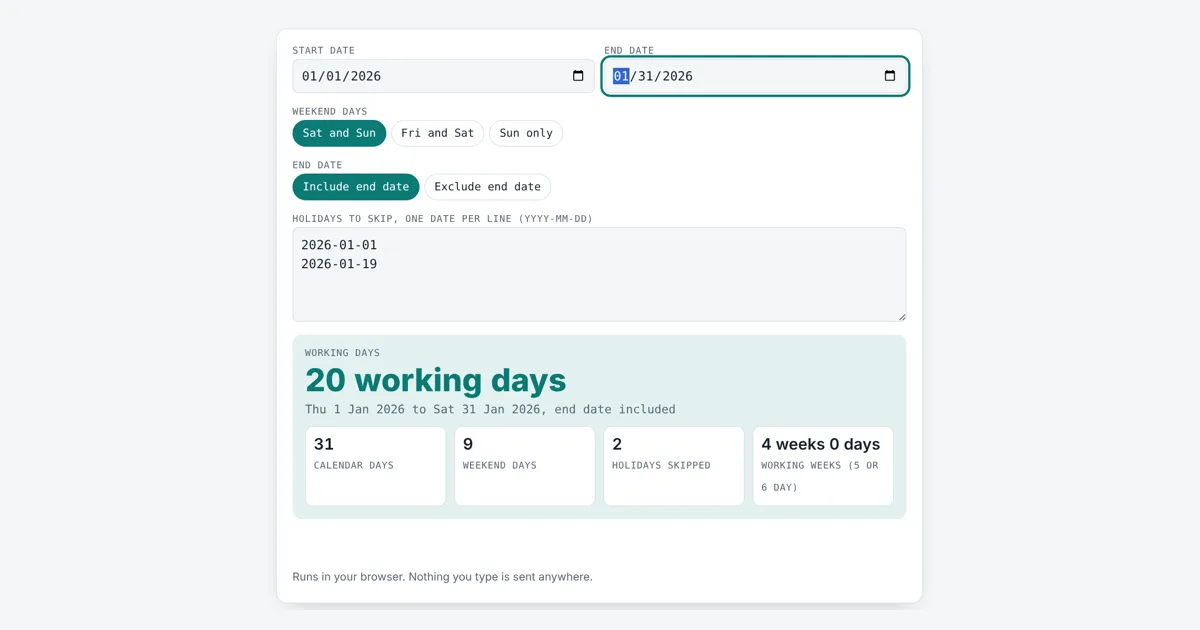
This working days calculator is for HR teams, payroll staff, project managers, freelancers and anyone counting a deadline or notice period. It counts the weekdays between two dates, skips the weekend you choose and any holidays you type, and shows the calendar days, weekend days and holidays it removed.
How Many Working Days Are Between Two Dates?
Count all calendar days in the range, subtract weekend days, then subtract holidays that fall on weekdays. For example, 1 to 31 January 2026 has 31 days, 9 of them Saturdays or Sundays, leaving 22 weekdays. Taking off New Year’s Day and Martin Luther King Jr. Day leaves 20 working days.
How Do You Count Working Days Between Two Dates?
Count every day from the start date to the end date, then take away the weekend days and any public holidays that fall on a weekday.
A working day, also called a business day, is a day when offices are normally open. In the US, UK and most of Europe the weekend is Saturday and Sunday, so a normal week has 5 working days. Many countries in the Middle East use a Friday and Saturday weekend, and some workplaces only close on Sunday, giving a 6 day working week. A holiday that falls on a weekend day is not taken off twice, because that day was already a day off. If you only need the plain number of days, the days between dates calculator gives it without skipping weekends.
How Many Working Days Are in 2026?
2026 has 261 weekdays from Monday to Friday, and 250 working days once the 11 US federal holidays are taken off.
The US Office of Personnel Management (OPM) lists the 2026 federal holidays, all on weekdays: 1 January, 19 January, 16 February, 25 May, 19 June, 3 July (Independence Day observed), 7 September, 12 October, 11 November, 26 November and 25 December. In the UK, bank holidays differ between England and Wales, Scotland and Northern Ireland and are listed on GOV.UK. Type the ones that apply to you into the holiday box.
Weekdays in Each Month of 2026
Monday to Friday counts from this tool, before any holidays are removed:
| Month | Weekdays | Month | Weekdays |
|---|---|---|---|
| January | 22 | July | 23 |
| February | 20 | August | 21 |
| March | 22 | September | 22 |
| April | 22 | October | 22 |
| May | 21 | November | 21 |
| June | 22 | December | 23 |
Should You Include the End Date?
Include the end date when both the first and last days are worked, such as a project running Monday 12 October to Friday 16 October 2026, which is 5 working days. Exclude it when you count a gap or a notice period that ends on that date, which gives 4. Leave and contract rules can set their own counting method, so check the wording. To turn working days into pay, the hourly to salary calculator converts a rate into yearly earnings, and the date calculator adds days to a date.
Worked Example
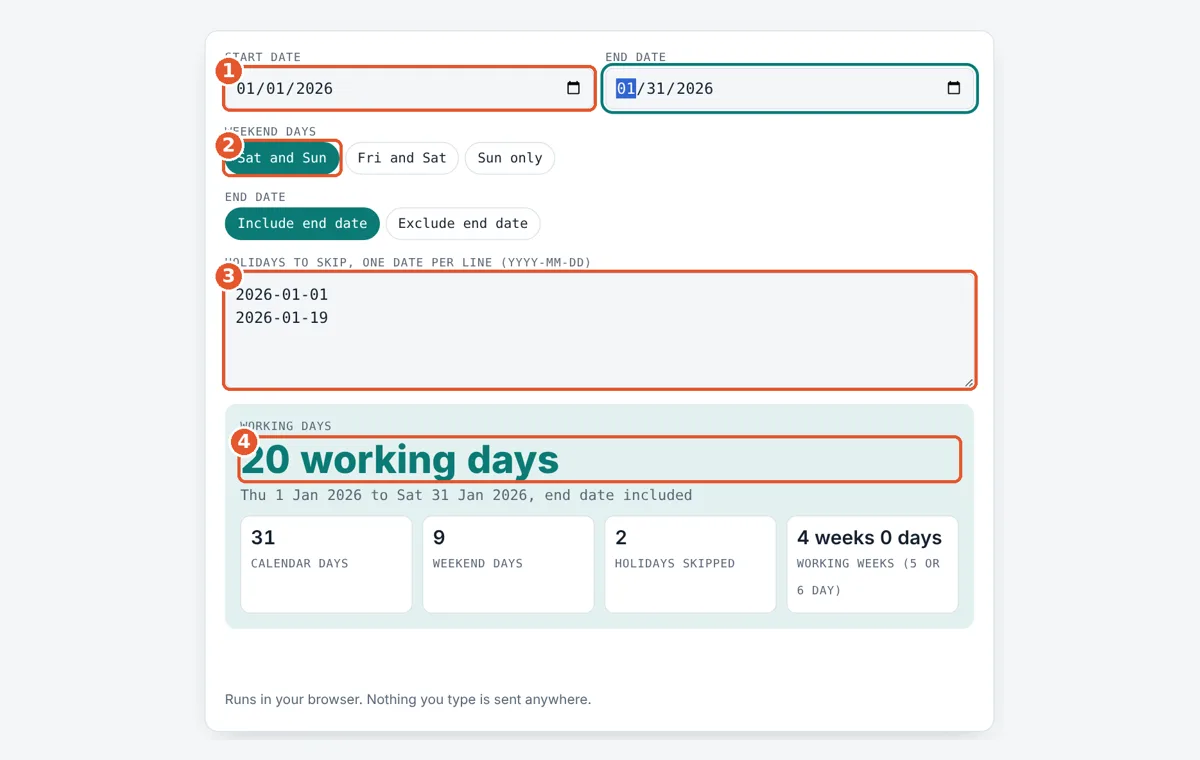
A US payroll team wants the working days in January 2026. Enter 2026-01-01 and 2026-01-31, keep Sat and Sun as the weekend, include the end date and type the two federal holidays 2026-01-01 and 2026-01-19. The tool shows 20 working days out of 31 calendar days, with 9 weekend days and 2 holidays skipped. Without the holidays the answer is 22. With a Friday and Saturday weekend and no holidays the same month has 21 working days, and with Sunday only it has 27.
How Do You Use the Working Days Calculator?
Pick the two dates
Choose a start date and an end date. They can be in either order.
Choose the weekend
Tap Sat and Sun, Fri and Sat, or Sun only to match your work week.
Set end date and holidays
Include or exclude the end date and type holidays to skip, one per line.
Read the working days
See the working days, plus calendar days, weekend days and holidays skipped.
Frequently Asked Questions
How many working days are in a year?
A year usually has 260 or 261 weekdays from Monday to Friday. 2026 has 261. After taking off 11 US federal holidays, 2026 has 250 working days. In the UK, 8 bank holidays in England and Wales would leave about 253.
Does the calculator include the start date?
Yes. The start date always counts if it is a working day. You can choose whether the end date counts. From Monday 12 October to Friday 16 October 2026 is 5 working days with the end date included and 4 without it.
What if a holiday falls on a weekend?
It is not taken off twice. A weekend day is already a day off, so the tool only counts holidays that land on a working day. Many employers give a substitute weekday instead, so type that date as the holiday.
How do I count working days in countries with a Friday and Saturday weekend?
Tap Fri and Sat. The tool then treats Sunday to Thursday as working days. January 2026 has 21 working days with a Friday and Saturday weekend, compared with 22 for a Saturday and Sunday weekend.
How many working days are in a month?
Most months have 20 to 23 weekdays from Monday to Friday. In 2026, February has the fewest with 20, while July and December have the most with 23. Public holidays then reduce the number further.
Can I enter the dates in reverse order?
Yes. If the end date is earlier than the start date, the tool swaps them and counts the same range, and the result line says the dates were swapped.
Sources and Further Reading
Related Tools
Last reviewed: October 2026