
Add or subtract years, months, weeks and days from any date and get the exact result with its weekday. Switch to business days if you need weekends skipped.

Contract deadlines, return windows, probation periods and court filing dates are usually written as “30 days from” or “6 months after” something. Counting that on a wall calendar is slow, and it’s easy to lose a day at the end of a month. This date calculator moves a start date forward or back by any mix of years, months, weeks and days, then tells you the weekday you land on. Need working days only? Pick business days and Saturdays and Sundays get skipped.
How do I add days to a date?
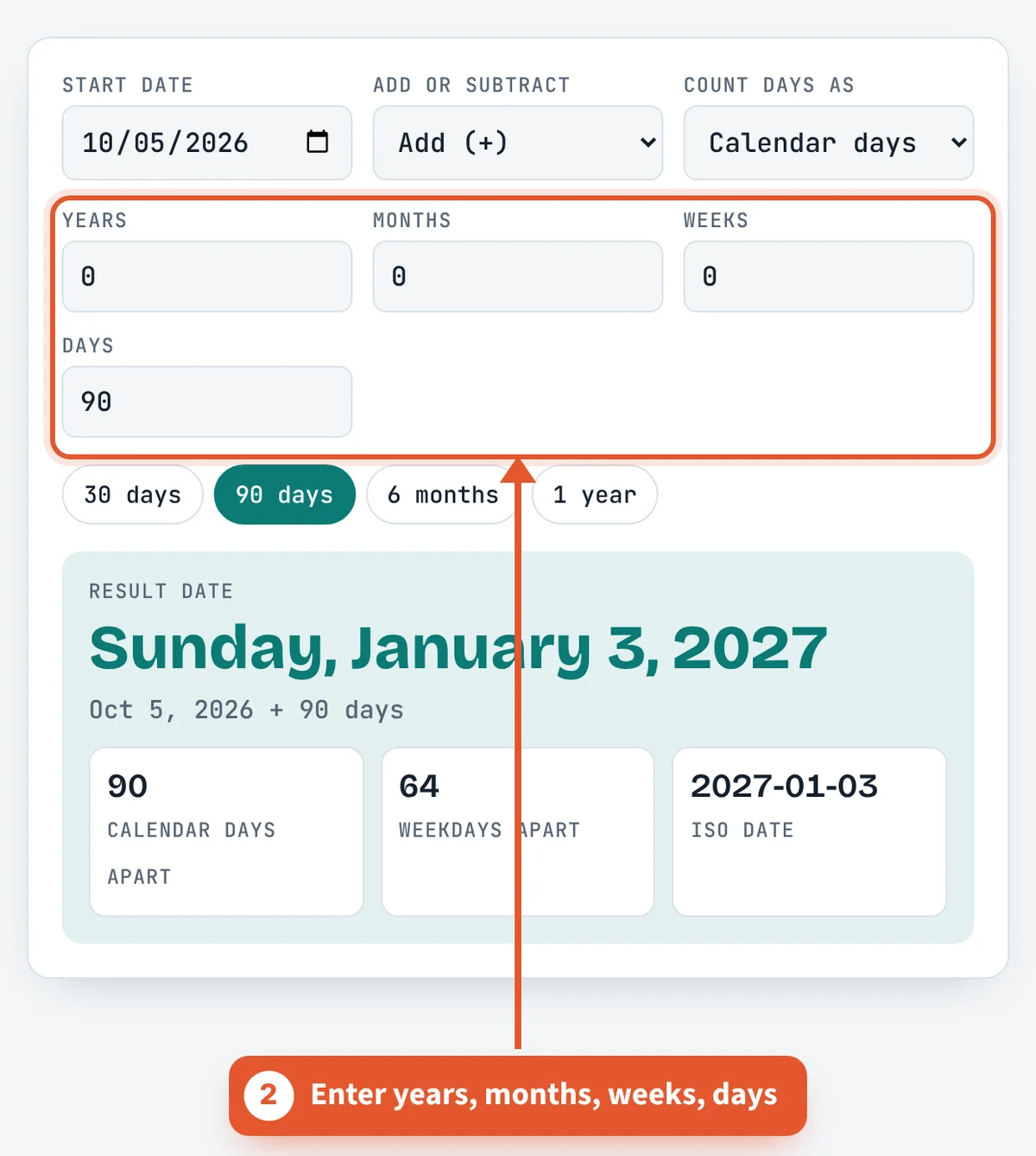
Start from your date and count forward the number of days, rolling into the next month when you pass its last day. The start date itself isn’t counted. With the date calculator you just type the number. For example, 90 days after Monday, October 5, 2026 is Sunday, January 3, 2027. Counting 10 business days from the same Monday lands on Monday, October 19, 2026.
How the calculator adds months and years
Months don’t all have the same length, so months are added first by moving the calendar month and keeping the day number. If that day doesn’t exist in the new month, the result snaps to the month’s last day. Add one month to January 31, 2026 and you get February 28, 2026, since 2026 isn’t a leap year. Weeks and days are added after that, one day at a time.
Common offsets from October 5, 2026
| Change | Result |
|---|---|
| − 30 days | Sat, Sep 5, 2026 |
| + 30 days | Wed, Nov 4, 2026 |
| + 60 days | Fri, Dec 4, 2026 |
| + 90 days | Sun, Jan 3, 2027 |
| + 180 days | Sat, Apr 3, 2027 |
| + 6 months | Mon, Apr 5, 2027 |
| + 1 year | Tue, Oct 5, 2027 |
Notice that 6 months and 180 days aren’t the same thing. They’re two days apart here, and the gap changes with the months involved.
Business days vs. calendar days
Business-day mode skips every Saturday and Sunday. It doesn’t know about federal holidays, so if Thanksgiving (Thursday, November 26, 2026) or Christmas falls inside your range, push the result out by one more day for each holiday your office or court observes. In this mode each week you enter counts as 5 business days.
How to use the Date Calculator
Pick the start date
It opens on today. Change it to any past or future date, such as a signing date or an invoice date.

Enter the time to add or subtract
Choose add or subtract, then fill in years, months, weeks and days, or tap a preset like 90 days. Switch to business days to skip weekends.
Read the result date
The new date shows with its weekday, along with the calendar days and weekdays between the two dates.


Why do leap years skip some century years?
The Julian calendar, introduced by Julius Caesar in 45 BC, added a leap day every 4 years, for an average year of 365.25 days. The solar year is about 365.2422 days, so the calendar gained roughly one day every 128 years. By the 1500s the spring equinox had drifted about 10 days earlier on the calendar.
In 1582 Pope Gregory XIII issued the reform now called the Gregorian calendar. Ten days were dropped, so Thursday, October 4, 1582 was followed by Friday, October 15. The new leap year rule is:
- A year divisible by 4 is a leap year,
- except a year divisible by 100 is not,
- except a year divisible by 400 is.
So 2000 was a leap year, 1900 was not, and 2100 will not be. This gives an average of 365.2425 days, off by only about one day in 3,000 years.
Countries switched at different times. Britain and its American colonies changed in 1752, skipping from September 2 to September 14. Date math across those years needs care, which is why historical dates are often marked Old Style or New Style.
To see which weekday any date fell on, use the day of the week calculator.
How do computers count the days between two dates?
Months have different lengths, so software first converts each date into a single running day count, subtracts, and converts back. Two systems are widely used.
The Julian Day Number counts days continuously from noon on January 1, 4713 BC in the proleptic Julian calendar, a starting point taken from the Julian Period proposed by the scholar Joseph Scaliger in 1583. Astronomers use it because any two dates in recorded history become a simple subtraction. October 10, 2026 is Julian Day 2,461,324.
Unix time counts seconds since midnight UTC on January 1, 1970, ignoring leap seconds, so every day is treated as exactly 86,400 seconds. Dividing by 86,400 gives a day count. It is what most programming languages and databases use internally.
For writing dates, the international standard ISO 8601 uses the YYYY-MM-DD order, such as 2026-10-10. It avoids the US and European month and day mix-up and sorts correctly as plain text.
You can inspect raw timestamps with the Unix timestamp converter or count the gap directly with the days between dates calculator.
Frequently asked questions
What date is 90 days from today?
It depends on today’s date, which is why the calculator starts on today. From October 5, 2026, 90 days later is Sunday, January 3, 2027.
What happens if I add a month to January 31?
You get the last day of February: February 28, or February 29 in a leap year like 2028. The calculator never rolls over into March.
Does business-day mode skip holidays?
No. It skips Saturdays and Sundays only. Add an extra day yourself for each holiday that falls in the range.
Is the start date counted?
No. Adding 1 day to a Monday gives Tuesday. That matches how most contracts and deadlines count “days after” a date.
Can I count backward from a date?
Yes. Set the second box to Subtract to find a date in the past, for example 45 days before a due date.
Sources and further reading
Related tools
Last reviewed: October 2026