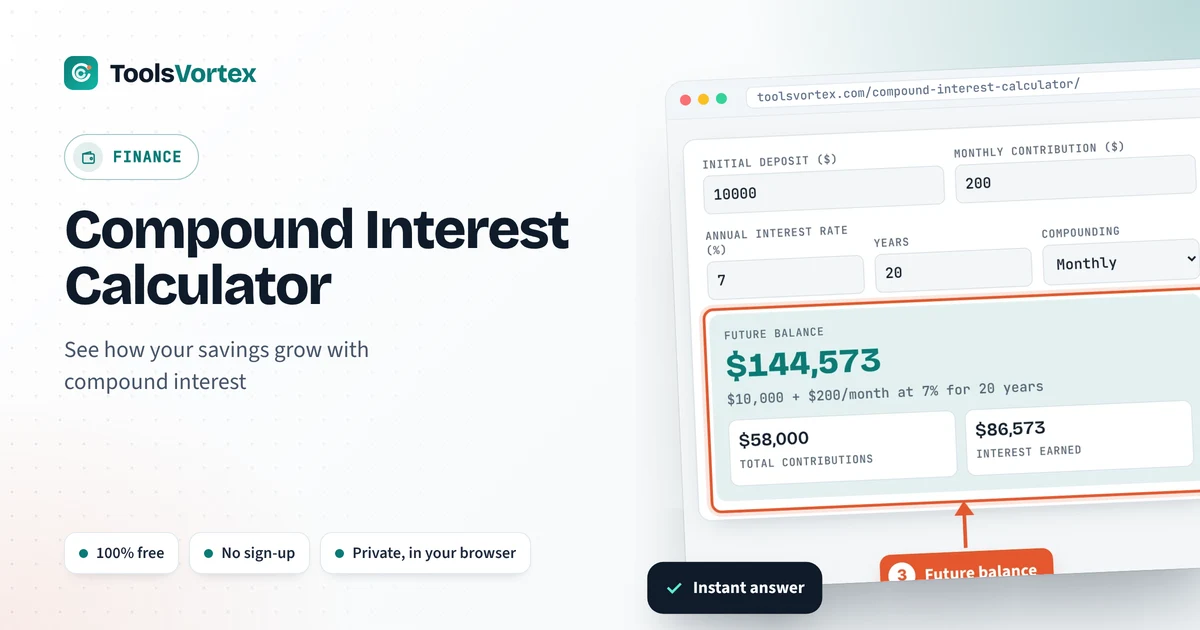
See how your savings grow with compound interest. Enter a starting amount, monthly contribution, interest rate and years to get your future balance.

Compound interest means you earn interest on your interest, which is why money saved early grows so much faster than money saved later. This compound interest calculator shows what a starting deposit plus regular monthly savings can grow to, and how much of the final balance comes from interest.
How does compound interest work?
Each period, interest is added to your balance, and the next period’s interest is calculated on that larger balance. The formula is A = P(1 + r/n)nt. For example, $10,000 at 7% compounded monthly for 20 years grows to about $40,387 without any extra deposits.
Compound interest formula
P is the starting amount, r the annual rate, n the number of compounding periods per year, t the years, PMT the monthly contribution and i the effective monthly rate.
The rule of 72
Divide 72 by the annual interest rate to estimate how many years it takes to double your money. At 6% it takes about 12 years; at 9%, about 8 years.
Growth of $10,000 at different rates
| Rate | 10 years | 20 years | 30 years |
|---|---|---|---|
| 4% | $14,908 | $22,226 | $33,135 |
| 6% | $18,194 | $33,102 | $60,226 |
| 8% | $22,196 | $49,268 | $109,357 |
| 10% | $27,070 | $73,281 | $198,374 |
Figures use monthly compounding with no extra deposits, before taxes and fees.
How to use the Compound Interest Calculator
Enter your deposit and monthly savings
Type the amount you start with and how much you will add each month.

Set the rate, years and compounding
Enter the expected annual interest rate, the number of years, and how often interest compounds.
Read your future balance
See the final balance, your total contributions and how much interest you earned.


What is the difference between APR and APY?
The annual percentage rate (APR) is the yearly rate before compounding. The annual percentage yield (APY) is what you actually earn in a year once interest is added to your balance and starts earning interest itself. The conversion is APY = (1 + r ÷ n)^n − 1, where r is the APR as a decimal and n is the number of compounding periods per year.
For example, 5% compounded monthly gives an APY of about 5.116%. Compounded daily, it is about 5.127%. With continuous compounding the formula becomes e^r − 1, which for 5% is about 5.127% as well, so daily compounding is already very close to the mathematical limit.
US law requires both numbers in different places. The Truth in Savings Act, carried out through Regulation DD, makes banks quote APY on savings accounts and CDs. The Truth in Lending Act, through Regulation Z, makes lenders quote APR on loans and cards. Compare savings offers by APY and loan offers by APR. To see what a high card APR costs over time, try the credit card payoff calculator.
How do inflation and taxes affect compound growth?
The balance a calculator shows is a nominal amount. What that money can buy depends on inflation, which in the US is usually tracked with the Consumer Price Index published by the Bureau of Labor Statistics. The real rate of return follows the Fisher equation: (1 + nominal rate) ÷ (1 + inflation rate) − 1. A 6% return during 3% inflation is a real return of about 2.9%, not 3%.
Taxes reduce growth too. Interest from savings accounts, CDs and bonds is generally taxed as ordinary income in the year it is earned, and banks send IRS Form 1099-INT when they pay you $10 or more in interest. Paying tax each year means less money stays invested to compound. Tax-advantaged accounts such as a 401(k) or an IRA delay or remove that drag.
- Enter your expected rate minus inflation to see growth in current dollars.
- Compare with the simple interest calculator to see how much compounding adds.
- Set a target and work backward with the savings goal calculator.
Frequently asked questions
What is the difference between simple and compound interest?
Simple interest is paid only on the original amount. Compound interest is also paid on interest already earned, so it grows faster.
How often should interest compound?
More frequent compounding gives slightly more interest. Monthly and daily compounding are common for savings accounts.
What return should I use for investments?
Returns are not guaranteed. Many people test a cautious rate, such as 5 to 7%, alongside a higher one to see a range.
Does this include taxes or inflation?
No. The result is before taxes, fees and inflation.
How long does it take to double my money?
Use the rule of 72: divide 72 by the interest rate. At 8%, money doubles in about 9 years.
Sources and further reading
Related tools
Last reviewed: October 2026