Type an annual rate to see how long money takes to double, or type the years to find the rate you need. Each answer is checked against the exact formula.
Runs in your browser. Assumes a steady rate compounded once a year; real returns vary.
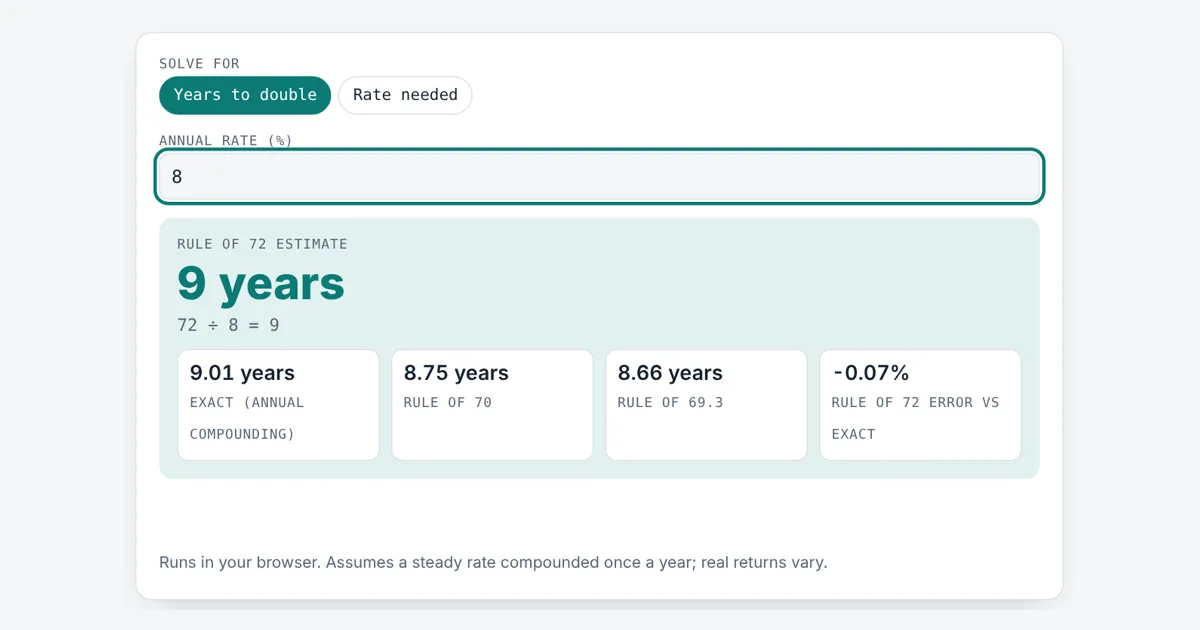
This rule of 72 calculator is for savers, investors and students who want a fast doubling time without a spreadsheet. It gives the quick mental maths answer, then shows the exact answer from logarithms, the rule of 70 and the rule of 69.3, so you can see how close the shortcut really is.
How Does the Rule of 72 Work?
The rule of 72 says money doubles in about 72 divided by the yearly interest rate. At 8% a year, 72 ÷ 8 = 9 years. The exact answer with yearly compounding is ln(2) ÷ ln(1.08) = 9.01 years, so the shortcut is off by less than 0.1%. It works best for rates between 6% and 10%.
What Is the Exact Formula for Doubling Time?
The exact doubling time with yearly compound interest is t = ln(2) ÷ ln(1 + r), where r is the rate as a decimal and ln is the natural logarithm.
rule of 72: t ≈ 72 ÷ rate %
rule of 70: t ≈ 70 ÷ rate %
rule of 69.3: t ≈ 69.3 ÷ rate %
Because ln(2) is about 0.693, the “true” constant for very small rates or continuous compounding is 69.3. The number 72 is used because it gives better answers at everyday rates and because it divides evenly by 1, 2, 3, 4, 6, 8, 9 and 12. Italian mathematician Luca Pacioli described the rule in his 1494 book Summa de arithmetica. To see the full growth curve, use the compound interest calculator.
How Accurate Is the Rule of 72?
The rule of 72 is within about 1% of the exact answer for rates from 6% to 10%, within about 2% from 4% to 12%, and almost perfect near 8%.
| Rate | Rule of 72 | Rule of 70 | Rule of 69.3 | Exact (yearly) |
|---|---|---|---|---|
| 1% | 72 | 70 | 69.3 | 69.66 |
| 2% | 36 | 35 | 34.65 | 35 |
| 3% | 24 | 23.33 | 23.1 | 23.45 |
| 4% | 18 | 17.5 | 17.32 | 17.67 |
| 6% | 12 | 11.67 | 11.55 | 11.9 |
| 8% | 9 | 8.75 | 8.66 | 9.01 |
| 10% | 7.2 | 7 | 6.93 | 7.27 |
| 12% | 6 | 5.83 | 5.77 | 6.12 |
| 20% | 3.6 | 3.5 | 3.46 | 3.8 |
All figures are years. At low rates the rule of 70 is closer, and at high rates such as 20% every shortcut runs short.
When Should You Use the Rule of 70 Instead of 72?
Use the rule of 70 for low rates of about 1% to 3%, such as inflation or population growth, and the rule of 72 for typical savings and investment returns.
Economists often quote the rule of 70: at 2% inflation, prices double in about 35 years, which matches the exact answer. The same idea works in reverse for losses. At 3% inflation, money loses half its buying power in about 23 to 24 years. For one off growth between two values, the percentage increase calculator is handy, and the APY calculator turns a quoted rate into its yearly yield. Past returns do not promise future ones.
Worked Example
An investor expects 8% a year and wants to know when 10,000 becomes 20,000. Enter 8: the tool shows 9 years by the rule of 72 and 9.01 years exactly, so the shortcut is just 0.07% short. The rule of 70 says 8.75 years and the rule of 69.3 says 8.66 years. Switching to Rate needed and typing 10 years gives 7.2% a year by the rule of 72, while the exact rate is 7.18%.
How Do You Use the Rule of 72 Calculator?
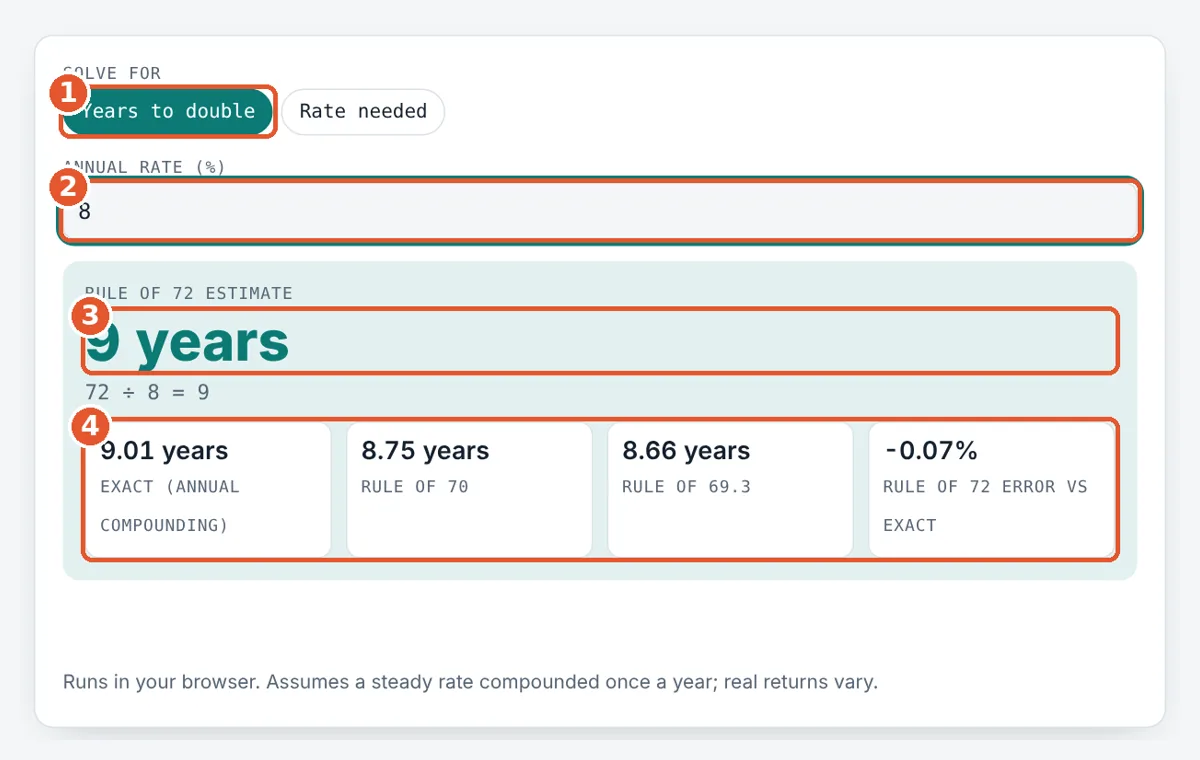
Choose what to solve
Pick Years to double to enter a rate, or Rate needed to enter a number of years.
Enter the rate or years
Type the yearly rate as a percent, such as 8, or the number of years you have.
Read the rule of 72 answer
The big number is 72 divided by your input, the quick mental maths answer.
Compare with exact maths
The boxes show the exact answer, the rules of 70 and 69.3, and how far off 72 is.
Frequently Asked Questions
How long does it take to double money at 6%?
At 6% a year the rule of 72 gives 72 ÷ 6 = 12 years. The exact answer with yearly compounding is 11.9 years, so the rule is about one month too long.
What interest rate doubles money in 5 years?
By the rule of 72 you need 72 ÷ 5 = 14.4% a year. The exact rate is about 14.87%, because the shortcut gets less accurate at higher rates. Few safe investments pay that much.
Why is it 72 and not 70?
72 gives closer answers for common rates between about 6% and 10%, and it divides neatly by many small numbers. The rule of 70 is more accurate for low rates such as 1% to 3%.
Can the rule of 72 be used for inflation?
Yes. Divide 72 by the inflation rate to see how long it takes prices to double or money to lose half its value. At 3% inflation that is 72 ÷ 3 = 24 years, close to the exact 23.45.
What is the rule of 114 and 144?
They work the same way for tripling and quadrupling. Divide 114 by the rate to estimate tripling time and 144 for quadrupling. At 8%, money triples in about 14.25 years and quadruples in about 18 years.
Does the rule of 72 work with monthly compounding?
It is still a good guide. At 8% compounded monthly the exact doubling time is about 8.69 years, between the rule of 72 answer of 9 and the rule of 69.3 answer of 8.66.
Sources and Further Reading
- Investor.gov (SEC): Compound interest calculator
- Wikipedia: Rule of 72
- US Bureau of Labor Statistics: Consumer Price Index
Related Tools
Last reviewed: October 2026