Convert a calendar date into the Julian codes used on food packaging and in the military, plus the astronomical Julian Day Number. Or type a code to get the calendar date back.
Runs in your browser. Nothing you type is sent anywhere.
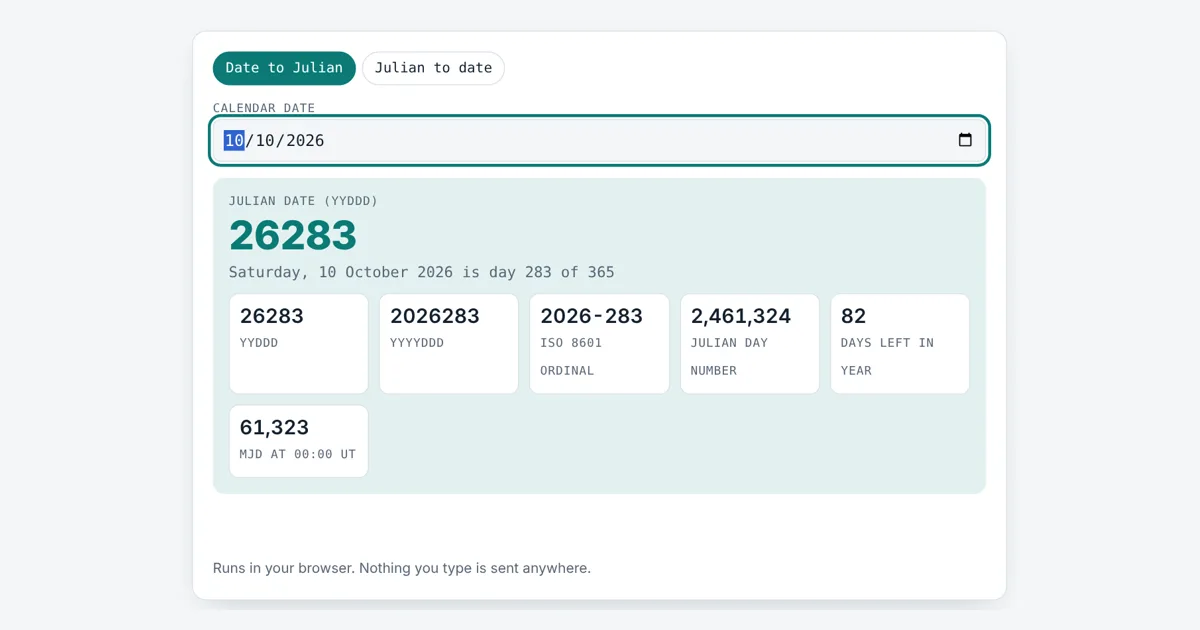
This julian date converter is for warehouse and food workers reading pack codes, military and logistics staff, programmers and astronomy students. It gives the day of the year as YYDDD and YYYYDDD, the ISO 8601 ordinal date, and the Julian Day Number, and it works in both directions.
How Do You Convert a Julian Date to a Calendar Date?
Split the code into year and day of year, then count that many days from 1 January. In YYDDD code 26283, 26 means 2026 and 283 means the 283rd day, which is 10 October 2026. Astronomers use a different Julian Day Number, a running day count, where 10 October 2026 is 2,461,324.
What Is a Julian Date on Food Packaging?
On food packaging, a Julian date is the year followed by the day of the year from 001 to 366, so 26283 means day 283 of 2026, which is 10 October 2026.
This style is properly called an ordinal date. Factories use it because a short code is easy to print and sort. The 5 digit form is YYDDD (2 digit year, 3 digit day) and the 7 digit form is YYYYDDD. Some packers print only the last digit of the year, such as 6283, so check the full label. The US military also writes dates this way on documents and supply records. ISO 8601, the international date standard, writes the same ordinal date as 2026-283.
What Is the Difference Between a Julian Date and a Julian Day Number?
A Julian date in industry is a day of the year, while the astronomical Julian Day Number is a single running count of days since 1 January 4713 BC in the Julian calendar.
Astronomers use the Julian Day Number, proposed from the Julian period of Joseph Scaliger, so they can subtract any two dates without worrying about months or calendars. The US Naval Observatory gives JDN 2,451,545 for 1 January 2000, and 10 October 2026 is 2,461,324. A Julian day starts at noon UT, so the full Julian Date at midnight is the number minus 0.5. The Modified Julian Date (MJD) subtracts 2,400,000.5 to give a shorter number, 61,323 at 00:00 UT on 10 October 2026.
YYDDD = last 2 digits of year, then day of year padded to 3 digits
JDN = days since 1 January 1970 + 2,440,588
MJD at 00:00 UT = JDN − 2,400,001
What Are the Julian Dates for 2026?
In 2026 the Julian dates run from 26001 on 1 January to 26365 on 31 December, because 2026 is a common year with 365 days. The table shows results from this tool. In a leap year such as 2024 or 2028, add 1 to every day after 28 February.
| Date | YYDDD | Julian Day Number |
|---|---|---|
| 1 Jan 2026 | 26001 | 2,461,042 |
| 31 Jan 2026 | 26031 | 2,461,072 |
| 14 Feb 2026 | 26045 | 2,461,086 |
| 28 Feb 2026 | 26059 | 2,461,100 |
| 1 Mar 2026 | 26060 | 2,461,101 |
| 30 Jun 2026 | 26181 | 2,461,222 |
| 4 Jul 2026 | 26185 | 2,461,226 |
| 10 Oct 2026 | 26283 | 2,461,324 |
| 31 Dec 2026 | 26365 | 2,461,406 |
To find the gap between two Julian codes in days, convert both and use the days between dates calculator. Computer systems often store dates as seconds instead, which the unix timestamp converter handles, and the day of the week calculator shows the weekday for any date.
Worked Example
A store manager finds the code 26283 on a box of canned beans. Tap Julian to date, type 26283 and keep YYDDD as the type. The tool shows Saturday, 10 October 2026, day 283 of 365, with 82 days left in the year. Switch to Date to Julian and pick 10 October 2026 to go the other way: the tool shows YYDDD 26283, YYYYDDD 2026283, ISO 8601 ordinal 2026-283 and the astronomical Julian Day Number 2,461,324. Typing the JDN 2451545 with Julian Day Number selected gives Saturday, 1 January 2000.
How Do You Use the Julian Date Converter?
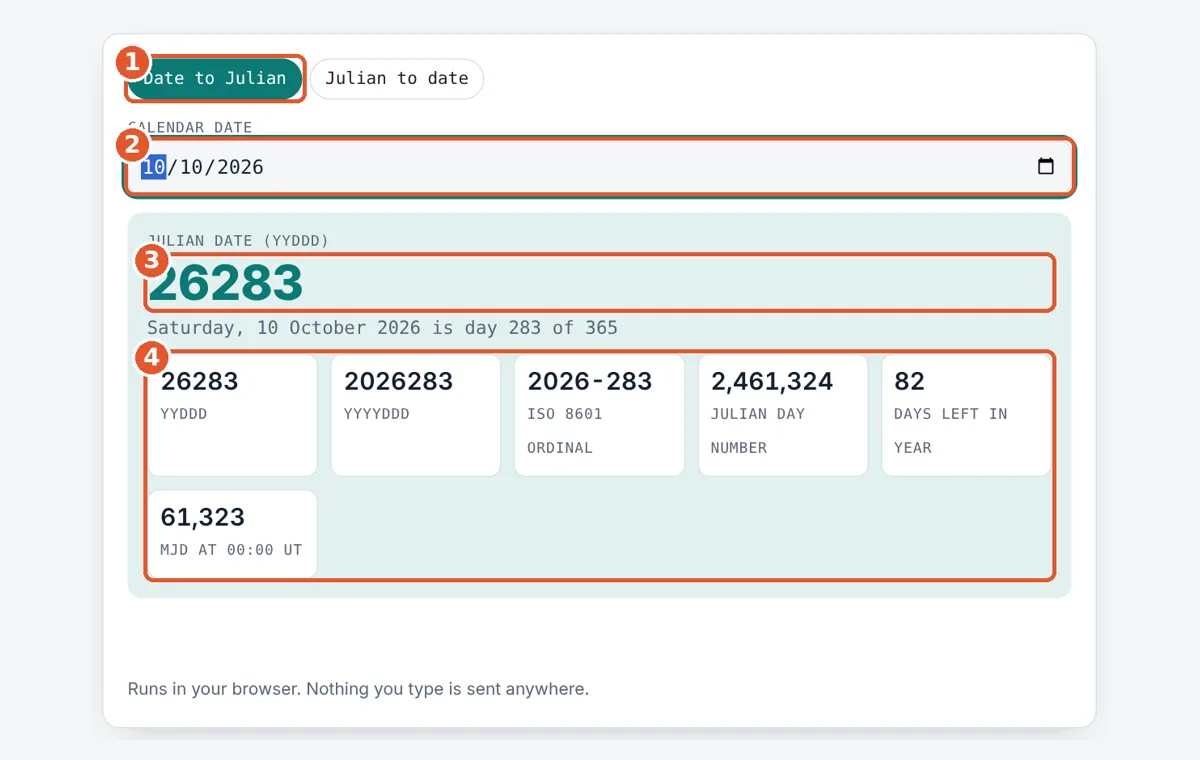
Choose the direction
Tap Date to Julian or Julian to date.
Enter the date or code
Pick a calendar date, or type a Julian code and choose its type.
Read the main result
See the YYDDD code or the calendar date with the weekday.
Check the other formats
Use YYYYDDD, ISO 8601, Julian Day Number, days left and MJD below.
Frequently Asked Questions
What does Julian date 26001 mean?
26001 means day 1 of 2026, which is Thursday, 1 January 2026. The first two digits are the year and the last three are the day of the year, counted from 001 on 1 January.
What day of the year is 31 December?
31 December is day 365 in a common year such as 2026, and day 366 in a leap year such as 2024 or 2028. So its YYDDD code is 26365 in 2026 and 24366 in 2024.
How do I read a 4 digit Julian code like 6283?
Some packers print only the last digit of the year. 6283 means day 283 of a year ending in 6, most likely 2026, which is 10 October. Use the YYYYDDD option with 2026283 to confirm the date.
How does the tool read the year in a YYDDD code?
Two digit years from 00 to 69 are read as 2000 to 2069, and 70 to 99 as 1970 to 1999. If your code is older or newer, use the 7 digit YYYYDDD option with the full year instead.
What is the Julian Day Number for today?
It depends on the date. For 10 October 2026 it is 2,461,324, and it goes up by exactly 1 each day. Pick any date in Date to Julian mode to see its number.
Is a Julian date the same as the Julian calendar?
No. The Julian calendar is the older calendar of Julius Caesar, with a leap year every 4 years. A Julian date on a package is just the day of the year in the normal Gregorian calendar.
Sources and Further Reading
- US Naval Observatory: Julian Date Converter
- ISO: ISO 8601 date and time format
- Wikipedia: Julian day
- Wikipedia: Ordinal date
Related Tools
Last reviewed: October 2026