Enter what you spend, what you have invested and what you save each year. You get your FI number and an estimate of how many years until you reach it.
Runs in your browser. An estimate in today’s money, not financial advice. Returns are not guaranteed.
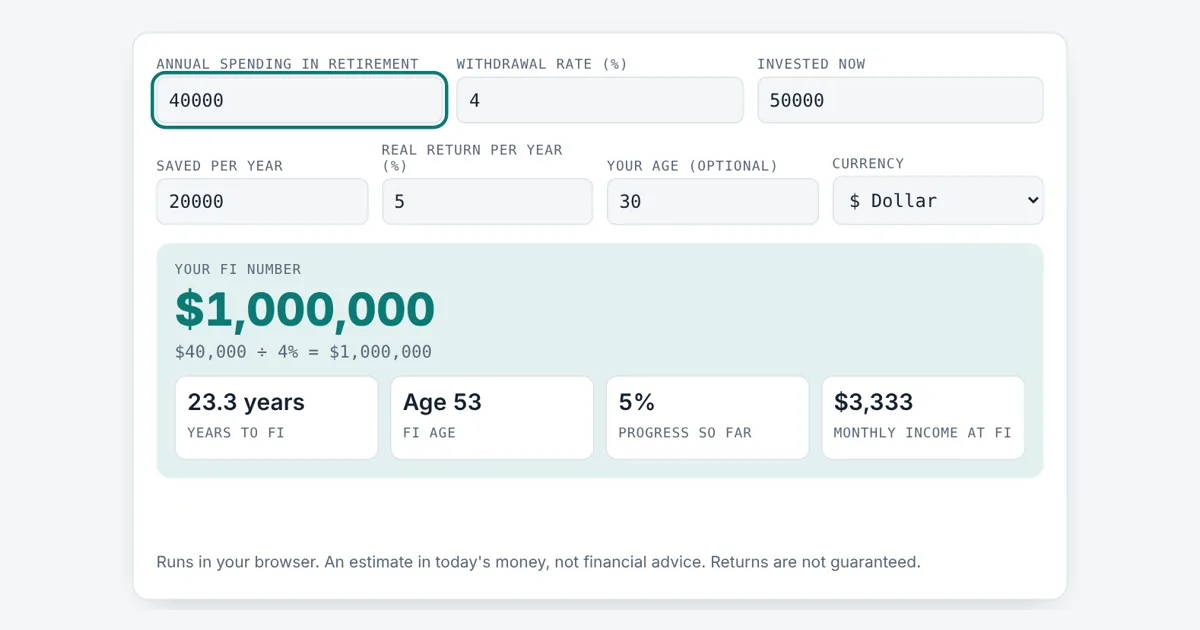
This fire calculator is for people who want to know when work could become optional. It uses the idea behind the FIRE movement, short for financial independence, retire early: once your investments are big enough to cover your spending, you are financially independent. You get your target number, the years to reach it, your age at that point and how far along you are.
How Do You Calculate Your FIRE Number?
Your FIRE number is your yearly spending divided by your withdrawal rate. At the common 4% rate that is the same as spending times 25. For example, $40,000 a year divided by 4% gives $1,000,000. Saving $20,000 a year from $50,000 at a 5% real return reaches that in about 23.3 years.
What Is the 4% Rule in FIRE?
The 4% rule says you can withdraw 4% of your portfolio in the first year of retirement, then raise that amount with inflation each year, and historically the money lasted at least 30 years in most cases.
It comes from financial planner William Bengen‘s 1994 research and the 1998 Trinity study by three professors at Trinity University, which tested withdrawal rates against US stock and bond returns from 1926 to 1995. The 4% figure is called a safe withdrawal rate, but it was tested on 30 year retirements. Many people who retire early pick 3% to 3.5% because their money may need to last 40 to 50 years.
years to FI: n = ln((F × r + S) ÷ (P × r + S)) ÷ ln(1 + r)
F = FI number, P = invested now, S = saved per year, r = real return
How Much Do I Need to Retire Early?
You need about 25 times your yearly spending at a 4% withdrawal rate, or about 28.6 times at 3.5% and 33.3 times at 3%.
| Yearly spending | FI number at 4% | At 3.5% | At 3% |
|---|---|---|---|
| $30,000 | $750,000 | $857,143 | $1,000,000 |
| $40,000 | $1,000,000 | $1,142,857 | $1,333,333 |
| $50,000 | $1,250,000 | $1,428,571 | $1,666,667 |
| $60,000 | $1,500,000 | $1,714,286 | $2,000,000 |
| $80,000 | $2,000,000 | $2,285,714 | $2,666,667 |
Cutting spending works twice: it lowers the FI number and frees more money to save. To set a monthly saving target, try the savings goal calculator.
What Return Should I Use in a FIRE Calculator?
Use a real return, which is the investment return after inflation, so every number stays in today’s money.
If you expect 7% growth and 2% inflation, the real return is about 5%. The years to FI assume you save the same amount each year, added at the end of the year, and that returns are steady, which real markets never are. A bad run of years early in retirement, called sequence of returns risk, is the main reason the 4% rule can fail. The compound interest calculator shows year by year growth if you want to test other returns. This tool gives estimates, not financial advice, and taxes and fees are not included.
Worked Example
Alex is 30, spends $40,000 a year, has $50,000 invested and saves $20,000 a year. With a 4% withdrawal rate and a 5% real return, the tool shows an FI number of $1,000,000, about 23.3 years to get there and an FI age of 53. Alex is 5% of the way. Raising savings to $30,000 a year cuts the wait to 18.5 years. Choosing a more careful 3.5% withdrawal rate lifts the target to $1,142,857 and the wait to 25.3 years.
How Do You Use the FIRE Calculator?
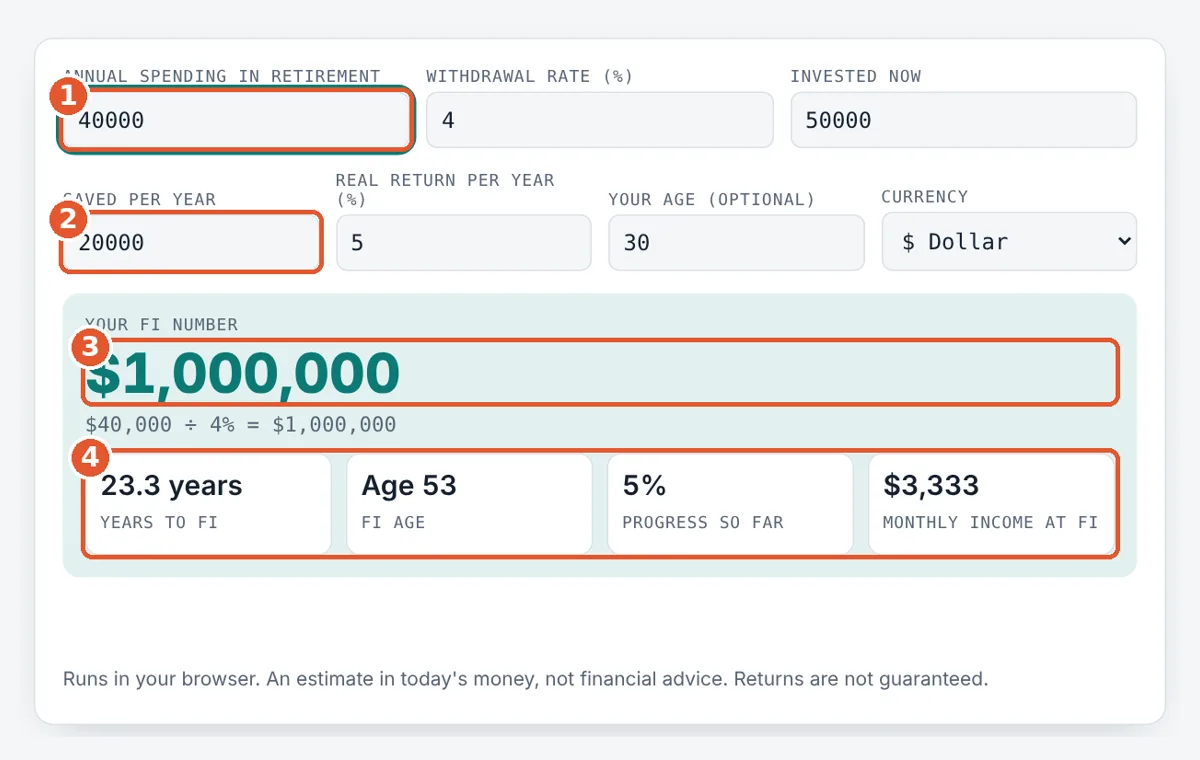
Enter spending and withdrawal rate
Type what you expect to spend each year in retirement and a withdrawal rate. 4% is the classic choice, 3% to 3.5% is more careful.
Enter savings and return
Add what you have invested now, what you save each year and a real return after inflation, such as 5%.
Read your FI number
The big number is your spending divided by the withdrawal rate: the portfolio you need.
Check years and age
The boxes show the years to FI, your age then, progress so far and the monthly income the target supports.
Frequently Asked Questions
What does FIRE stand for?
FIRE stands for financial independence, retire early. The goal is to build investments large enough that withdrawing about 3% to 4% a year covers your living costs, so paid work becomes a choice rather than a need.
How long does it take to reach FIRE starting from zero?
It depends mostly on your savings rate. Starting from $0 with a 5% real return, saving $20,000 a year reaches $1,000,000 in about 25.7 years, while saving $40,000 a year takes about 16.6 years.
What is Lean FIRE and Fat FIRE?
Lean FIRE means retiring on a small budget, such as $30,000 a year, which needs about $750,000 at 4%. Fat FIRE means a large budget, such as $100,000 a year, which needs about $2,500,000 at the same rate.
Is the 4% rule still safe?
Nobody can promise it. It held up in most past 30 year periods in US data, but future returns may be lower and early retirees need money for longer. Using 3.5% and keeping some spending flexible lowers the risk.
Should I include my home in my FIRE number?
Usually not. Your FI number is the invested money that pays for living costs, and a home you live in does not produce cash. A paid off home does lower your yearly spending, which lowers the number you need.
Does this FIRE calculator include taxes?
No. Enter spending as the amount you need after tax, and remember that withdrawals from some accounts are taxed. If you expect 15% tax on withdrawals, $40,000 of spending needs about $47,059 of withdrawals.
Sources and Further Reading
- Wikipedia: Trinity study (Cooley, Hubbard and Walz, 1998)
- Wikipedia: FIRE movement
- US Bureau of Labor Statistics: Consumer Price Index
- Investor.gov (SEC): Compound interest calculator
Related Tools
Last reviewed: October 2026