Enter your weight, height and body fat percentage to see how much lean mass you carry for your height. You get FFMI, the height-adjusted normalized FFMI, lean and fat mass.
Runs in your browser. Nothing you type is sent anywhere.
This ffmi calculator is for lifters, athletes and anyone tracking body composition who wants a better muscle measure than BMI. It turns your weight, height and body fat into a fat-free mass index, a normalized score for comparing people of different heights, and your fat mass index.
How Do You Calculate Your FFMI?
FFMI equals your fat-free mass in kilograms divided by your height in metres squared. For example, an 80 kg man who is 1.75 m tall with 15% body fat has 68 kg of fat-free mass. 68 divided by 1.75 squared gives an FFMI of 22.2, and the normalized FFMI is 22.5.
What Is FFMI?
FFMI, the fat-free mass index, is your fat-free mass in kilograms divided by your height in metres squared. Fat-free mass is everything that is not fat: muscle, bone, organs and water. FFMI works like BMI but ignores fat, so it shows how much lean tissue you carry for your height. Its partner, the fat mass index (FMI), does the same for fat. The two were proposed as a pair by VanItallie and colleagues in 1990 to describe nutrition status better than BMI alone.
How Do You Calculate FFMI and Normalized FFMI?
You calculate FFMI by multiplying weight by (1 minus body fat as a decimal), then dividing by height in metres squared.
FFMI = fat-free mass ÷ height(m)²
normalized FFMI = FFMI + 6.1 × (1.8 − height(m))
Normalized FFMI adjusts the score to a height of 1.8 m, because taller people tend to score a little lower for the same build. The correction comes from the Kouri et al. 1995 study of 157 male athletes. The paper’s text uses 6.1, while its abstract quotes 6.3; this tool uses 6.1, the value most researchers apply. The result depends heavily on your body fat number, so a reading from DEXA (a low dose X-ray scan) or a careful tape method is better than a guess.
What Is a Good FFMI for Men and Women?
A typical young adult has an FFMI of about 19 for men and 15 for women, based on a Swiss study of 5,635 healthy adults that found medians of 18.9 and 15.4. Regular strength trainers usually sit a few points higher. Example results from this tool:
| Person | Body fat | FFMI | Normalized |
|---|---|---|---|
| Woman 55 kg, 160 cm | 28% | 15.5 | 16.7 |
| Woman 65 kg, 170 cm | 22% | 17.5 | 18.2 |
| Man 70 kg, 180 cm | 20% | 17.3 | 17.3 |
| Man 80 kg, 175 cm | 15% | 22.2 | 22.5 |
| Man 90 kg, 180 cm | 10% | 25.0 | 25.0 |
Is an FFMI of 25 the Natural Limit?
An FFMI of 25 is a rough upper range seen in drug-free men, not a hard limit. In the Kouri study, no non-user went above a normalized score of 25.0, while many steroid users did, and some topped 30. However, the sample was small, and a few natural athletes with great genetics do exceed 25. The cut-off was never studied in women.
If you do not know your body fat, estimate it first with the body fat calculator or the tape-based navy body fat calculator. To see lean mass from height and weight alone, try the lean body mass calculator. FFMI is an estimate for fitness tracking, not a medical test.
Worked Example
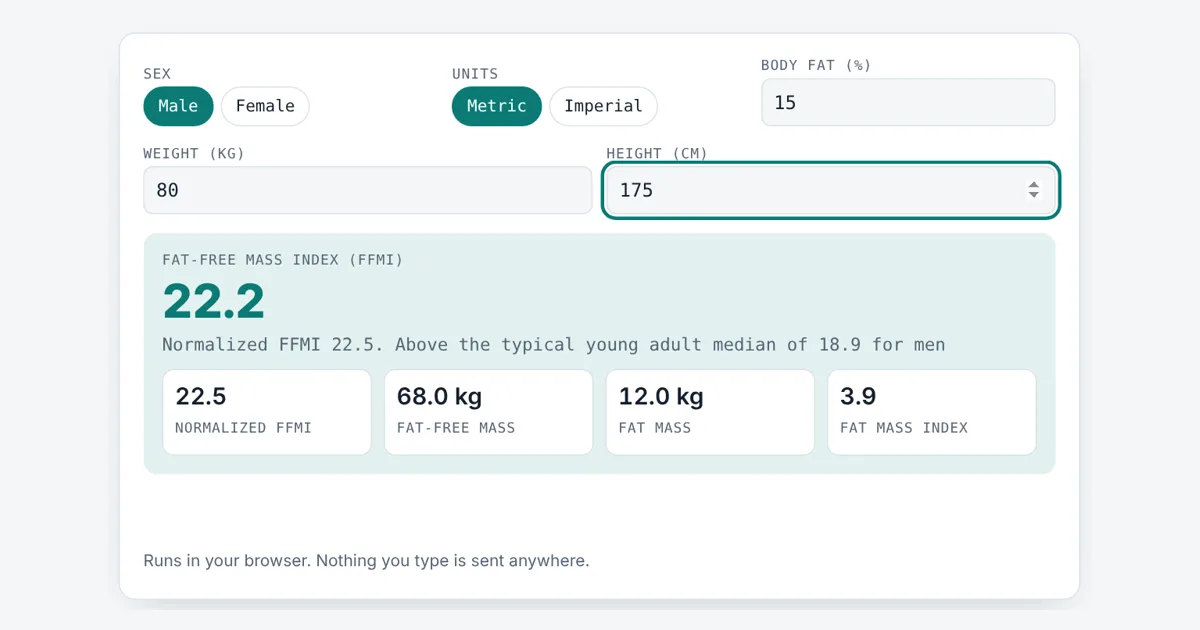
Jon is a man who weighs 80 kg, is 175 cm tall and has 15% body fat from a DEXA scan. The tool shows an FFMI of 22.2 and a normalized FFMI of 22.5, with 68.0 kg of fat-free mass, 12.0 kg of fat and a fat mass index of 3.9. In Imperial, a man at 180 lb, 5 ft 10 in and 12% body fat gets an FFMI of 22.7 (normalized 22.9) and 158.4 lb of fat-free mass.
How Do You Use the FFMI Calculator?
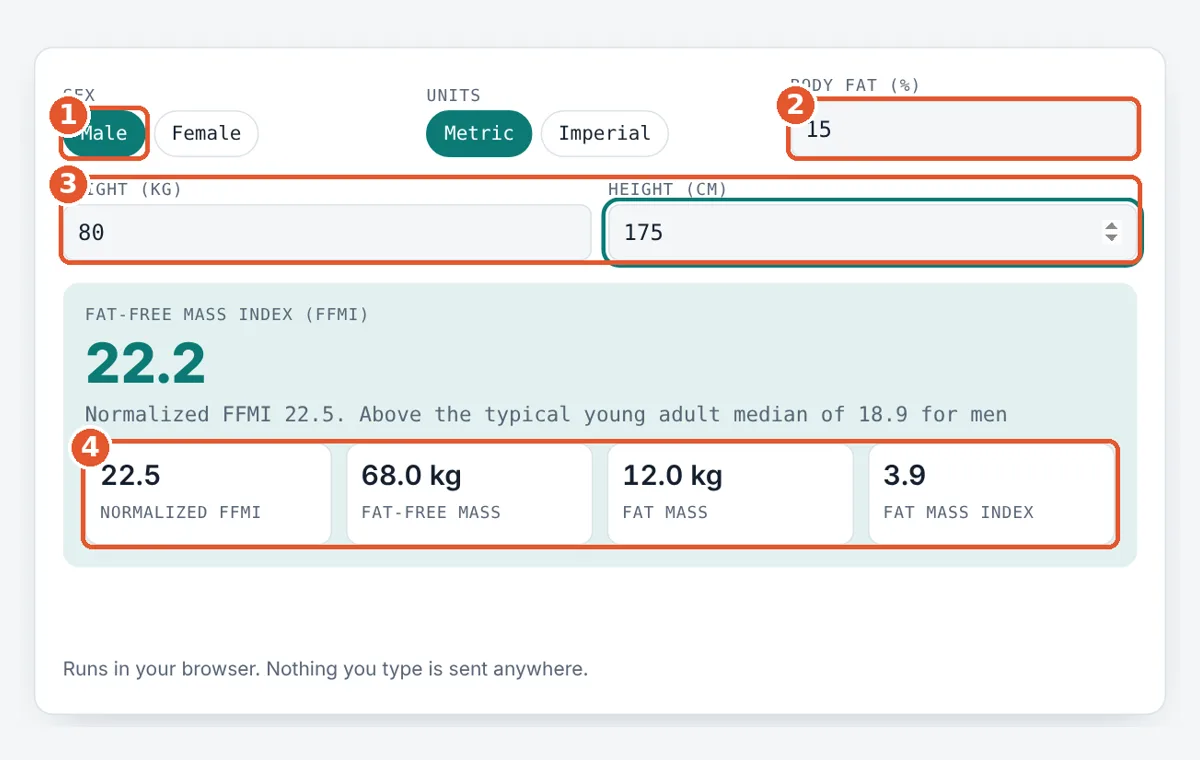
Pick sex and units
Tap Male or Female and choose Metric or Imperial.
Enter body fat
Type your body fat percentage from a scan, calipers or a tape method.
Add weight and height
Fill in weight and height. Results update as you type.
Read your FFMI
The big number is FFMI. The boxes show normalized FFMI, fat-free mass, fat mass and fat mass index.
Frequently Asked Questions
What is the difference between FFMI and BMI?
BMI divides total weight by height squared, so muscle and fat count the same. FFMI only counts fat-free mass, so a muscular person with low fat scores high on FFMI while their BMI may wrongly label them overweight.
What FFMI is considered muscular?
For men, an FFMI around 22 to 23 usually reflects a clearly trained, muscular build, and 24 to 25 is near the top of what most drug-free lifters reach. For women, scores of about 18 to 20 reflect a lot of muscle.
Why does normalized FFMI use 1.8 metres?
The Kouri study adjusted every score to a height of 1.8 m so tall and short men could be compared fairly. People taller than 1.8 m get a small subtraction and shorter people get a small addition.
How accurate is FFMI?
FFMI is only as accurate as your body fat figure. A 3 point error in body fat changes FFMI by about 0.8 for an 80 kg, 175 cm man. DEXA or a lab method gives a far more trustworthy result than a bathroom scale.
Can women use the FFMI calculator?
Yes. The formula works for anyone, but the 25 cut-off from Kouri 1995 was based only on men. A Swiss study found a median FFMI of 15.4 in young women, compared with 18.9 in young men.
How much can I raise my FFMI?
Beginners who train hard and eat enough protein often add 1 to 2 FFMI points in the first year or two. Progress slows after that. Results depend on age, sex, genetics, sleep and training quality.
Sources and Further Reading
- Kouri EM, Pope HG et al. Fat-free mass index in users and nonusers of anabolic-androgenic steroids, Clin J Sport Med 1995 (PubMed)
- Schutz Y, Kyle UU, Pichard C. Fat-free mass index and fat mass index percentiles in Caucasians aged 18 to 98 y, Int J Obes 2002 (University of Lausanne record)
Related Tools
Last reviewed: October 2026