Enter two mixed numbers, pick an operation and get the answer in simplest form, as an improper fraction and as a decimal, with each step written out.
Runs in your browser. Nothing you type is sent anywhere.
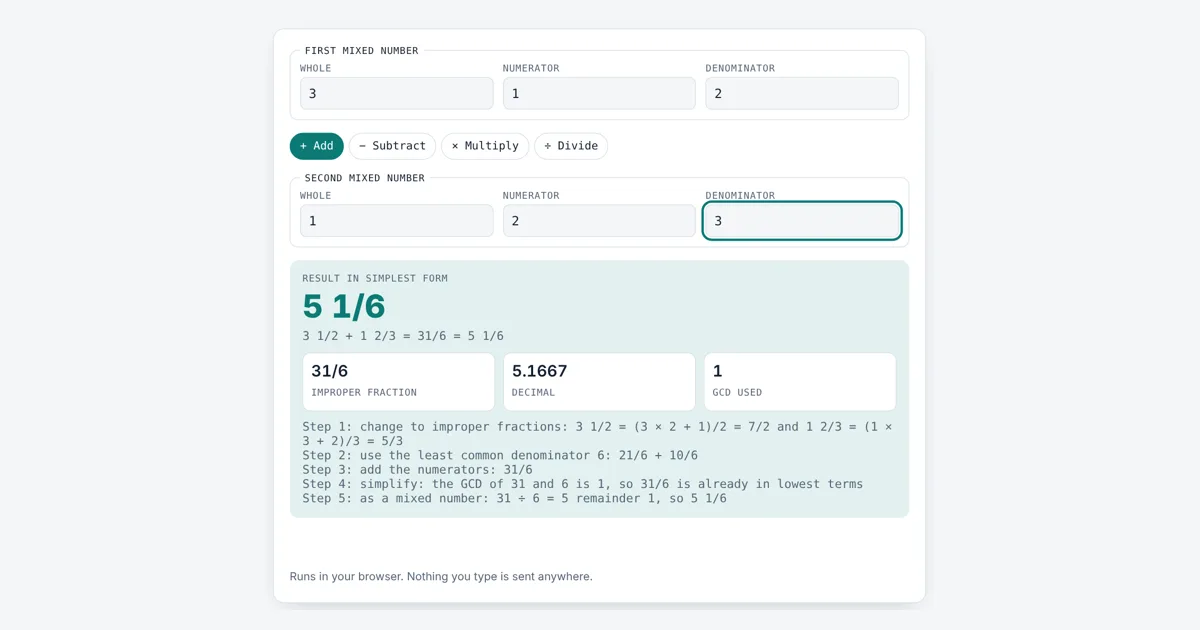
This mixed number calculator is for pupils checking fraction homework, parents helping with it, and cooks or builders who scale measurements like 3 1/2 cups or 1 2/3 feet. It adds, subtracts, multiplies and divides mixed numbers, shows the working line by line, and simplifies the answer with the greatest common divisor.
How Do You Add Mixed Numbers?
To add mixed numbers, turn each into an improper fraction, rewrite them over a common denominator, add the numerators, then simplify and convert back. For example, 3 1/2 + 1 2/3 = 7/2 + 5/3 = 21/6 + 10/6 = 31/6, and 31 ÷ 6 = 5 remainder 1, so the answer is 5 1/6.
What Is a Mixed Number?
A mixed number is a whole number and a proper fraction written together, such as 3 1/2, which means 3 + 1/2. A proper fraction has a numerator smaller than its denominator. Mixed numbers are easy to read, but for working out sums it is simpler to change them into an improper fraction, where the top is bigger than the bottom.
3 1/2 = (3 × 2 + 1) / 2 = 7/2
How Do You Subtract Mixed Numbers?
You subtract mixed numbers the same way you add them: make improper fractions, give them a common denominator, then subtract the numerators. The least common denominator is the smallest number both denominators divide into, which is the least common multiple of the two. For 3 1/2 − 1 2/3, the LCD of 2 and 3 is 6, so 21/6 − 10/6 = 11/6 = 1 5/6. Working with improper fractions avoids the borrowing step that trips many students up. To find an LCD for bigger denominators, use the LCM calculator.
How Do You Multiply and Divide Mixed Numbers?
To multiply mixed numbers, change them to improper fractions and multiply the tops and the bottoms; no common denominator is needed. So 3 1/2 × 1 2/3 = 7/2 × 5/3 = 35/6 = 5 5/6. To divide, multiply by the reciprocal of the second fraction, which means flipping it upside down: 3 1/2 ÷ 1 2/3 = 7/2 × 3/5 = 21/10 = 2 1/10. Many people remember this as “keep, change, flip”.
| Problem | Improper working | Answer |
|---|---|---|
| 3 1/2 + 1 2/3 | 21/6 + 10/6 = 31/6 | 5 1/6 |
| 3 1/2 − 1 2/3 | 21/6 − 10/6 = 11/6 | 1 5/6 |
| 3 1/2 × 1 2/3 | 7/2 × 5/3 = 35/6 | 5 5/6 |
| 3 1/2 ÷ 1 2/3 | 7/2 × 3/5 = 21/10 | 2 1/10 |
| 2 1/4 + 5/8 | 18/8 + 5/8 = 23/8 | 2 7/8 |
| 2 3/4 × 7/8 | 11/4 × 7/8 = 77/32 | 2 13/32 |
| 4 1/2 ÷ 3/4 | 9/2 × 4/3 = 36/6 | 6 |
| 1 5/8 − 2 1/4 | 13/8 − 18/8 = −5/8 | −5/8 |
How Do You Simplify the Answer?
You simplify by dividing the top and bottom by their greatest common divisor (GCD), then turning any improper fraction back into a mixed number. For 36/6 the GCD is 6, which leaves 6/1, just the whole number 6. To go from an improper fraction to a mixed number, divide: 31 ÷ 6 = 5 remainder 1, so 31/6 = 5 1/6. The tool lists the GCD it used, and the GCF calculator shows how it is found. For problems with plain fractions only, the fraction calculator works too.
Worked Example
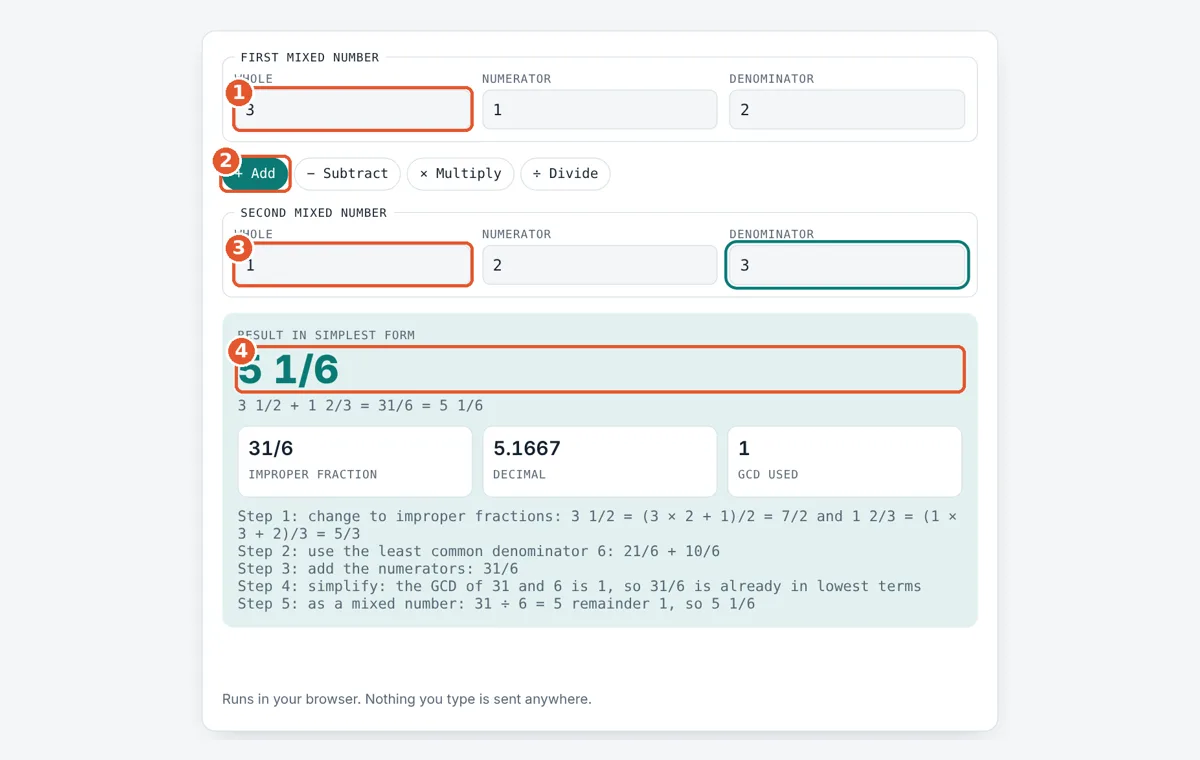
A recipe needs 3 1/2 cups of flour for the bread and 1 2/3 cups for the topping. Enter 3, 1, 2 as the first number and 1, 2, 3 as the second, then press + Add. The tool shows 5 1/6 cups, with 3 1/2 + 1 2/3 = 31/6 = 5 1/6 and a decimal of 5.1667. The steps show 7/2 and 5/3 rewritten over the LCD 6 as 21/6 + 10/6. Press ÷ Divide and the answer changes to 2 1/10, so the bread uses a little over twice as much flour as the topping.
How Do You Use the Mixed Number Calculator?
Enter the first mixed number
Type the whole number, numerator and denominator. Leave Whole empty for a plain fraction.
Pick the operation
Choose Add, Subtract, Multiply or Divide.
Enter the second mixed number
Fill in the second whole number and fraction. The answer updates as you type.
Read the simplest answer
The big result is the simplest mixed number; the boxes show the improper fraction, decimal and GCD.
Frequently Asked Questions
How do you convert a mixed number to an improper fraction?
Multiply the whole number by the denominator, add the numerator, and put the total over the same denominator. For 2 3/4, that is 2 × 4 + 3 = 11, so 2 3/4 = 11/4.
What is 2 1/4 plus 5/8?
2 1/4 + 5/8 = 2 7/8. Change 2 1/4 to 9/4, then to 18/8 so both have the denominator 8. Adding gives 18/8 + 5/8 = 23/8, and 23 ÷ 8 = 2 remainder 7.
Can the answer be negative?
Yes. If you subtract a larger mixed number from a smaller one, the result is negative. For example, 1 5/8 − 2 1/4 = 13/8 − 18/8 = −5/8. To enter a negative mixed number, put the minus sign on the whole number.
Do I need a common denominator to multiply mixed numbers?
No. A common denominator is only needed to add or subtract. To multiply, change both to improper fractions and multiply straight across: 2 3/4 × 7/8 = 11/4 × 7/8 = 77/32 = 2 13/32.
Why can I not divide by zero?
Dividing by 0 has no answer, because no number times 0 gives a non-zero result. A second number of 0 has no reciprocal to flip, so the tool shows an error instead of a result.
How do I enter a whole number or a plain fraction?
For a whole number such as 4, type 4 in Whole and leave the fraction boxes empty. For a plain fraction such as 3/4, leave Whole empty and fill in only the numerator and denominator.
Sources and Further Reading
- Wikipedia: Fraction (mixed numbers and arithmetic)
- Wolfram MathWorld: Mixed Fraction
- Wikipedia: Lowest common denominator
Related Tools
Last reviewed: October 2026