Work out your five heart rate training zones in beats per minute. Choose a maximum heart rate formula or enter a tested value, add your resting heart rate for the heart rate reserve (Karvonen) method, and see each zone instantly.
An estimate for healthy adults, not medical advice.
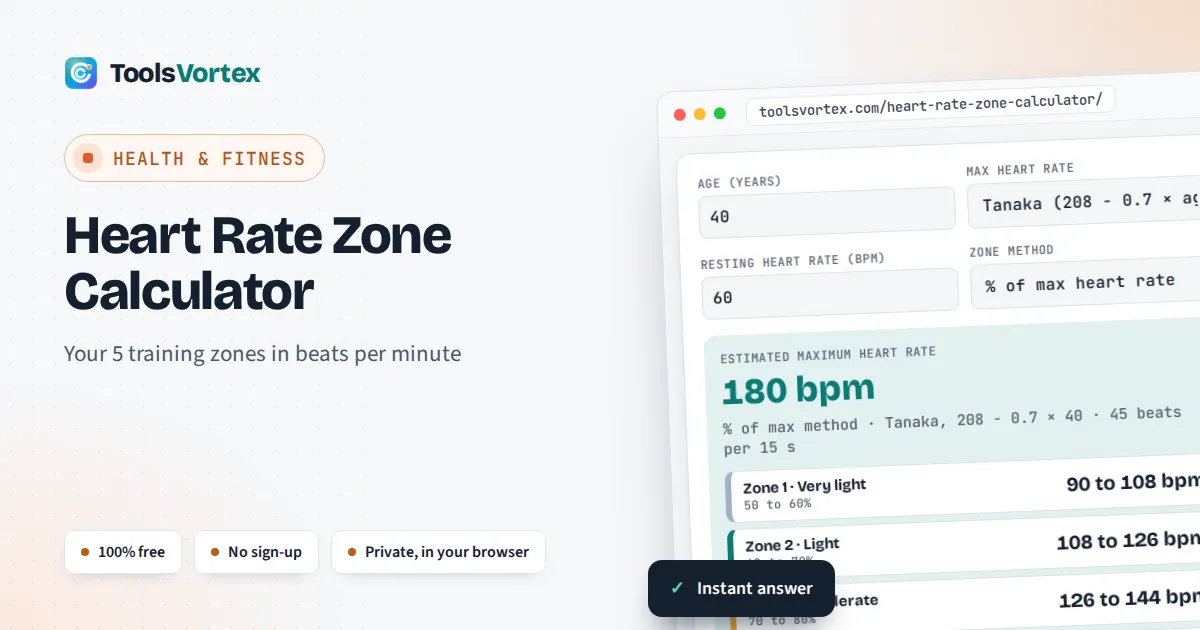
This heart rate zone calculator turns your age, or a maximum you have measured, into five training zones in beats per minute, for runners, cyclists, walkers and anyone who trains with a watch or chest strap. Zones give you a simple way to keep easy days easy and hard days hard. The tool shows which formula it used, lets you add your resting heart rate for a more personal result, and marks the moderate and vigorous bands that match UK activity guidelines.
How do you calculate heart rate zones?
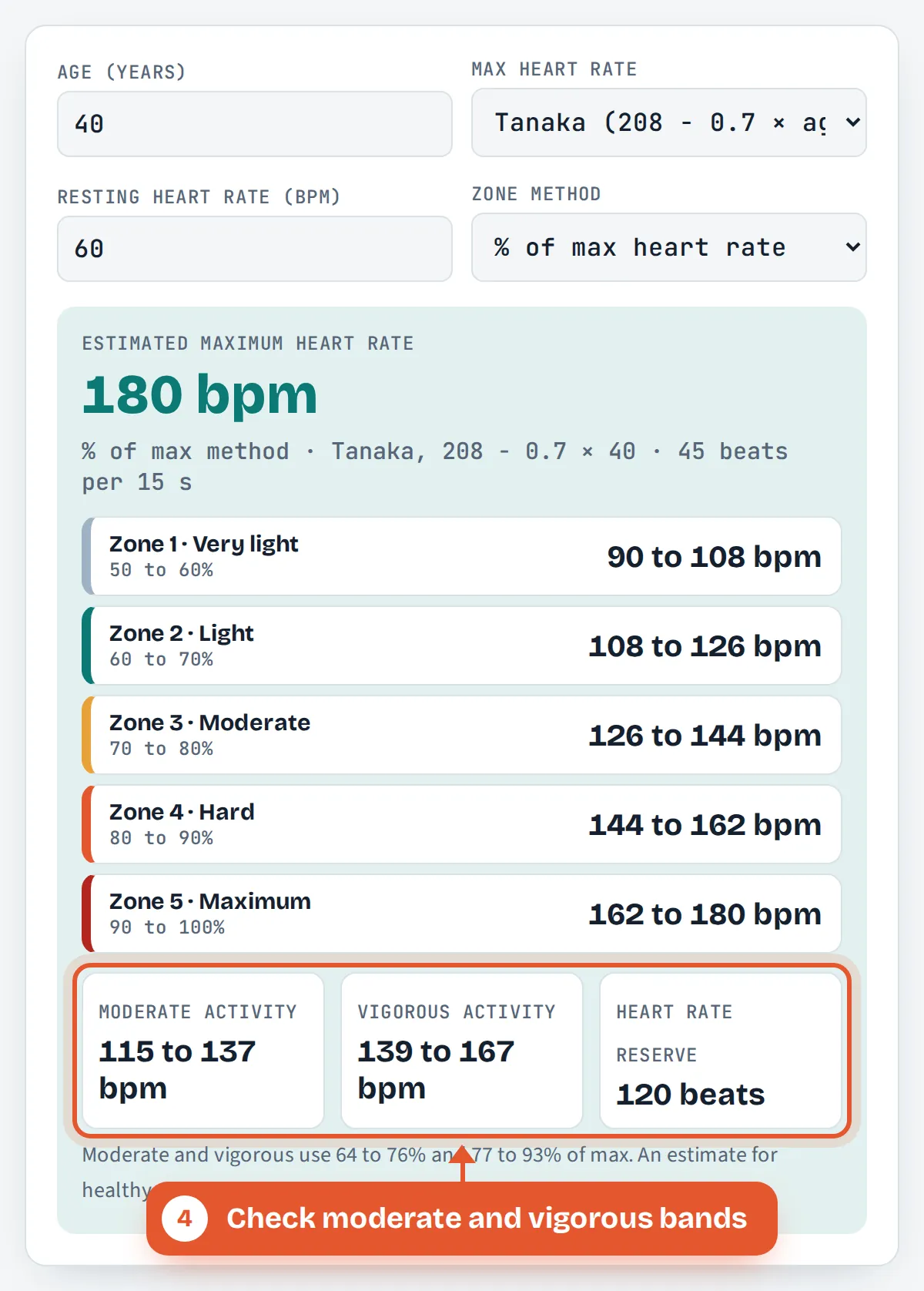
Estimate your maximum heart rate with the Tanaka formula, 208 − 0.7 × age, then take percentages of it: zone 1 is 50 to 60%, zone 2 is 60 to 70%, up to zone 5 at 90 to 100%. A heart rate zone calculator does this instantly. At age 40 your maximum is about 180 bpm, so zone 2 is 108 to 126 bpm.
Which Maximum Heart Rate Formula Is Most Accurate?
For most healthy adults the Tanaka formula is a better estimate than 220 − age. Tanaka and colleagues pooled 351 studies covering 18,712 people in 2001 and found HRmax = 208 − 0.7 × age. They concluded that the old 220 − age rule underestimates maximum heart rate in older adults. For women, Gulati and colleagues followed 5,437 healthy women aged 35 and over in the St. James Women Take Heart Project and proposed 206 − 0.88 × age, noting that 220 − age was based mainly on studies of men.
Traditional: max HR = 220 − age
Gulati, women (2010): max HR = 206 − 0.88 × age
% of max method: zone bpm = max HR × zone %
Heart rate reserve (Karvonen): zone bpm = resting HR + (max HR − resting HR) × zone %
All three are averages. A real maximum is often 10 bpm or more above or below the formula for your age, so a measured maximum always beats a formula. If you have seen a reliable peak on a chest strap during an all out effort, choose “I know my max” and enter it.
What Are the Five Heart Rate Zones?
The five zone model splits your range into bands of 10 percentage points, from 50% of maximum up to 100%. This table shows the estimated maximum by age for each formula, plus the moderate and vigorous bands based on Tanaka:
| Age | Tanaka | 220 − age | Gulati (women) | Moderate 64 to 76% | Vigorous 77 to 93% |
|---|---|---|---|---|---|
| 20 | 194 | 200 | 188 | 124 to 147 | 149 to 180 |
| 30 | 187 | 190 | 180 | 120 to 142 | 144 to 174 |
| 40 | 180 | 180 | 171 | 115 to 137 | 139 to 167 |
| 50 | 173 | 170 | 162 | 111 to 131 | 133 to 161 |
| 60 | 166 | 160 | 153 | 106 to 126 | 128 to 154 |
| 70 | 159 | 150 | 144 | 102 to 121 | 122 to 148 |
All values are in beats per minute. Zones 1 and 2 are easy enough to hold a conversation. Zone 3 feels steady but harder to talk through. Zones 4 and 5 are hard efforts you can only sustain for minutes, used in intervals and races. The often quoted “fat burning zone” is really zone 2: a larger share of the energy comes from fat at low intensity, but you burn more total calories per minute when you work harder.
How Do Heart Rate Zones Match the NHS Activity Guidelines?
The NHS asks adults aged 19 to 64 to do at least 150 minutes of moderate activity or 75 minutes of vigorous activity a week, plus strengthening on at least 2 days. Harvard Health puts moderate intensity at about 64 to 76% of maximum heart rate and vigorous at about 77 to 93%, which the calculator shows in the boxes under the zones.
Roughly, moderate covers the top of zone 2 and zone 3, and vigorous covers the top of zone 3, zone 4 and the start of zone 5. The NHS talk test is a quick check: at moderate intensity you can talk but not sing, while at vigorous intensity you cannot say more than a few words without pausing for breath.
Worked Example: What Are Priya’s Heart Rate Zones?
Priya is 45, runs three times a week and measures a resting heart rate of 62 bpm first thing in the morning.
- Tanaka: 208 − 0.7 × 45 = 176.5 bpm
- 220 − age: 220 − 45 = 175 bpm
- Gulati: 206 − 0.88 × 45 = 166.4 bpm
- Heart rate reserve (Tanaka): 176.5 − 62 = 114.5 beats
- Zone 2 with Karvonen: 62 + 114.5 × 0.60 = 131 to 62 + 114.5 × 0.70 = 142, so 131 to 142 bpm
With the simple % of max method her zone 2 would be 106 to 124 bpm. The reserve method sets it higher because it accounts for her low resting rate, which is typical of fitter people. Using the Gulati estimate instead would lower every zone by about 5 to 10 beats, so if her easy runs feel too hard at 131 to 142 bpm, the women’s formula may suit her better. Once she has a few weeks of data, she can compare the zones against how her easy, steady and hard sessions actually feel.
How Do You Measure Your Resting Heart Rate?
Measure your resting heart rate in the morning before you get out of bed, after you wake naturally. Find the pulse on your wrist or neck, count the beats for 30 seconds and double it, or read it from a watch. Take it on three or four mornings and use the average. Harvard Health gives 60 to 100 bpm as a normal resting heart rate, and well trained people are often below 60. A rising morning value over several days can be a sign of poor sleep, illness or overtraining.
When Should You Not Rely on Heart Rate Zones?
Heart rate zones are an estimate for healthy adults, not medical advice. Medicines that slow the heart, such as beta blockers, make formula based zones unreliable, so use the talk test or how hard the effort feels instead and ask your GP or cardiac rehab team for a target. Heat, dehydration, caffeine and altitude all raise your heart rate at the same pace. Speak to a doctor before starting hard exercise if you have a heart condition, high blood pressure or diabetes, or if you are pregnant.
Stop and get urgent help if you have chest pain, severe breathlessness, dizziness or a racing or irregular heartbeat. If you also track pace, the pace calculator helps you match zones to running speeds, and the walking calories burned calculator estimates the energy cost of your easy days.
How Do You Use the Heart Rate Zone Calculator?
Enter your age and formula
Type your age and pick Tanaka, 220 − age or the Gulati formula for women, or choose “I know my max”.

Add your resting heart rate
Enter your morning resting heart rate and choose % of max or the heart rate reserve method.
Read your five zones
Each zone shows its range in beats per minute, from very light zone 1 to maximum zone 5.
Check moderate and vigorous bands
The boxes below show the heart rate ranges that count as moderate or vigorous activity, plus your heart rate reserve.


Frequently Asked Questions
What is zone 2 heart rate for my age?
Zone 2 is 60 to 70% of your maximum heart rate. With the Tanaka formula that is about 112 to 131 bpm at 30, 108 to 126 bpm at 40 and 104 to 121 bpm at 50. Adding your resting heart rate with the reserve method usually moves it a little higher.
Is 220 minus age accurate?
It is a rough guide. A 2001 analysis of 18,712 people found 208 − 0.7 × age fits better, and that 220 − age underestimates maximum heart rate in older adults. Both formulas can still be 10 beats or more out for an individual.
What is the Karvonen method?
The Karvonen method uses heart rate reserve, which is your maximum minus your resting heart rate. Each zone is resting heart rate plus a percentage of that reserve. It gives higher, more personal zones for people with a low resting heart rate.
What is a normal resting heart rate?
Harvard Health gives 60 to 100 beats per minute as normal for adults. Regular endurance exercise often lowers it below 60. If yours is often outside that range for no clear reason, or you feel dizzy or faint, see your GP.
Which heart rate counts as moderate exercise?
About 64 to 76% of your maximum heart rate counts as moderate intensity and 77 to 93% as vigorous. The NHS recommends 150 minutes of moderate or 75 minutes of vigorous activity a week for adults aged 19 to 64.
Why does my watch show different zones?
Watches use their own default formulas, zone splits and sometimes your recorded peak heart rate, so numbers vary between brands. Set your watch to the same maximum and method you use here, or enter a measured maximum, to keep zones consistent.
Sources and Further Reading
- Tanaka H, Monahan KD, Seals DR. Age-predicted maximal heart rate revisited, J Am Coll Cardiol 2001 (PubMed)
- All about your heart rate, Harvard Health Publishing
- Physical activity guidelines for adults aged 19 to 64, NHS
Related Tools
Last reviewed: October 2026