Simplify a ratio, solve a proportion with a missing value, scale a ratio to a known size or share an amount in a ratio. Works with 2 to 10 parts, decimals and fractions, and shows every step.
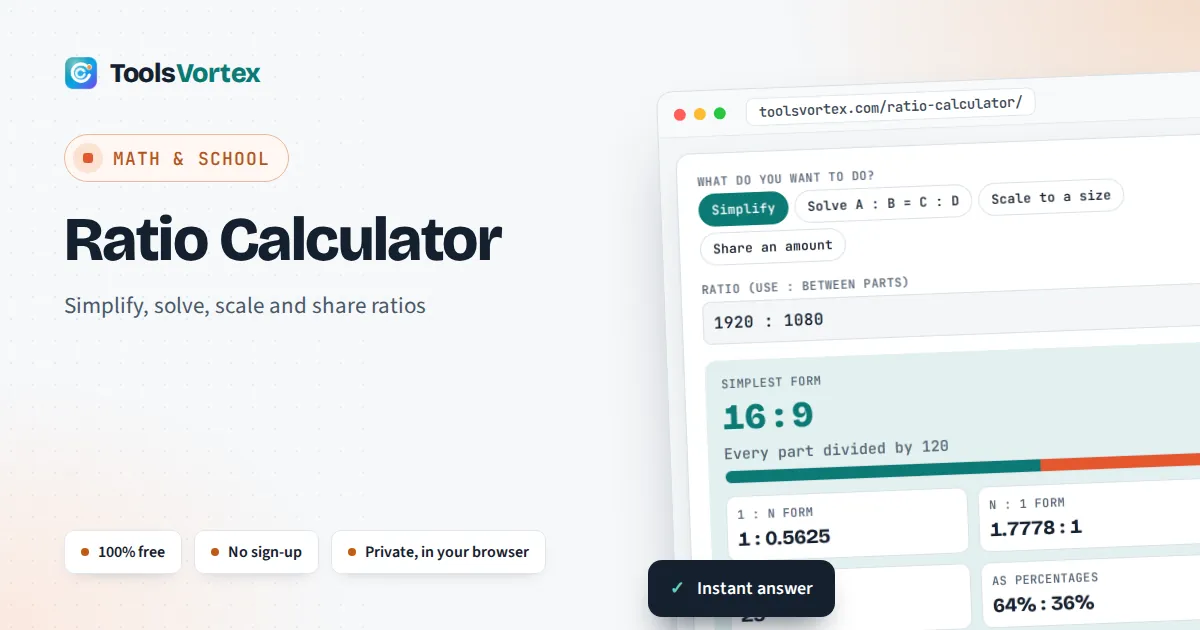
This ratio calculator simplifies ratios, solves proportions, scales a ratio up or down and shares an amount of money in a given ratio, for students, teachers, cooks, builders and anyone splitting a bill. It accepts whole numbers, decimals and fractions, handles up to 10 parts, and gives the 1 : n form, percentages and fractions of the total alongside a step by step working that matches how ratio is taught in UK and Irish schools.
How do you simplify a ratio?
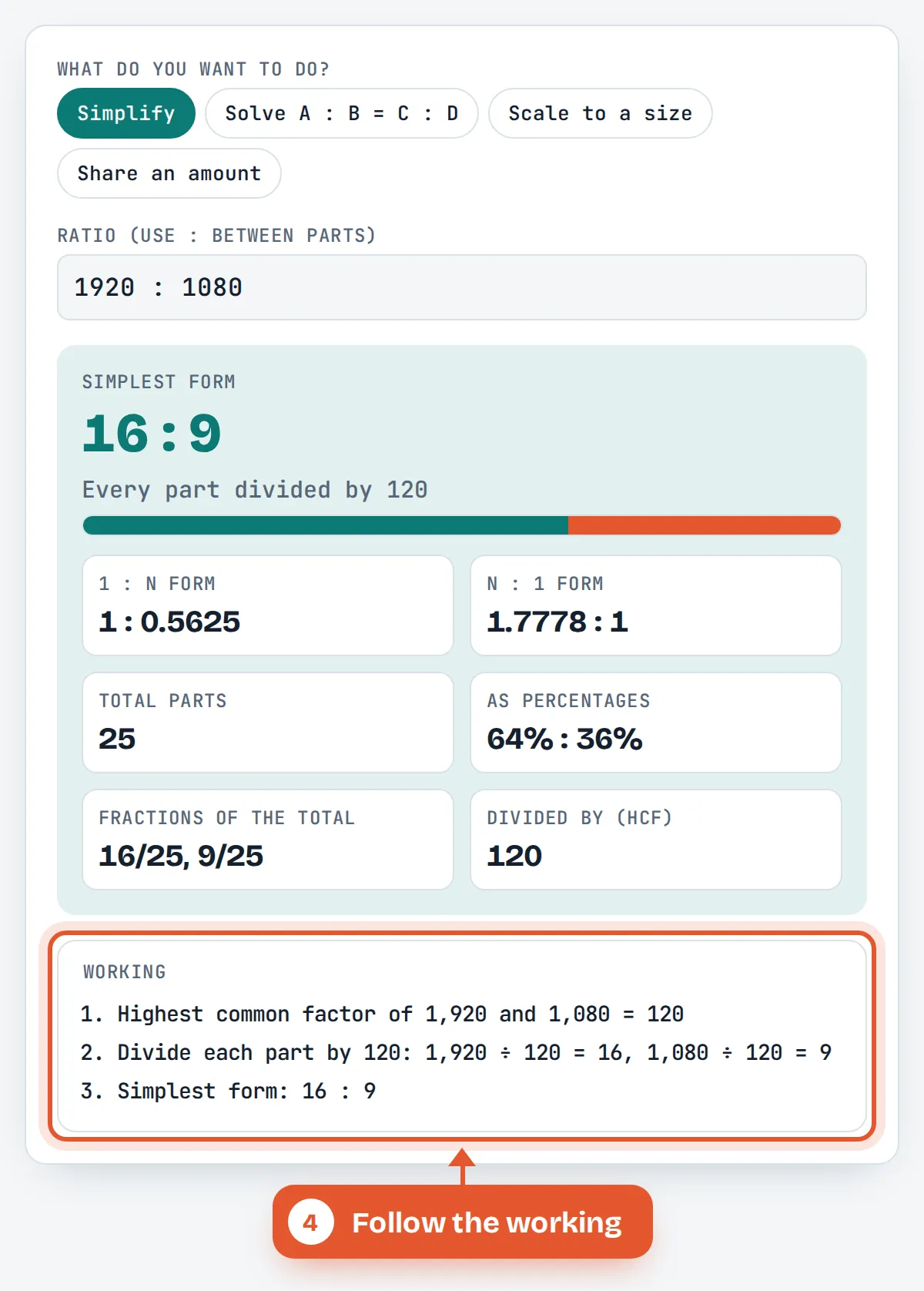
Divide every part of the ratio by their highest common factor. For 1920 : 1080 the highest common factor is 120, so it simplifies to 16 : 9. If a ratio has decimals or fractions, multiply every part by the same number to get whole numbers first. A ratio calculator does both steps automatically.
What Is a Ratio?
A ratio compares quantities by showing how many times one contains another, written a : b and read “a to b”. In a bowl of 8 oranges and 6 lemons, the ratio of oranges to lemons is 8 : 6, which simplifies to 4 : 3. That is a part to part ratio. The ratio of oranges to all the fruit is 8 : 14, or 4 : 7, which is part to whole and is the same as the fraction 4/7. Ratios can have more than two parts, such as 2 : 3 : 4, but then they no longer turn into a single fraction.
Ratios are among the oldest ideas in mathematics: Book V of Euclid’s Elements sets out 18 definitions about them. In Ireland, ratio and proportion are Junior Cycle learning outcomes N.2 and N.3, including currency conversion and speed, distance and time problems.
How Do You Solve a Proportion With a Missing Value?
Cross multiply and divide. A proportion says two ratios are equal, A : B = C : D, which means A × D = B × C. If one value is missing, multiply the two values that sit diagonally opposite each other and divide by the remaining one.
Missing D = B × C ÷ A Missing C = A × D ÷ B
Missing B = A × D ÷ C Missing A = B × C ÷ D
For 3 : 4 = 15 : D, the missing value is 4 × 15 ÷ 3 = 20. A recipe works the same way: if 300 g of flour serves 4, then for 6 people you need 300 × 6 ÷ 4 = 450 g.
How Do You Share an Amount in a Ratio?
Add up the parts, divide the amount by that total to find one part, then multiply by each share. The three steps work for money, ingredients, paint colors or anything else that is split in proportion.
Worked example: sharing €900 in the ratio 2 : 3 : 4
Aoife, Ben and Clara run a weekend market stall and agree to share €900 of profit in the ratio 2 : 3 : 4, by hours worked. The ratio has 2 + 3 + 4 = 9 parts, so one part is €900 ÷ 9 = €100. Aoife gets 2 × €100 = €200, Ben gets 3 × €100 = €300 and Clara gets 4 × €100 = €400. Check: €200 + €300 + €400 = €900. Clara’s share is 4/9 of the total, about 44.4%, which you can confirm with the percentage calculator. When an amount does not divide exactly into cents, the calculator rounds the shares so they still add up to the full amount and tells you which share took the extra cent.
Where Do Ratios Appear in Everyday Life?
Ratios turn up wherever two quantities must stay in step. These common European examples all use the same method as the calculator.
| Use | Ratio | What it means |
|---|---|---|
| Widescreen TV, monitor or video | 16 : 9 | 1920 × 1080 and 1280 × 720 pixels both simplify to 16 : 9 |
| Leaning ladder (UK HSE guidance) | 1 : 4 | 1 unit out from the wall for every 4 units up, about 75° |
| Walking map | 1 : 25,000 | 4 cm on the map is 100,000 cm, or 1 km, on the ground |
| Recipe for 4 scaled to 6 | 4 : 6 = 2 : 3 | Multiply every ingredient by 1.5 |
| Profit shared by hours worked | 2 : 3 : 4 | Shares of 2/9, 3/9 and 4/9 of the total |
Screen shapes have their own tool: the aspect ratio calculator finds the missing width or height for 16 : 9, 4 : 3 and 21 : 9 screens. To turn a ratio into a fraction of the whole and simplify it, use the fraction calculator.
How Do You Write a Ratio in the Form 1 : n?
Divide every part by the first part. 16 : 9 becomes 1 : 0.5625 and 2 : 5 becomes 1 : 2.5. The 1 : n form makes ratios easy to compare even when they do not simplify to whole numbers, and it is how map scales and ladder rules are usually written. Dividing by the last part instead gives the n : 1 form, so 16 : 9 is also 1.78 : 1, the number often printed for screen shapes.
How Do You Use the Ratio Calculator?
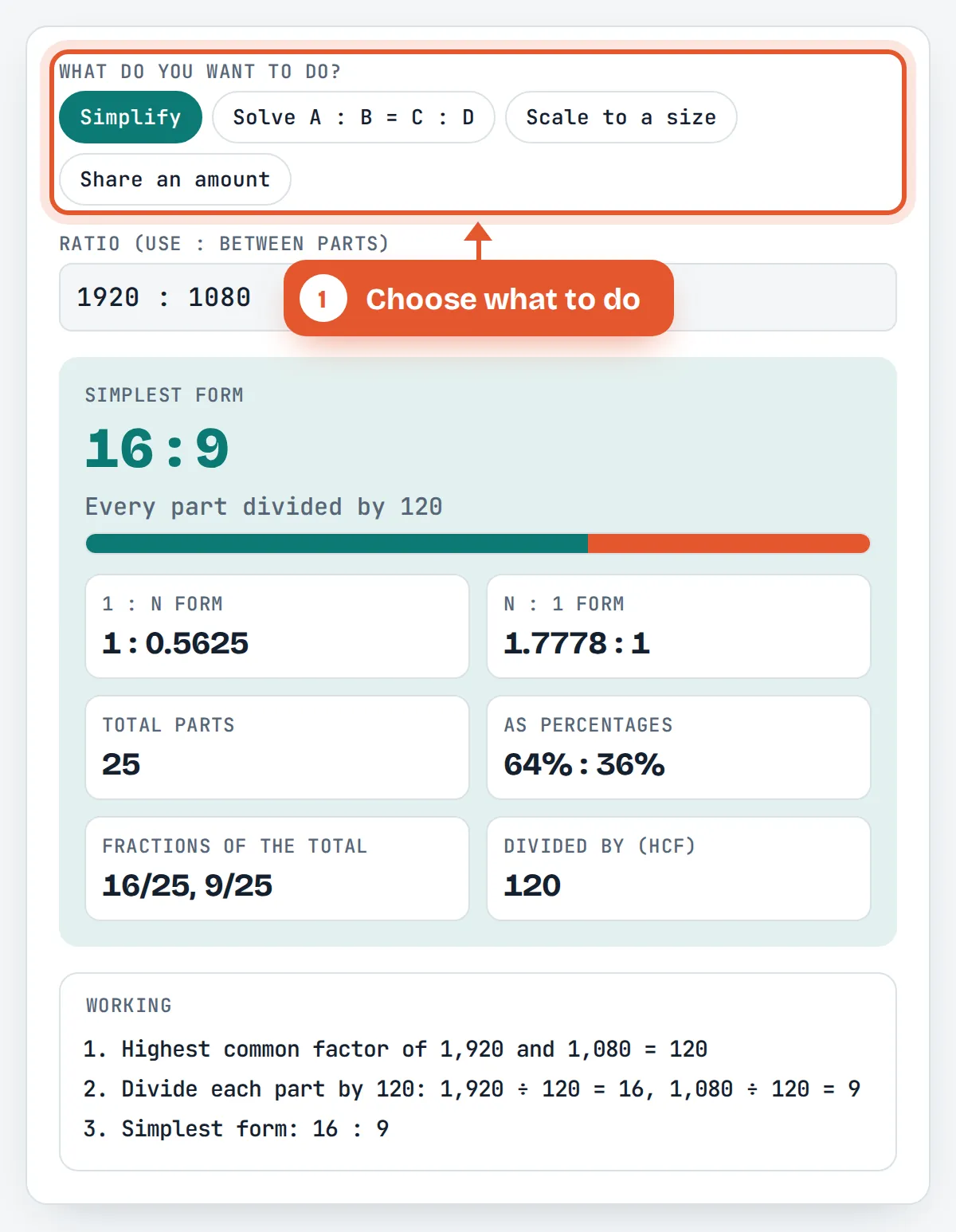
Choose what to do
Pick Simplify, Solve A : B = C : D, Scale to a size or Share an amount. The inputs change to match.

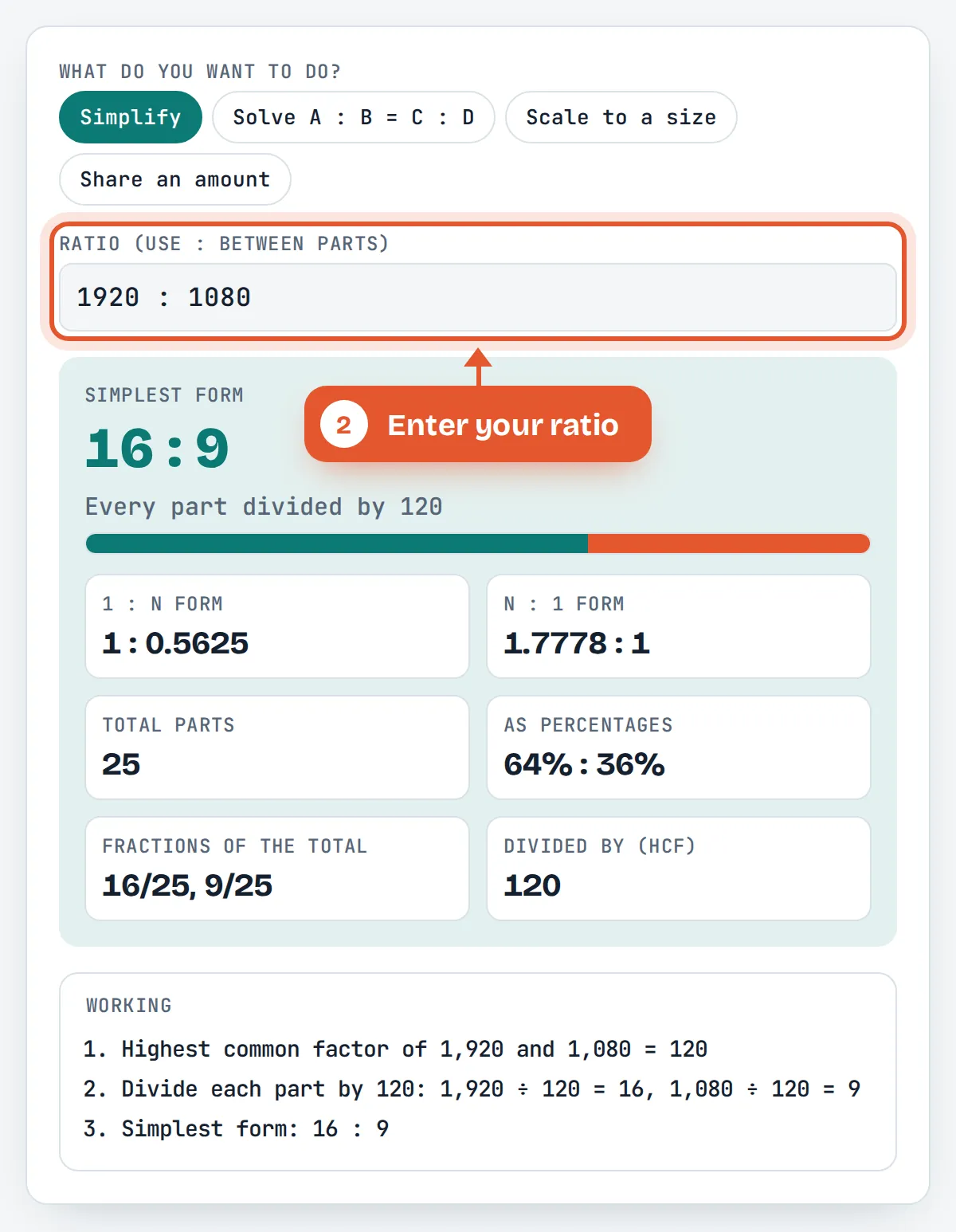
Enter your ratio
Type the parts separated by colons, such as 1920 : 1080 or 1.5 : 2.25 : 3. Fractions such as 1/2 : 3/4 also work.
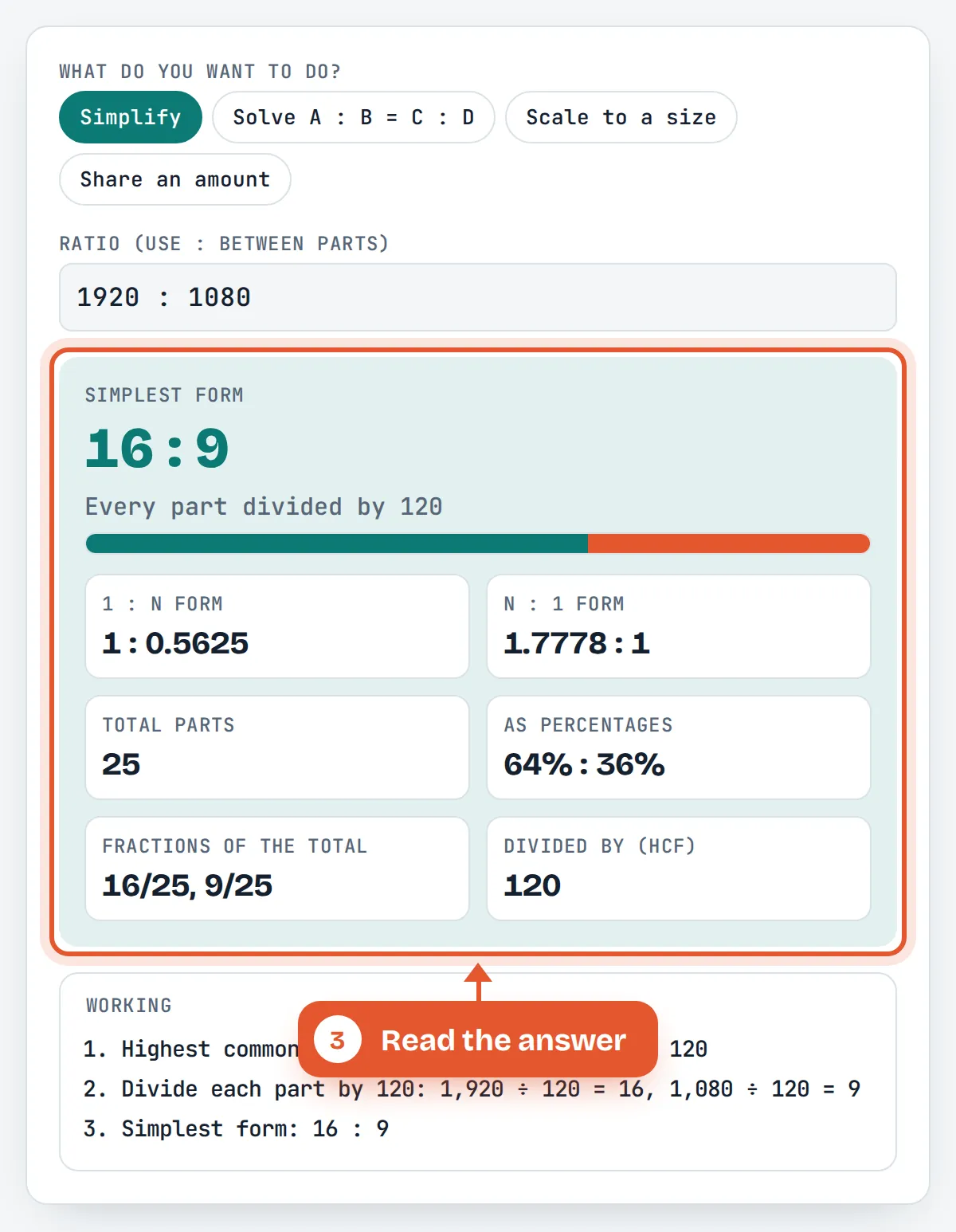
Read the answer
The result appears in large text with a colored bar showing each part’s share, plus the 1 : n form, percentages and fractions of the total.
Follow the working
Each step is written out, from clearing decimals and finding the highest common factor to the final answer, so you can check it or copy the method.
Frequently Asked Questions
What is 1920 : 1080 in its simplest form?
1920 : 1080 simplifies to 16 : 9. The highest common factor of 1920 and 1080 is 120, and 1920 ÷ 120 = 16 while 1080 ÷ 120 = 9. That is why Full HD screens are described as 16 : 9 widescreen.
How do you simplify a ratio with decimals?
Multiply every part by 10, 100 or 1,000 until all parts are whole numbers, then divide by the highest common factor. For 1.5 : 2.25, multiply by 100 to get 150 : 225, then divide by 75 to get 2 : 3.
Is a ratio the same as a fraction?
Not quite. A two part ratio a : b compares the parts with each other, while the fraction a/(a + b) compares one part with the whole. In a 3 : 2 ratio, the first part is 3/5 of the total, or 60%, not 3/2.
Does the order of a ratio matter?
Yes. 3 : 2 and 2 : 3 are different ratios. The order must match the order of the things being compared, so “boys to girls is 3 : 2” means 3 boys for every 2 girls. Reversing it gives the girls to boys ratio.
How do you increase a ratio while keeping it the same?
Multiply every part by the same number. 2 : 3 multiplied by 4 becomes 8 : 12, which is the same ratio. Use Scale to a size when you know what one part must become, for example 16 : 9 with a width of 1280 gives 1280 : 720.
What does a ratio of 1 in 4 mean?
“1 in 4” usually means 1 unit of one quantity for every 4 units of another, so 1 : 4. The UK Health and Safety Executive uses it for leaning ladders: 1 unit out from the wall for every 4 units up, which puts the ladder at about 75°.
Sources and Further Reading
Related Tools
Last reviewed: October 2026