Work out your basal metabolic rate: the calories your body burns at complete rest in a day. See the result from three published formulas side by side, in kcal and kJ, with metric, stone or pound inputs.
An estimate for healthy adults, not medical advice.
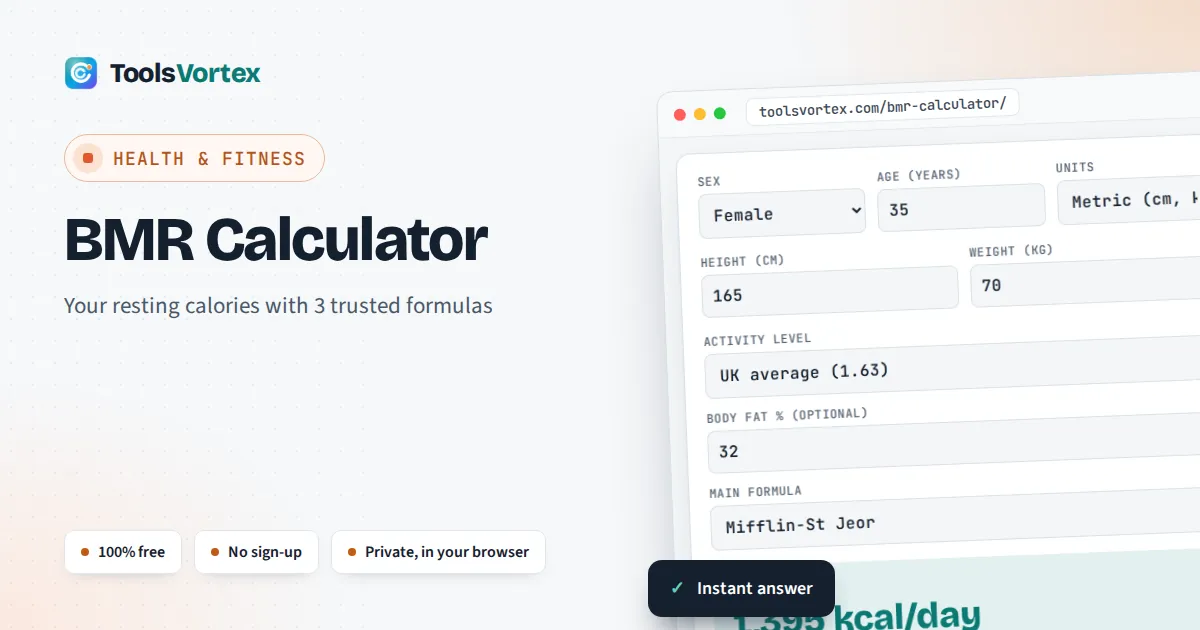
This BMR calculator estimates how many calories your body uses at complete rest, for adults who want a starting point for a diet, a training plan or a chat with a dietitian. Your BMR covers breathing, circulation, brain activity and keeping warm, and it is usually the largest share of the energy you burn in a day. Movement and digestion come on top, which is why the tool also multiplies your BMR by an activity level to show your total daily needs.
How do you calculate BMR?
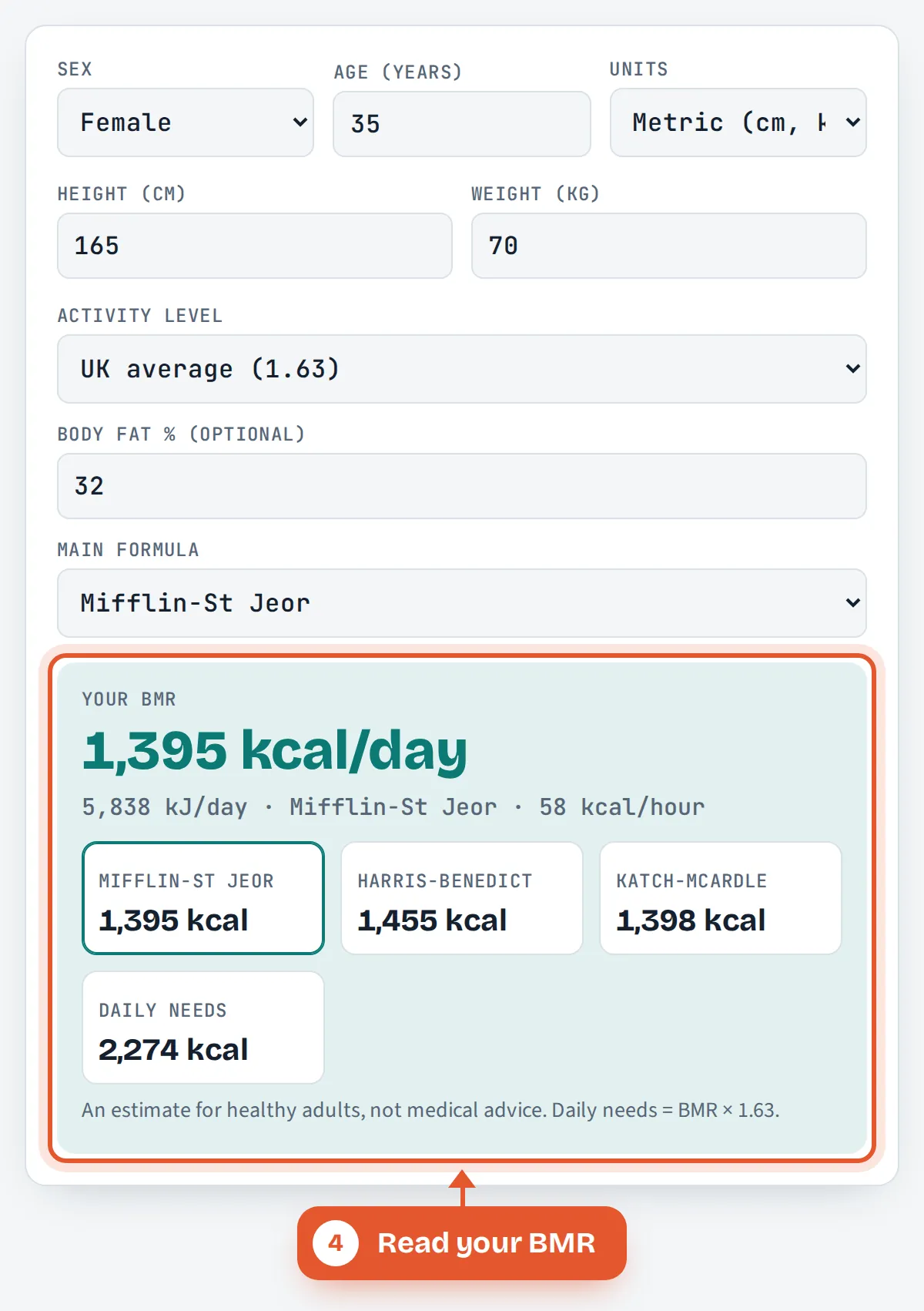
Most dietitians use the Mifflin-St Jeor equation: BMR = 10 × weight in kg + 6.25 × height in cm − 5 × age, then add 5 for men or subtract 161 for women. A BMR calculator does this instantly. A 35 year old woman weighing 70 kg at 165 cm has a BMR of about 1,395 kcal a day.
Which Formulas Does This BMR Calculator Use?
The calculator runs three published equations at once, so you can see how much they agree. Weight is in kilograms, height in centimeters and age in years.
Men: 10 × kg + 6.25 × cm − 5 × age + 5
Women: 10 × kg + 6.25 × cm − 5 × age − 161
Revised Harris-Benedict (Roza and Shizgal, 1984)
Men: 13.397 × kg + 4.799 × cm − 5.677 × age + 88.362
Women: 9.247 × kg + 3.098 × cm − 4.330 × age + 447.593
Katch-McArdle
370 + 21.6 × lean body mass in kg
Lean body mass = weight × (1 − body fat % ÷ 100)
The original Mifflin-St Jeor paper gives the coefficients as 9.99 and 4.92. The rounded 10 and 5 used here change the answer by only a few calories. Katch-McArdle ignores sex and age and uses lean mass instead, so it suits people who know their body fat from a scan or a body fat calculator. Leave body fat blank and the tool simply skips it.
What Is a Normal BMR by Age?
There is no single normal BMR, because it depends mostly on body size and sex. BMR falls by about 5 kcal a day for every extra year of age in the Mifflin-St Jeor equation, as this table shows for two example adults:
| Age | Man, 85 kg, 178 cm | Woman, 70 kg, 165 cm |
|---|---|---|
| 20 | 1,868 kcal | 1,470 kcal |
| 30 | 1,818 kcal | 1,420 kcal |
| 40 | 1,768 kcal | 1,370 kcal |
| 50 | 1,718 kcal | 1,320 kcal |
| 60 | 1,668 kcal | 1,270 kcal |
| 70 | 1,618 kcal | 1,220 kcal |
Men usually have a higher BMR than women of the same weight because they tend to carry more muscle, which burns more energy at rest than fat. The fall with age largely reflects loss of muscle, which is why strength training is the main lever you control.
Worked Example: What Is Sarah’s BMR?
Sarah is 35, 165 cm tall and weighs 70 kg (about 11 stone). A smart scale puts her body fat at 32%.
- Mifflin-St Jeor: 700 + 1,031.25 − 175 − 161 = 1,395 kcal (5,838 kJ)
- Harris-Benedict: 647.3 + 511.2 − 151.6 + 447.6 = 1,455 kcal
- Katch-McArdle: lean mass 70 × 0.68 = 47.6 kg, so 370 + 1,028.2 = 1,398 kcal
The three answers sit within 60 kcal of each other. With the UK average activity level of 1.63, her daily needs are about 1,395 × 1.63 = 2,274 kcal. That is close to the 2,000 kcal the NHS uses for an average woman, and the difference comes from her height, weight and activity.
How Do You Turn BMR Into Daily Calories?
Multiply your BMR by a physical activity level (PAL) to estimate total daily energy expenditure. The joint FAO, WHO and UNU expert report on human energy requirements classes a PAL of 1.40 to 1.69 as sedentary or light, 1.70 to 1.99 as moderately active and 2.00 to 2.40 as vigorous. In the UK, the Scientific Advisory Committee on Nutrition (SACN) uses a median PAL of 1.63 for adults, with 1.49 and 1.78 as the lower and upper quartiles. These are the values behind the activity menu above.
If you want a full daily target for losing, keeping or gaining weight, use the calorie calculator, which starts from these numbers and adjusts for your goal. Our guide on how many calories to eat to lose weight explains safe deficits, and the protein intake calculator helps you protect muscle while you diet.
What Is the Difference Between BMR and RMR?
BMR is measured in strict lab conditions: after a night’s sleep, 12 hours of fasting and lying still in a warm room. Resting metabolic rate (RMR or REE) is measured under looser conditions and is usually slightly higher. The Mifflin-St Jeor equation was actually built from resting energy measurements, but in everyday use the two terms are treated as the same number. Food labels across the UK and EU show energy in both kJ and kcal (1 kcal = 4.184 kJ), so the calculator gives both.
How Accurate Is a BMR Calculator?
A BMR calculator is a good estimate for most healthy adults, but it can be 10% or more out for an individual. Mifflin-St Jeor was developed from 498 healthy adults aged 19 to 78 and explained about 71% of the differences in their measured energy use. A 2005 systematic review in the Journal of the American Dietetic Association found it predicted resting energy within 10% of the measured value in more people than any other common equation, in both normal weight and obese adults. The same paper that introduced it found the 1919 Harris-Benedict equations overestimated by about 5%.
Results are less reliable for very muscular athletes, people with obesity, older adults, and during pregnancy or illness. Thyroid problems, some medicines, fever and long periods of dieting all change BMR. This is an estimate, not medical advice. See your GP or doctor if you are losing or gaining weight without trying, feel cold or tired all the time, or are thinking about a very low calorie diet (800 kcal a day or less), which UK NICE guidance says should not be used routinely and only with ongoing clinical support. Under 18s, pregnant or breastfeeding women should ask a doctor or registered dietitian instead of using adult equations.
How Do You Use the BMR Calculator?
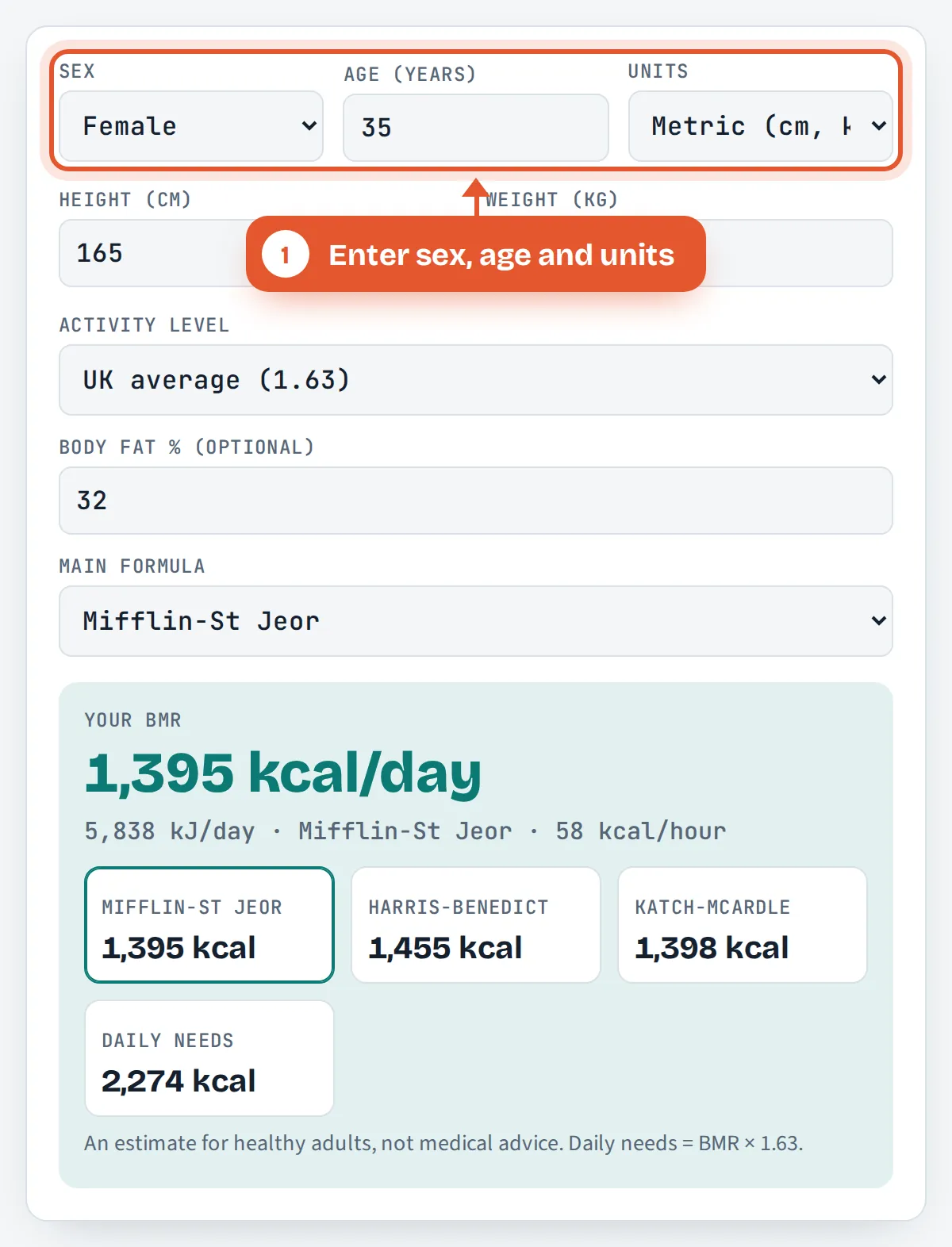
Enter sex, age and units
Pick your sex and age, then choose metric, UK (stone and pounds) or US units.

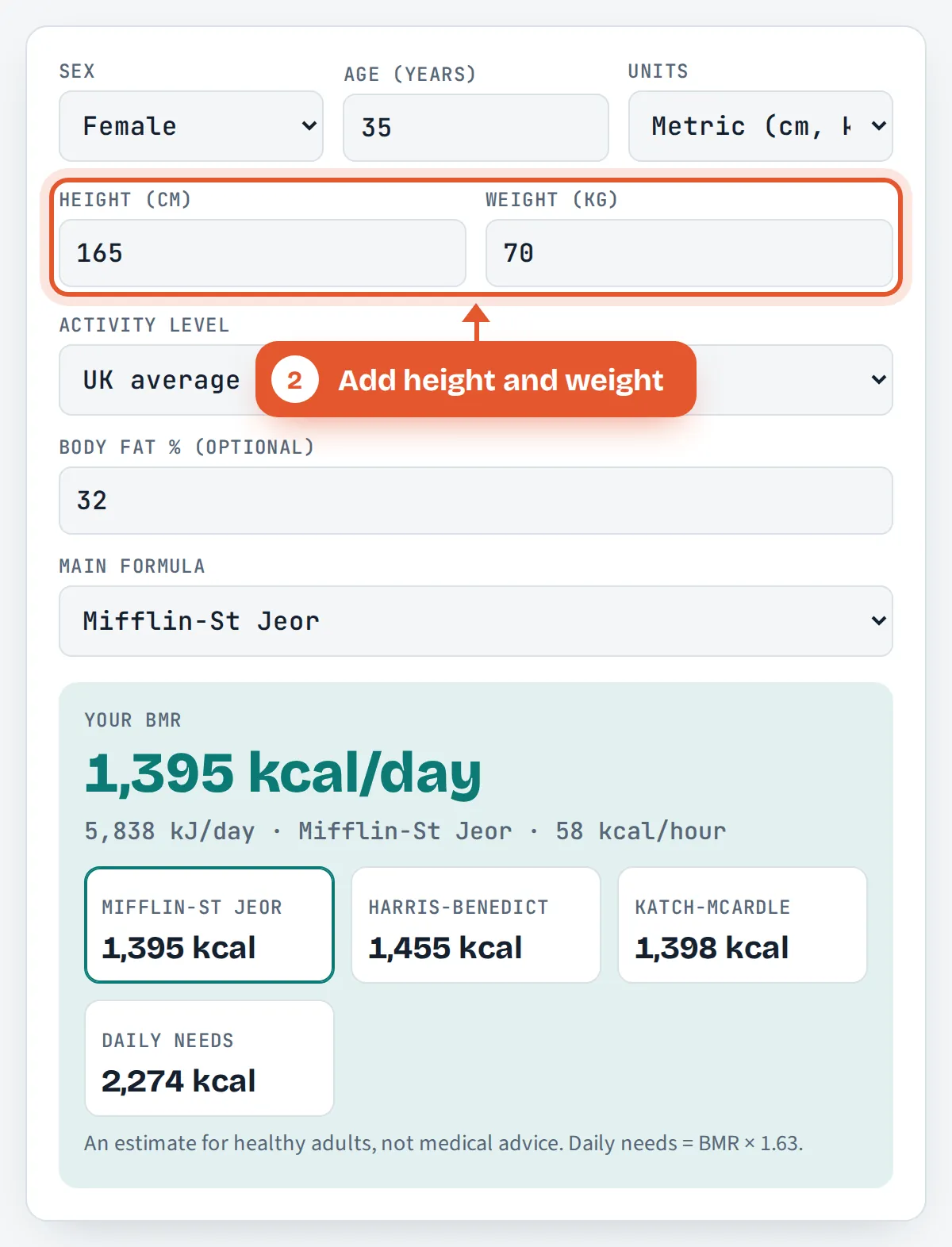
Add height and weight
Type your height and weight. The fields change to match the units you chose.
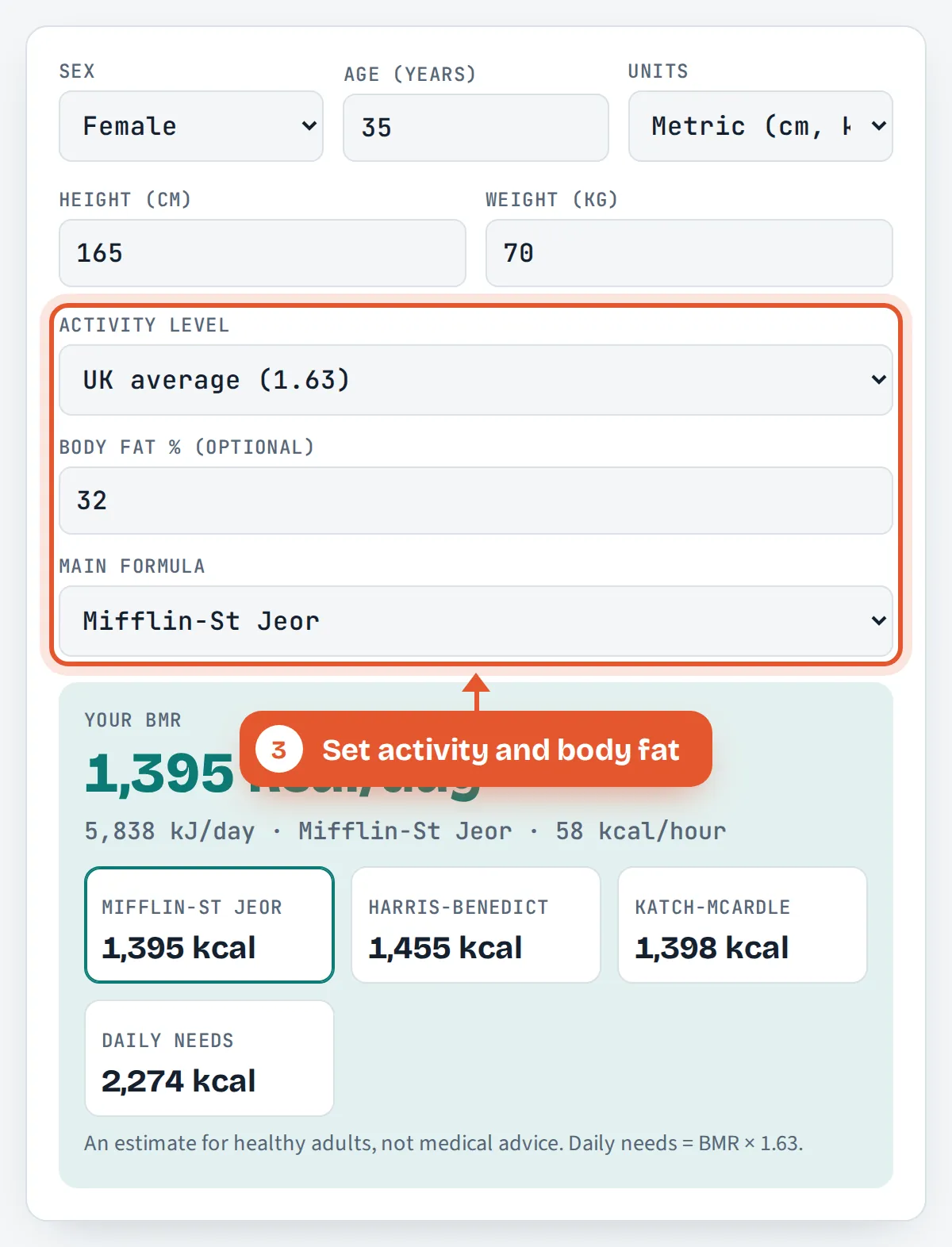
Set activity and body fat
Choose the activity level closest to a normal week. Add body fat if you know it to unlock Katch-McArdle.
Read your BMR
Your BMR shows in large text with kJ below, plus all three formulas and your estimated daily needs.
Frequently Asked Questions
What is a normal BMR for a woman?
For women aged 20 to 60, between 155 and 175 cm tall and weighing 55 to 85 kg, Mifflin-St Jeor gives about 1,060 to 1,680 kcal a day. A 35 year old woman at 165 cm and 70 kg comes out at about 1,395 kcal.
What is a normal BMR for a man?
For men aged 20 to 60, between 165 and 190 cm tall and weighing 65 to 100 kg, Mifflin-St Jeor gives about 1,390 to 2,090 kcal a day. A 40 year old man at 178 cm and 85 kg has a BMR of about 1,768 kcal.
Is my BMR the number of calories I should eat?
No. BMR is only what you burn at complete rest. Your daily needs are your BMR multiplied by an activity level, usually 1.4 to 2.0. Eating at your BMR is already a deficit for almost everyone who moves during the day.
Should I eat below my BMR to lose weight?
It is not recommended without supervision. Eating below your BMR for long periods makes it hard to get enough protein and nutrients and can cause muscle loss. A moderate deficit from your daily needs, not your BMR, is safer and easier to keep up.
Does BMR go down with age?
Yes. In the Mifflin-St Jeor equation BMR drops by 5 kcal a day for each year of age, so about 50 kcal per decade. Much of the real decline comes from losing muscle, which regular strength training can slow.
Can I increase my BMR?
Building muscle is the most reliable way, because lean tissue burns more energy at rest than fat. Strength training two or more days a week, eating enough protein and avoiding crash diets all help keep your BMR from falling.
Sources and Further Reading
- Mifflin MD et al. A new predictive equation for resting energy expenditure in healthy individuals, Am J Clin Nutr 1990 (PubMed)
- SACN Dietary Reference Values for Energy, GOV.UK (2011)
- What should my daily intake of calories be? NHS
Related Tools
Last reviewed: October 2026