Enter your treadmill speed, incline, body weight and time to see how many calories you burned. Works for walking and running in km/h or mph.
Runs in your browser. Nothing you type is sent anywhere.
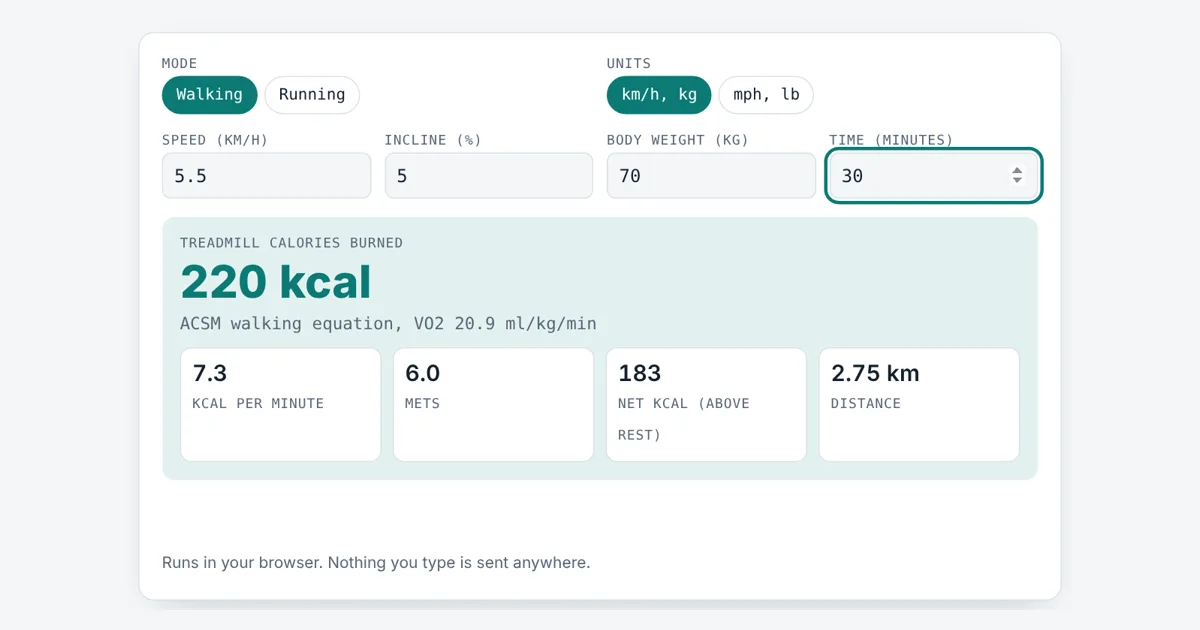
This treadmill calories calculator is for walkers and runners who want a fair estimate of their gym workout that takes the incline into account. It uses the ACSM walking and running equations, which most lab tests are based on, and shows calories, METs, net calories and distance.
How Many Calories Do You Burn on a Treadmill?
A 70 kg person walking at 5.5 km/h (3.4 mph) on a 5% incline for 30 minutes burns about 220 kcal, using the ACSM walking equation. Running at 10 km/h (6.2 mph) on a flat belt for 30 minutes burns about 387 kcal. Heavier people, faster speeds and steeper inclines all raise the number.
How Are Treadmill Calories Calculated?
Treadmill calories are calculated by working out how much oxygen you use from your speed and incline, then turning that oxygen into calories at about 5 kcal per litre. The equations come from the American College of Sports Medicine (ACSM) and are printed in its Guidelines for Exercise Testing and Prescription.
Running: VO2 = 0.2 × S + 0.9 × S × G + 3.5
S = speed in metres per minute, G = grade as a decimal (5% = 0.05)
kcal per minute = VO2 × weight(kg) ÷ 1000 × 5
VO2 is oxygen use in millilitres per kilogram per minute. Each equation has three parts: a horizontal part for moving forward, a vertical part for climbing the grade (the incline), and 3.5 for resting. That 3.5 is one MET, so dividing VO2 by 3.5 gives the effort in METs. The walking equation suits about 1.9 to 3.7 mph (3 to 6 km/h), and the running equation suits speeds over 5 mph (8 km/h).
How Much Does Incline Increase Calories Burned?
Incline raises calories burned a lot when walking, because each 1% of grade adds about the same oxygen cost as speeding up. For a 70 kg person walking at 5 km/h for 30 minutes, this tool gives:
| Incline | METs | Calories in 30 min |
|---|---|---|
| 0% | 3.4 | 124 kcal |
| 2% | 4.2 | 156 kcal |
| 4% | 5.1 | 187 kcal |
| 6% | 6.0 | 219 kcal |
| 8% | 6.8 | 250 kcal |
| 10% | 7.7 | 282 kcal |
| 12% | 8.5 | 313 kcal |
| 15% | 9.8 | 360 kcal |
Going from flat to a 12% grade, the setting used in the popular 12-3-30 workout, more than doubles the burn. For running, incline matters less in the formula, because the vertical cost is halved (0.9 instead of 1.8).
Is Running or Walking Better for Burning Calories on a Treadmill?
Running burns more calories per minute, but a steep walk can match a slow jog. At 70 kg, a 30 minute run at 10 km/h on a flat belt burns about 387 kcal, while walking at 5 km/h on a 15% incline burns about 360 kcal. Pick the option you can keep doing safely. To plan pace for outdoor runs, try the pace calculator, and for flat outdoor walks see the walking calories burned calculator.
Why Does My Treadmill Show a Different Number?
Many treadmills use similar equations but may assume a default weight or count gross instead of net calories, so their numbers can be higher or lower. Holding the handrails also cuts the real effort, often a lot, while the display still counts full effort. Enter your true weight here and walk without holding on. To see how the workout fits your day, use the calorie calculator.
This is an estimate, not medical advice. Check with a doctor before steep or fast treadmill work if you have heart, lung or joint problems.
Worked Example
Lena weighs 70 kg and walks at 5.5 km/h on a 5% incline for 30 minutes. With Walking and km/h, kg picked, the tool shows 220 kcal, a VO2 of 20.9 ml/kg/min, 6.0 METs, 183 net kcal and 2.75 km covered. Her partner weighs 150 lb and runs at 6 mph on a 2% incline for 45 minutes: with Running and mph, lb picked, the tool shows 591 kcal and 4.5 miles.
How Do You Use the Treadmill Calories Calculator?
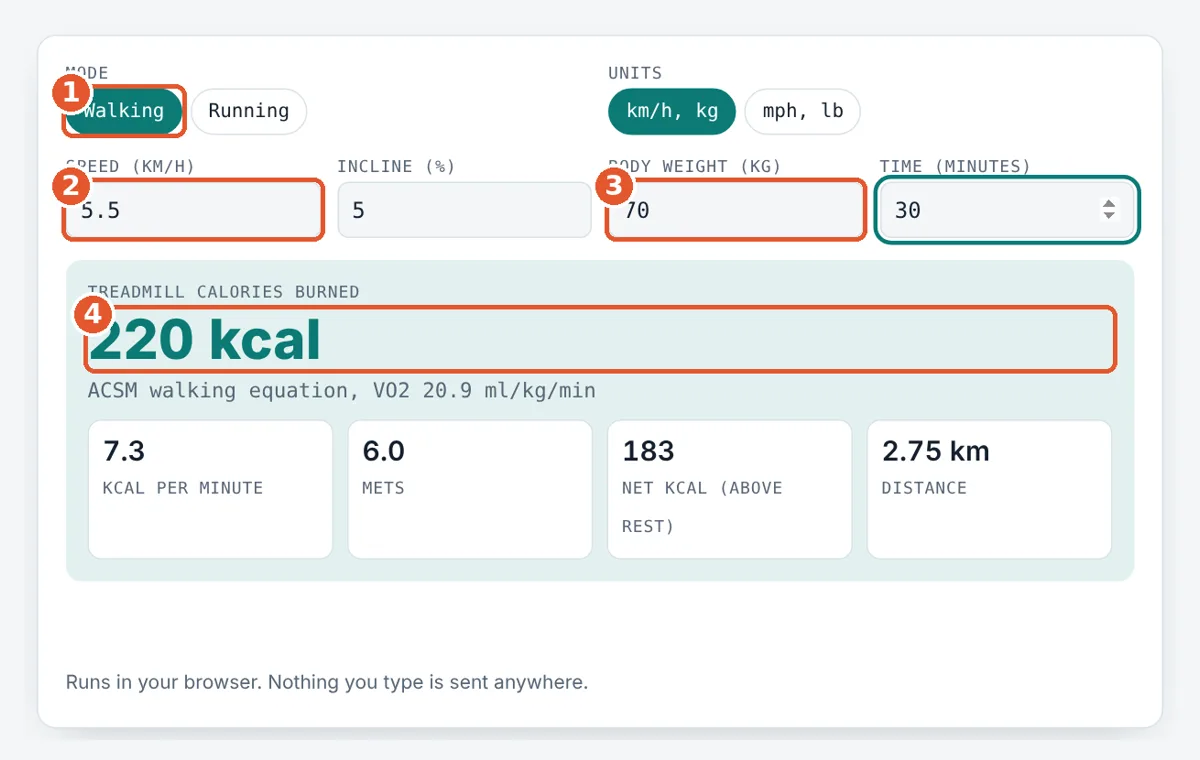
Pick walk or run and units
Tap Walking or Running, then choose km/h and kg or mph and lb.
Enter speed and incline
Copy the speed and incline percentage from the treadmill display.
Add weight and time
Type your body weight and the minutes you spent on the belt.
Read the results
The big number is total calories. The boxes show kcal per minute, METs, net calories and distance.
Frequently Asked Questions
How many calories does the 12-3-30 treadmill workout burn?
The 12-3-30 workout is 12% incline, 3 mph, for 30 minutes. With the ACSM walking equation, a 180 lb (81.6 kg) person burns about 354 kcal, or about 11.8 kcal per minute.
Does holding the handrails reduce calories burned?
Yes. Leaning on the rails takes some of your body weight off your legs, so you do less work than the equation assumes. Let go, or only touch the rails lightly for balance.
Should I use 1% incline to match outdoor running?
Many runners set 1% to make up for no wind resistance indoors. For a 70 kg runner at 10 km/h for 30 minutes, going from 0% to 1% raises this estimate from 387 to 403 kcal.
What is the difference between gross and net treadmill calories?
Gross calories include what you would burn at rest anyway, and net calories do not. For a 30 minute walk at 5.5 km/h and 5% incline at 70 kg, gross is 220 kcal and net is 183 kcal.
Are treadmill calorie equations accurate?
The ACSM equations give reasonable estimates for steady exercise within the speed ranges they were built for. They are less reliable for very fast walking, running uphill above about 15%, and people with unusual running form or fitness.
Can I use this for a curved or manual treadmill?
The equations assume a motorised belt at a steady speed. Curved and manual treadmills make you push the belt, so they usually cost more energy, and this tool will likely underestimate your burn on them.
Sources and Further Reading
- Adult Compendium of Physical Activities: unit conversions and ACSM metabolic equations
- American College of Sports Medicine: ACSM Guidelines for Exercise Testing and Prescription
- CDC: Measuring physical activity intensity (METs)
Related Tools
Last reviewed: October 2026