Type a pressure in psi and get bar at once, or switch direction to turn bar into psi. Kilopascals, atmospheres and kgf/cm² are shown too.
Uses 1 psi = 6,894.757 Pa and 1 bar = 100,000 Pa. Runs in your browser. Nothing you type is sent anywhere.
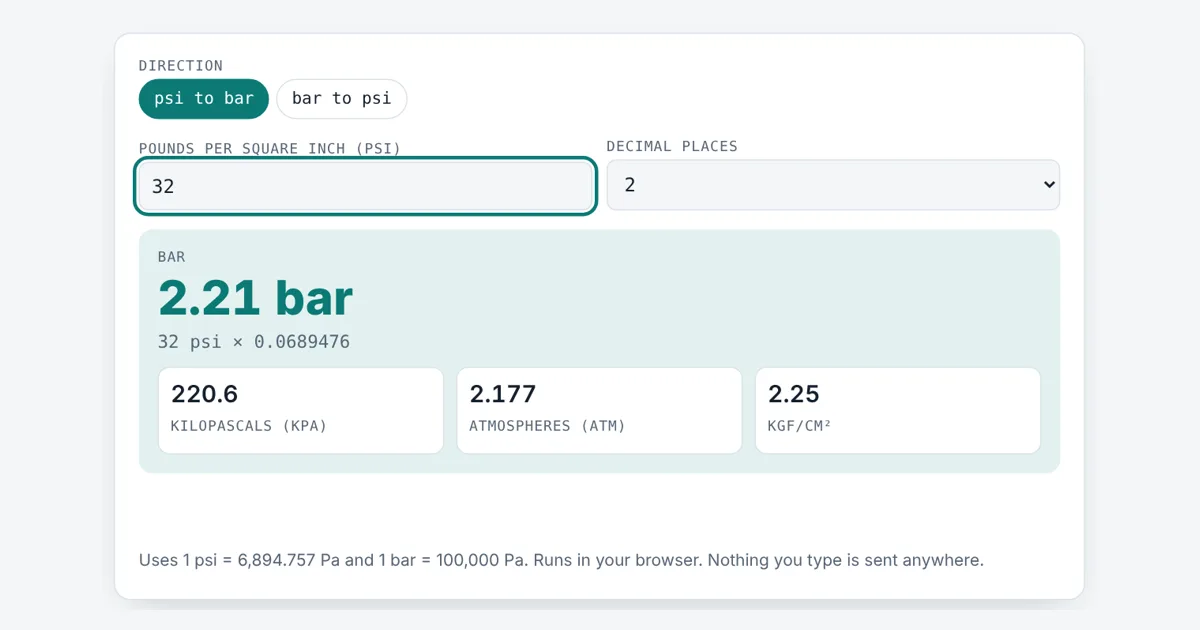
This psi to bar converter is for drivers, cyclists, mechanics and anyone reading a pressure gauge in one unit and a manual in another. US and UK tyre placards often list psi, while European cars, pumps and diving gear use bar or kPa. The tool uses the exact definitions, so a 32 psi tyre reads 2.21 bar every time.
How Do You Convert PSI to Bar?
To convert psi to bar, multiply by 0.0689476, because one psi is 6,894.76 pascals and one bar is 100,000 pascals. For example, a tyre at 32 psi × 0.0689476 = 2.21 bar, which is also 220.6 kPa. To go back, multiply bar by 14.5038, so 2.2 bar is 31.9 psi.
How Many PSI Is 1 Bar?
One bar is 14.5038 psi, and one psi is 0.0689476 bar, because a bar is exactly 100,000 pascals and a psi is about 6,894.757 pascals.
1 psi = 1 lbf/in² = 6,894.757 Pa
bar = psi × 0.0689476
psi = bar × 14.5038
PSI means pounds force per square inch, the US customary and imperial unit of pressure. The bar is a metric unit that is not part of the SI but is widely used because 1 bar is close to air pressure at sea level. The SI unit is the pascal, one newton per square meter, and the kilopascal (kPa) is 1,000 Pa, so 1 bar = 100 kPa. The standard atmosphere (atm) is 101,325 Pa, or 14.696 psi, which is just above 1 bar.
What Is the Tyre Pressure in PSI to Bar?
Most car tyres run between 30 and 35 psi, which is about 2.1 to 2.4 bar, but always use the figure on your car’s door pillar or manual.
| psi | bar | kPa | Typical use |
|---|---|---|---|
| 26 | 1.79 | 179.3 | Some small car rear tyres |
| 30 | 2.07 | 206.8 | Car tyres, light load |
| 32 | 2.21 | 220.6 | Common car tyre value |
| 35 | 2.41 | 241.3 | Car tyres, full load |
| 40 | 2.76 | 275.8 | SUV and van tyres |
| 44 | 3.03 | 303.4 | Light truck and space saver spares |
| 50 | 3.45 | 344.7 | Mountain bike, upper range |
| 80 | 5.52 | 551.6 | Hybrid and touring bike |
| 100 | 6.89 | 689.5 | Road bike tyres |
| 110 | 7.58 | 758.4 | Narrow road bike tyres |
Typical uses are general ranges, not advice for your vehicle. Check pressure when tyres are cold, because driving warms the air and raises the reading.
What Is the Difference Between psi and psig?
Psig is gauge pressure, measured above the air around you, while psia is absolute pressure, measured from a perfect vacuum.
A tyre gauge shows gauge pressure, so 32 psi on the gauge is about 46.7 psia at sea level. The same idea applies to bar, written barg and bara. This tool converts the number as given, so gauge stays gauge. To plan fuel for a trip after checking your tyres, the fuel cost calculator helps, and for speed units the mph to km/h converter is handy.
Worked Example
A UK driver’s door sticker says 32 psi, but the garage air pump at a holiday stop in France only shows bar. Type 32 with psi to bar selected: the tool shows 2.21 bar, which is 220.6 kPa, 2.177 atm or 2.25 kgf/cm². Back home, a European pump manual recommends 2.2 bar for the spare: switch to bar to psi and type 2.2 to see 31.91 psi. A diver’s 200 bar cylinder works the same way: 200 bar is 2,900.75 psi.
How Do You Use the PSI to Bar Converter?
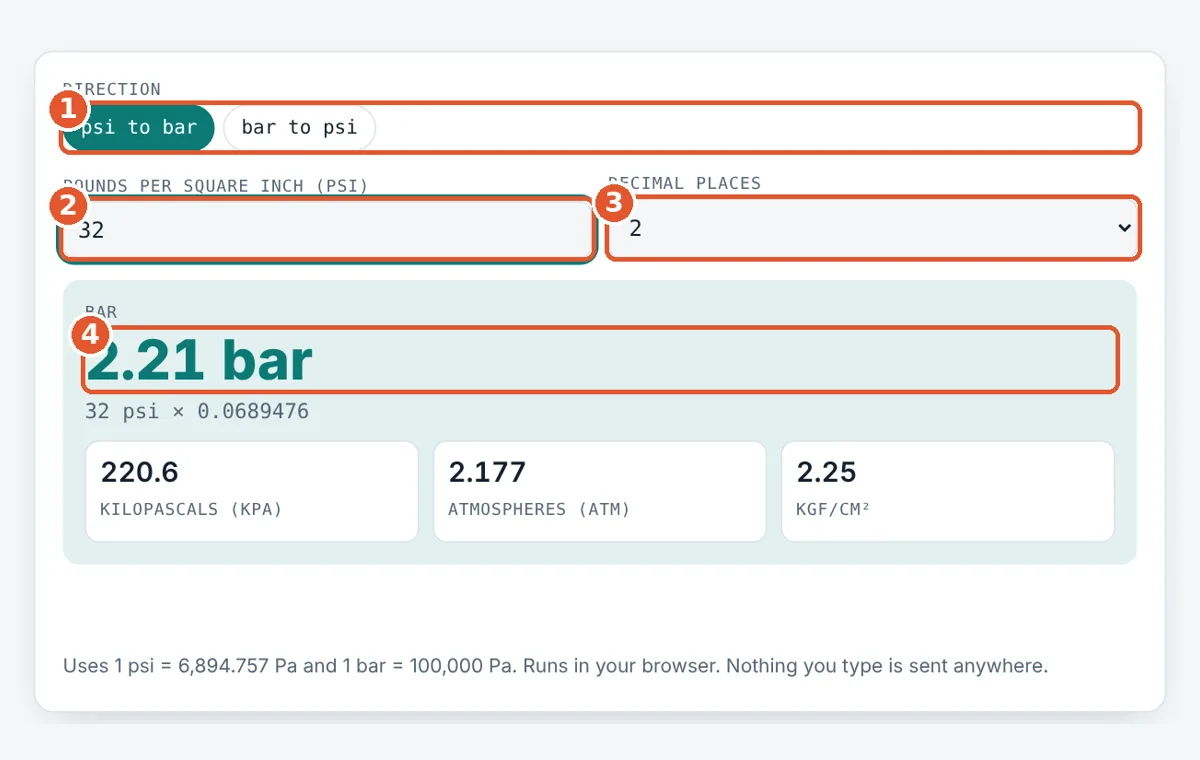
Pick a direction
Choose psi to bar, or bar to psi if your gauge shows bar.
Type the pressure
Enter the pressure, such as 32 for a car tyre or 100 for a road bike.
Choose decimal places
Use 1 or 2 for tyres, or more for lab and engineering work.
Read the result
The big number is the converted pressure, with kPa, atm and kgf/cm² below.
Frequently Asked Questions
Is 2.2 bar the same as 32 psi?
Very nearly. 2.2 bar is 31.91 psi, and 32 psi is 2.21 bar. The gap of 0.09 psi is smaller than the accuracy of most tyre gauges, which is why tyre charts often list them together.
How many psi is 2.5 bar?
2.5 bar is 36.26 psi. Multiply 2.5 by 14.5038. That is a common pressure for loaded car tyres or the front tyres of larger cars and SUVs.
How do I convert psi to kPa?
Multiply psi by 6.89476 to get kilopascals. For example, 32 psi × 6.89476 = 220.6 kPa. Divide kPa by 100 to get bar, so 220.6 kPa is 2.206 bar.
Is 1 bar equal to 1 atmosphere?
Not exactly. 1 bar is 100,000 Pa and 1 standard atmosphere is 101,325 Pa, so 1 atm is 1.01325 bar. The two are close enough that weather maps once used millibars and atmospheres side by side.
Why does my tyre pressure change in cold weather?
Air pressure in a closed tyre falls as it cools. A drop of about 10 °C can lower a car tyre by roughly 1 to 2 psi, or about 0.1 bar. Check tyres cold and top them up in winter.
How many psi is 200 bar in a scuba tank?
200 bar is 2,900.75 psi. Multiply 200 by 14.5038. Common aluminium tanks in the US are rated at 3,000 psi, which is 206.84 bar, so always check the rating stamped on the tank neck.
Sources and Further Reading
- NIST Guide to the SI, Appendix B.9: pressure conversion factors
- BIPM: The SI Brochure, the pascal and non SI units
- NHTSA: Tires and tire pressure safety
Related Tools
Last reviewed: October 2026