Paste or type a list of numbers and get the mean, median, mode, range, count and sum at once, plus the list sorted from smallest to largest.
Runs in your browser. Nothing you type is sent anywhere.
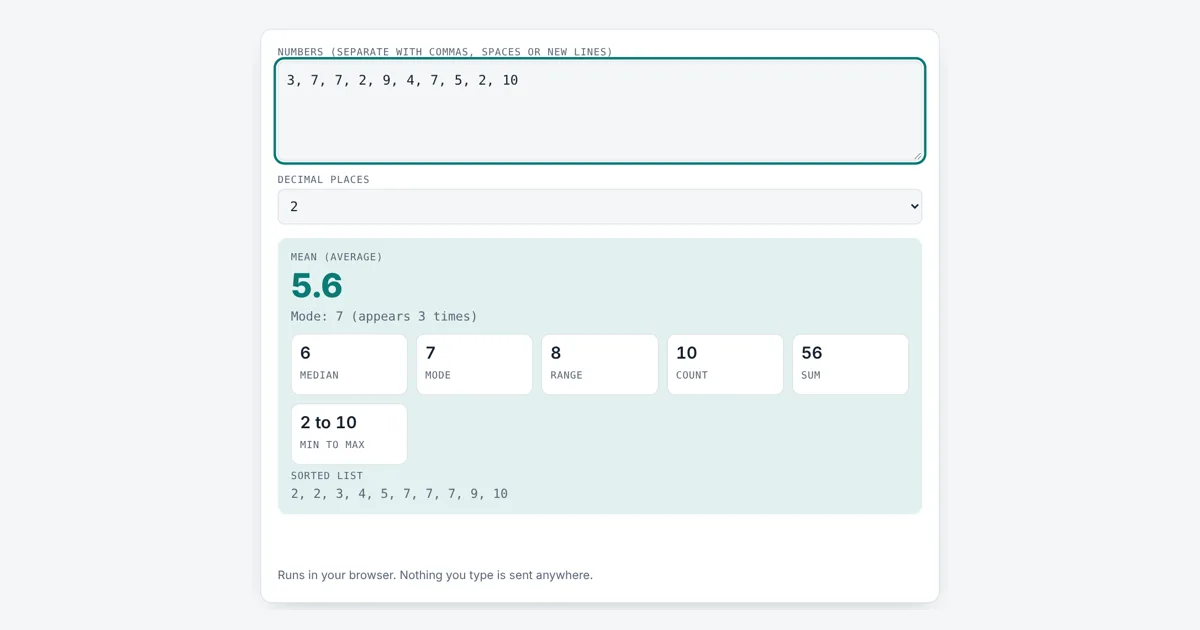
This mean median mode calculator is for students checking homework, teachers making answer keys, and anyone summing up a small data set such as test scores or daily sales. Paste your numbers and you get all three measures of center, the range and a sorted list, with no mode and multiple modes handled clearly.
How Do You Find Mean Median Mode for a List of Numbers?
The mean is the sum divided by the count, the median is the middle value of the sorted list, and the mode is the value that appears most often. For 3, 7, 7, 2, 9, 4, 7, 5, 2, 10 the sum is 56, so the mean is 5.6, the median is 6 and the mode is 7.
What Is the Difference Between Mean, Median and Mode?
The mean is the arithmetic average, the median is the middle value when the numbers are sorted, and the mode is the most frequent value; all three are measures of central tendency that describe a typical value in different ways.
The arithmetic mean uses every value, so one very large or small number, called an outlier, can pull it a long way. The median only looks at position, so it resists outliers. That is why reports on household income, such as those from the US Census Bureau, usually quote the median. The mode is the only one that also works for categories, such as the most common shoe size.
median = middle value (odd count) or average of the two middle values (even count)
range = largest value − smallest value
How Do You Find the Median of an Even Set of Numbers?
With an even count, sort the numbers and take the average of the two middle values. For 2, 2, 3, 4, 5, 7, 7, 7, 9, 10 the middle pair is 5 and 7, so the median is (5 + 7) ÷ 2 = 6. With an odd count there is one middle value, so for 1, 4, 8 the median is simply 4.
Can a Data Set Have No Mode or More Than One Mode?
Yes. If every value appears the same number of times, there is no mode, and if two or more values tie for most frequent, all of them are modes. A set with two modes is called bimodal. This tool lists every tied mode and says “No mode” when nothing repeats more than anything else.
| Data set | Mean | Median | Mode | Range |
|---|---|---|---|---|
| 3, 7, 7, 2, 9, 4, 7, 5, 2, 10 | 5.6 | 6 | 7 | 8 |
| 1, 2, 2, 3, 3, 4 | 2.5 | 2.5 | 2, 3 | 3 |
| 5, 1, 9, 3 | 4.5 | 4 | No mode | 8 |
| 2.5, −1, 4 | 1.83 | 2.5 | No mode | 5 |
| 10, 10, 10, 200 | 57.5 | 10 | 10 | 190 |
The last row shows the outlier effect: one value of 200 lifts the mean to 57.5 while the median stays at 10. To see how spread out the values are, the standard deviation calculator goes a step further than the range, and the average calculator is handy when you only need the mean.
Worked Example
A teacher records ten quiz scores out of 10: 3, 7, 7, 2, 9, 4, 7, 5, 2, 10. Paste them in the tool and it returns a mean of 5.6 (56 ÷ 10), a median of 6 (the average of 5 and 7), a mode of 7 (appears 3 times), a range of 8 and a sum of 56. The sorted list reads 2, 2, 3, 4, 5, 7, 7, 7, 9, 10. Changing the list to 1, 2, 2, 3, 3, 4 shows two modes, 2 and 3, each appearing 2 times.
How Do You Use the Mean Median Mode Calculator?
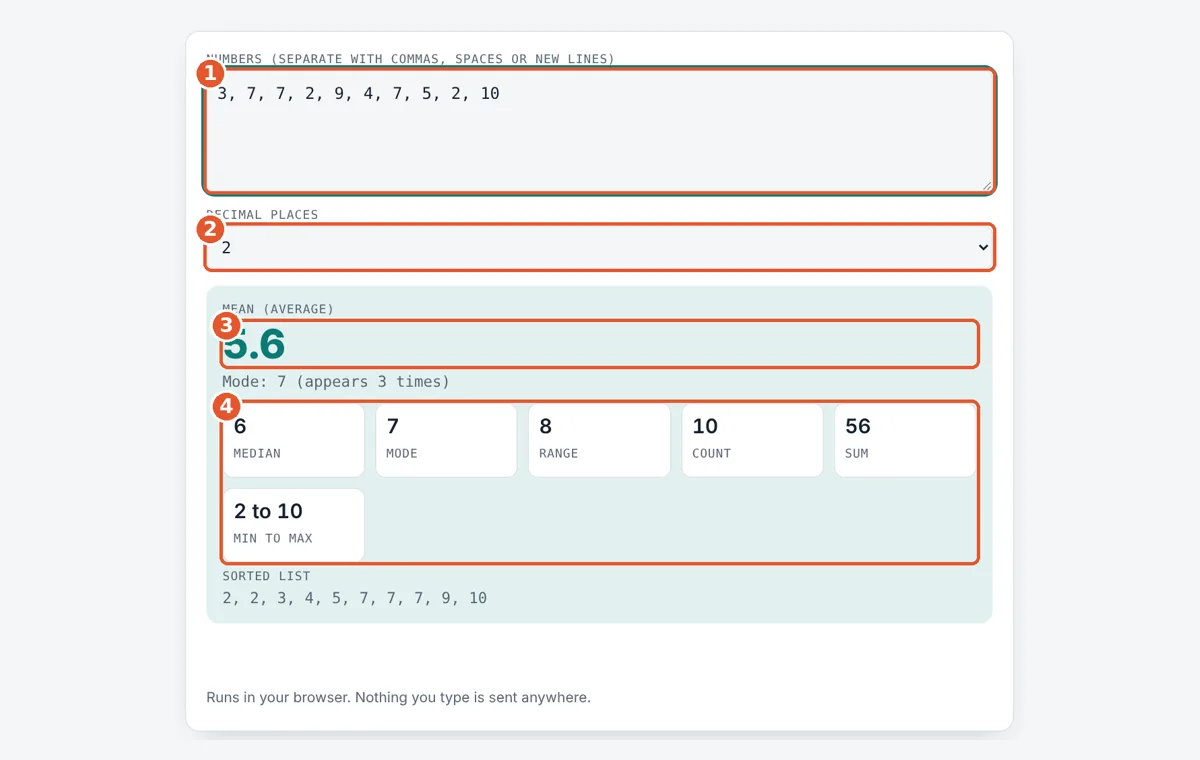
Enter your numbers
Type or paste the values into the box, separated by commas, spaces or new lines.
Pick decimal places
Choose how many decimal places to show for the mean and the other results.
Read the mean
The big number is the mean. The line under it names the mode or modes.
Check the other stats
The boxes show the median, mode, range, count, sum and the sorted list.
Frequently Asked Questions
What is the mode if two numbers appear equally often?
If two numbers tie for the most appearances, the data set has two modes and is called bimodal. For 1, 2, 2, 3, 3, 4 both 2 and 3 appear twice, so the modes are 2 and 3. This tool lists every tied value.
Is the median always one of the numbers in the list?
No. With an odd count the median is one of the values, but with an even count it is the average of the two middle values. For 5, 1, 9, 3 the sorted middle pair is 3 and 5, so the median is 4.
Which is better to use, mean or median?
Use the median when the data has outliers or is skewed, such as house prices or incomes, because one extreme value barely moves it. Use the mean when the values are fairly even, since it uses every number in the set.
Can the mean be a decimal when all numbers are whole?
Yes. The mean of 1, 2 and 2 is 5 ÷ 3, which is about 1.67. The mean only stays whole when the sum divides evenly by the count. Choose more decimal places in the tool to see extra digits.
How is the range different from the other results?
The range is a measure of spread, not of center. It is the largest value minus the smallest, so for 2 to 10 the range is 8. It only uses two values, which makes it very sensitive to outliers.
Can I enter negative numbers and decimals?
Yes. Negative numbers like −1 and decimals like 2.5 both work. For 2.5, −1, 4 the tool gives a mean of 1.83, a median of 2.5, a range of 5 and no mode, because every value appears once.
Sources and Further Reading
- NIST/SEMATECH e-Handbook of Statistical Methods: Measures of Location
- Wikipedia: Mode (statistics)
- Wikipedia: Median
Related Tools
Last reviewed: October 2026