Type a speed in knots and get miles per hour at once, or switch direction to turn mph into knots. Km/h, meters per second and the Beaufort wind force are shown too.
Uses 1 knot = 1.852 km/h and 1 mile = 1.609344 km, both exact. Runs in your browser. Nothing you type is sent anywhere.
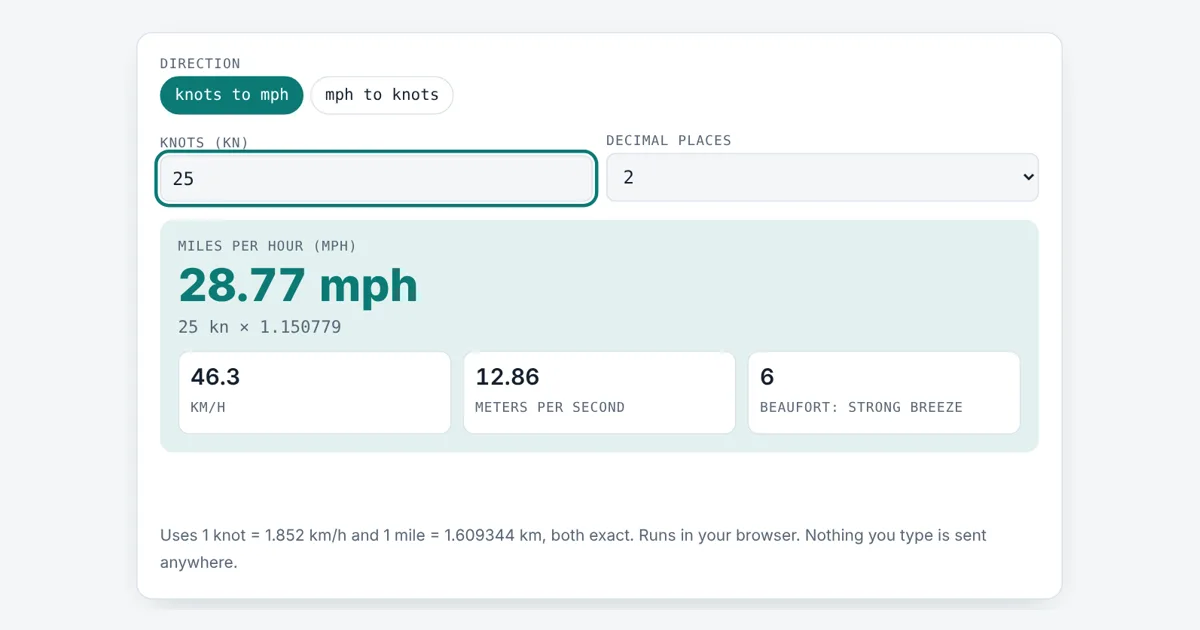
This knots to mph converter is for sailors, pilots, anglers, kite surfers and anyone reading a marine or aviation forecast. Boats, aircraft and wind reports use knots, while road signs in the US and UK use miles per hour. The tool uses the exact definitions of the nautical mile and the statute mile, and it tells you the Beaufort force for a wind speed.
How Do You Convert Knots to MPH?
To convert knots to mph, multiply by 1.150779, because one knot is one nautical mile per hour, 1,852 meters, and a statute mile is 1,609.344 meters. For example, a 25 knot wind × 1.150779 = 28.77 mph, or 46.3 km/h. To go back, multiply mph by 0.868976, so 60 mph is 52.14 knots.
Why Is a Knot Faster Than a Mile per Hour?
A knot is faster because a nautical mile, 1,852 meters, is longer than a statute mile, 1,609.344 meters, so one knot is about 15 percent faster than one mph.
1 mph = 1.609344 km/h (exact)
mph = knots × 1.150779
knots = mph × 0.868976
m/s = knots × 0.514444
The nautical mile was first based on one minute of latitude, so charts and navigation use it naturally. In 1929 the International Hydrographic Conference fixed it at exactly 1,852 m, and the US adopted that value in 1954. The knot is one nautical mile per hour. The name comes from the old log line, a rope with knots tied at regular spaces that sailors let out behind the ship and counted against a sand glass. The statute mile is the land mile of 5,280 feet. The International Civil Aviation Organization (ICAO) uses knots for airspeed and wind.
What Is the Knots to MPH Conversion Table?
Values from this tool, rounded to 2 decimal places:
| Knots | mph | km/h | m/s |
|---|---|---|---|
| 1 | 1.15 | 1.85 | 0.51 |
| 5 | 5.75 | 9.26 | 2.57 |
| 10 | 11.51 | 18.52 | 5.14 |
| 15 | 17.26 | 27.78 | 7.72 |
| 20 | 23.02 | 37.04 | 10.29 |
| 25 | 28.77 | 46.3 | 12.86 |
| 30 | 34.52 | 55.56 | 15.43 |
| 40 | 46.03 | 74.08 | 20.58 |
| 50 | 57.54 | 92.6 | 25.72 |
| 64 | 73.65 | 118.53 | 32.92 |
| 100 | 115.08 | 185.2 | 51.44 |
What Does a Wind Speed in Knots Mean on the Beaufort Scale?
The Beaufort scale turns wind speed into a force number from 0 to 12, and the tool shows the force for any speed you enter.
The scale was created by Admiral Francis Beaufort in 1805 and is still used in shipping forecasts. Force 4, 11 to 16 knots, is a moderate breeze with small waves. Force 6, 22 to 27 knots, is a strong breeze, which many small boat sailors treat as their limit. Force 8, gale, starts at 34 knots, and force 12, hurricane force, starts at 64 knots, about 73.65 mph. Bands are based on the speed rounded to the nearest knot. For road speeds, use the mph to km/h converter, and for distances the km to miles converter.
Worked Example
A sailor reads a forecast of 25 knots for the afternoon and a friend asks what that means in mph. Type 25 with knots to mph selected: the tool shows 28.77 mph, which is 46.3 km/h or 12.86 m/s, and Beaufort force 6, strong breeze. Later a pilot friend says the car drove at 60 mph on the way to the airfield. Switch to mph to knots and type 60 to see 52.14 knots.
How Do You Use the Knots to MPH Converter?
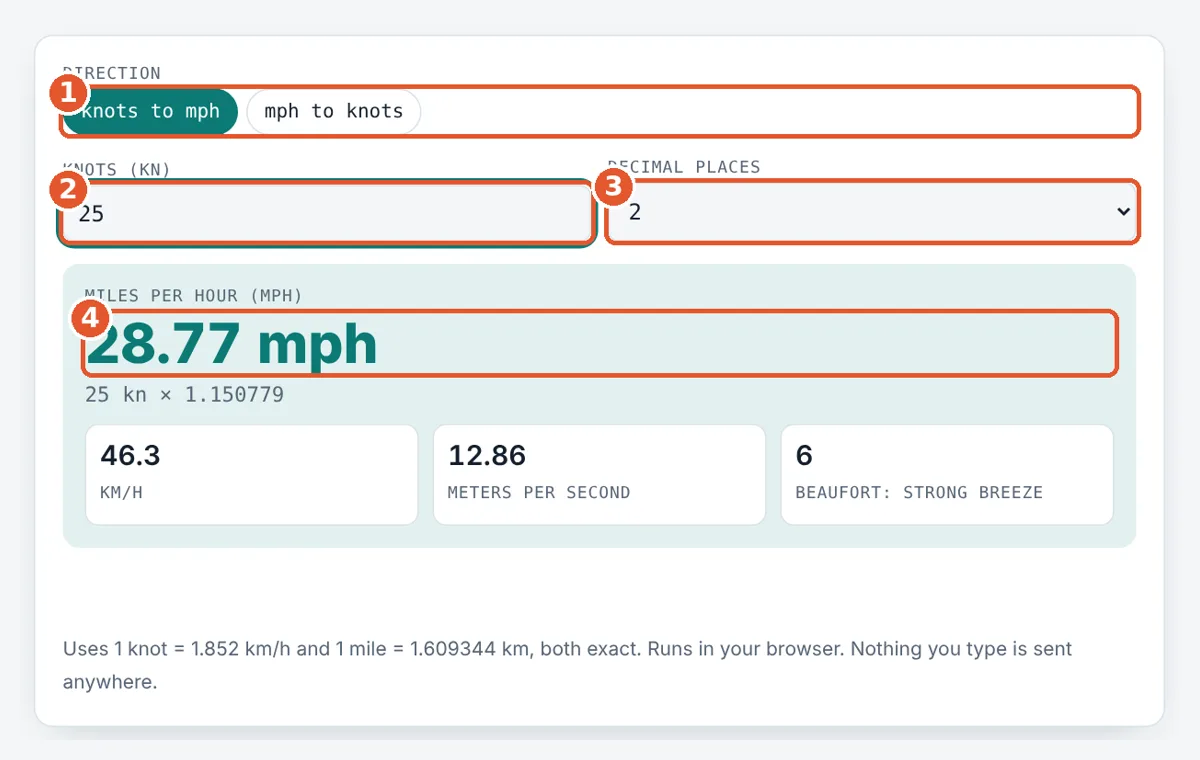
Pick a direction
Choose knots to mph, or mph to knots if your number is in miles per hour.
Type the speed
Enter the speed, such as 25 for a wind forecast or 450 for a jet.
Choose decimal places
Use 0 or 1 for forecasts, or more for exact work.
Read the result
The big number is the converted speed, with km/h, m/s and the Beaufort force below.
Frequently Asked Questions
How fast is 1 knot in mph?
One knot is 1.150779 mph, about 1.15 mph. It is also exactly 1.852 km/h and about 0.514 meters per second. A boat at 10 knots is moving at about 11.5 mph.
How many knots is 100 mph?
100 mph is 86.9 knots. Multiply 100 by 0.868976 to get 86.8976 knots. In km/h, 100 mph is 160.93, and on the Beaufort scale that is force 12, hurricane force.
Why do ships and planes use knots?
A nautical mile matches one minute of latitude on a chart, so distances and speeds in knots work directly with charts and map grids. ICAO and the world's navies use knots for this reason.
Is a nautical mile the same as a mile?
No. A nautical mile is exactly 1,852 meters, while a statute mile on land is 1,609.344 meters. So a nautical mile is about 1.15 statute miles, or 6,076 feet.
What wind speed in knots is a gale?
A gale, Beaufort force 8, is 34 to 40 knots, which is about 39 to 46 mph. Force 9, severe gale, is 41 to 47 knots, and storm force 10 begins at 48 knots.
How fast is a cruise ship in knots?
Many large cruise ships cruise at about 18 to 22 knots, which is roughly 21 to 25 mph. Put 20 knots in the tool and it gives 23.02 mph, or 37.04 km/h.
Sources and Further Reading
- NIST Guide to the SI, Appendix B.9: velocity factors, knot = 0.5144444 m/s
- Met Office: The Beaufort wind force scale
- NOAA National Weather Service: Beaufort wind scale
Related Tools
Last reviewed: October 2026