Enter the area, the R-value you want and what is already there, pick fiberglass batts, blown cellulose or spray foam, and get the thickness and how many packs, bags or kits to buy.
Based on a settled density of about 1.55 lb/ft³. Always check the coverage chart on the bag.
Runs in your browser. Nothing you type is sent anywhere.
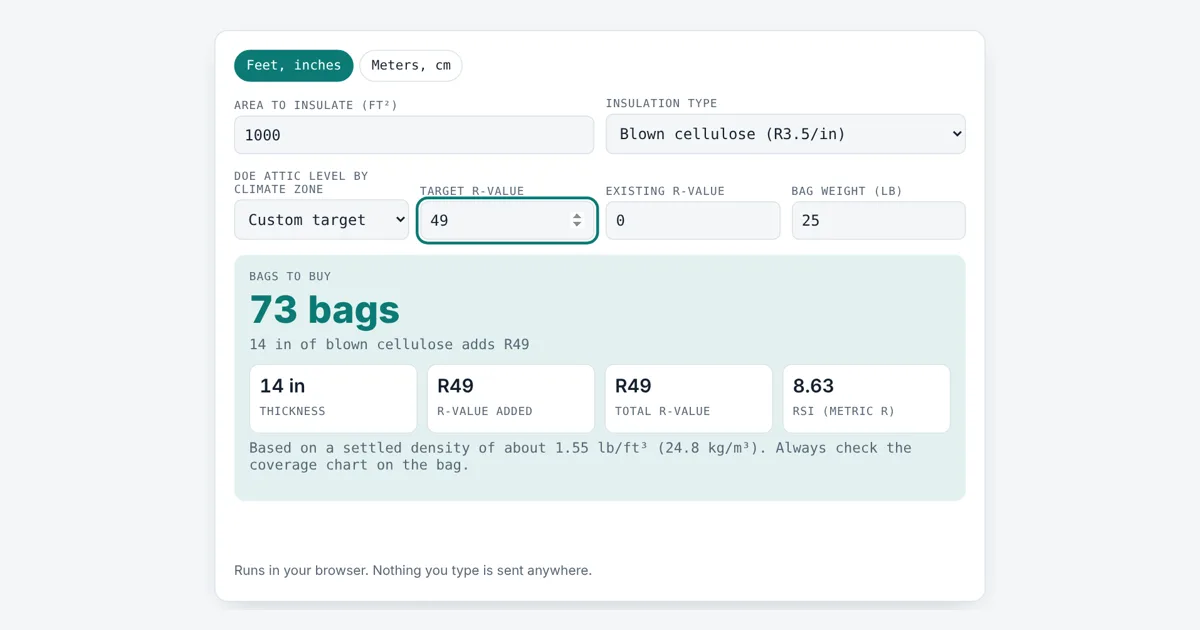
This insulation calculator is for homeowners and DIY installers topping up an attic, floor or wall. Pick a material, enter the area and a target R-value or a US Department of Energy climate zone level, and you get the thickness needed, the R-value added and how many bags, batt packs or spray foam kits to buy.
How Do You Calculate How Much Insulation You Need?
Subtract your existing R-value from the target, then divide by the R-value per inch of the material to get the thickness. Blown cellulose is about R3.5 per inch, so R49 needs 14 inches. Over 1,000 square feet at about 1.55 lb per cubic foot, that is 73 bags of 25 lb.
What Is R-Value in Insulation?
R-value is a measure of how well insulation resists heat flow, and a higher number means better insulation.
The US Department of Energy notes that R-value depends on the type, thickness and density of the material, and that layers add up, so R19 on top of R30 gives R49. Squashed insulation loses part of its rating, so never compress batts into a shallow space. Outside the US the same idea is written as RSI, in m²·K/W, where RSI = R × 0.1761. R49 is about RSI 8.6.
thickness (in) = R needed ÷ R per inch
cellulose bags = area (ft²) × thickness (in) ÷ 12 × 1.55 lb/ft³ ÷ bag weight
batt layers = round up (R needed ÷ batt R)
spray foam board feet = area (ft²) × thickness (in)
What R-Value Insulation Do I Need for My Attic?
The US Department of Energy recommends R30 to R49 for an uninsulated attic in Zone 1, R49 to R60 in Zones 2 and 3, and R60 in Zones 4 to 8.
Zones run from 1 in the hottest south, such as Hawaii and south Florida, to 7 and 8 in the far north and Alaska, and match the International Energy Conservation Code map. The DOE table also lists floors, from R13 in warm zones to R38 in the coldest.
| Climate zone | Uninsulated attic | Attic with 3 to 4 in | Floor |
|---|---|---|---|
| 1 | R30 to R49 | R19 to R38 | R13 |
| 2 | R49 to R60 | R38 to R49 | R13 |
| 3 | R49 to R60 | R38 to R49 | R19 |
| 4 (not marine) | R60 | R49 | R19 |
| 4 marine and 5 | R60 | R49 | R30 |
| 6 | R60 | R49 | R30 |
| 7 and 8 | R60 | R49 | R38 |
Which Insulation Type Has the Highest R-Value per Inch?
Closed cell spray foam has the highest R-value per inch of the common home materials, at about R6.5, roughly twice that of fiberglass or cellulose.
| Material | Typical R per inch | Thickness for R38 | Thickness for R49 |
|---|---|---|---|
| Fiberglass batts | about 3.0 to 3.7 | 12 in (R-38 batt) | about 16 in (R-30 + R-19) |
| Blown cellulose | about 3.5 | 10.9 in | 14 in |
| Open cell spray foam | about 3.6 | 10.6 in | 13.6 in |
| Closed cell spray foam | about 6.5 | 5.8 in | 7.5 in |
Fiberglass batts are pre-cut blankets sized to fit between studs and joists. Blown cellulose is loose-fill recycled paper, treated for fire and pests, that fills gaps around wires and pipes. Spray foam expands to seal air leaks as well as insulate, and is sold by the board foot, a square foot of foam 1 inch thick. These per inch values are typical figures from DOE guides and maker data; the label on the product you buy is the number to trust.
Is It Worth Adding More Attic Insulation?
Adding attic insulation is usually worth it when you have less than the DOE level for your zone, because the attic is where most heat is lost or gained through the ceiling.
Seal air leaks around lights, pipes and the attic hatch first, since moving air bypasses insulation. To see what the heating or cooling costs you now, the electricity cost calculator turns watts and hours into money, and the BTU calculator shows how a better insulated room changes the heating or cooling size you need. For the attic floor area itself, the square footage calculator adds up odd shapes.
Worked Example
A homeowner in Zone 2 has 1,000 square feet of attic floor with no insulation and wants R49. With blown cellulose and 25 lb bags, the tool shows 73 bags and 14 in of settled depth, RSI 8.63. If 3 inches of old fiberglass at about R11 is already there, entering 11 as the existing R-value drops it to 10.9 in and 57 bags. With fiberglass instead, R-19 batts need 2 layers for R38, or 50 packs at 40 ft² each over 1,000 ft². For 500 ft² of closed cell foam at R21, it gives 3.2 in (8.2 cm in metric mode), 1,615 board feet and 3 kits of 600 board feet.
How Do You Use the Insulation Calculator?
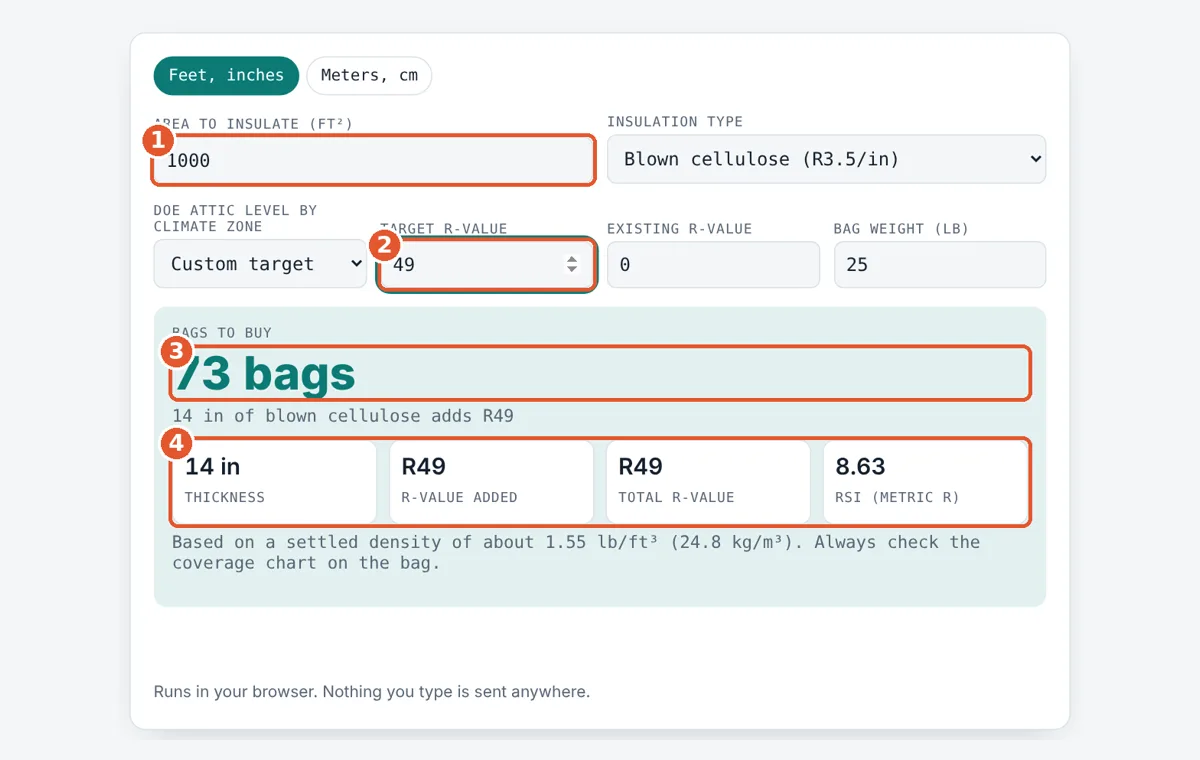
Pick units and area
Choose feet or meters, then type the area you plan to insulate.
Choose material and target
Select the insulation type, a DOE climate zone or your own target R-value, and any existing R-value.
Read what to buy
The big number shows the bags, batt packs or spray foam kits you need.
Check thickness and R-value
The boxes show the depth, R-value added, total R-value and the metric RSI.
Frequently Asked Questions
How many inches of blown insulation do I need for R60?
About 17 inches of blown cellulose gives R60, at roughly R3.5 per inch. Loose-fill fiberglass is lower per inch, often near R2.5, so it needs closer to 22 to 24 inches. The bag chart lists the exact settled depth.
Can I put new insulation over old insulation?
Yes, as long as the old insulation is dry and free of mold or pests. Add the R-values together. Use unfaced batts or loose fill on top, because a kraft facing between layers can trap moisture.
How many bags of blown insulation for 1,000 square feet?
For R38 with cellulose, about 57 bags of 25 lb; for R49, about 73 bags. That assumes roughly 1.55 lb per cubic foot settled. Maker charts vary, so read the bag before you buy.
What is the difference between R-value and RSI?
R-value uses US units, ft²·°F·h/Btu. RSI is the metric version in m²·K/W, used in Canada, the UK and Europe. Multiply R by 0.1761 to get RSI, so R49 equals about RSI 8.6.
Does compressing insulation lower its R-value?
Yes. The US DOE says compressed insulation does not give its full rated R-value. A 10 inch R-30 batt squeezed into a 2 × 6 cavity, which is 5.5 inches deep, performs well below R30.
How many layers of R-19 batts make R38?
Two layers of R-19 batts make R38, because R-values add up. Lay the second layer at right angles across the joists to cover the wood, which otherwise acts as a thermal bridge.
Sources and Further Reading
- US Department of Energy, Energy Saver: Insulation and recommended R-values
- US Department of Energy, Energy Saver: Types of insulation
- ENERGY STAR: Recommended home insulation R-values
Related Tools
Last reviewed: October 2026