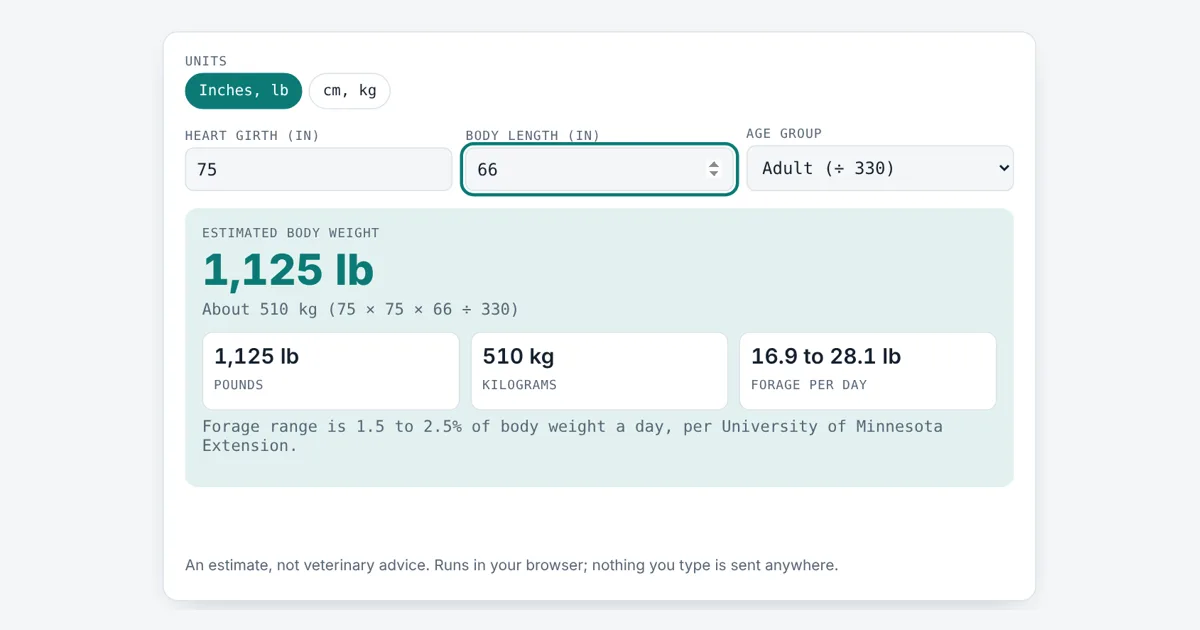
Measure your horse’s heart girth and body length with a soft tape, type them in, and get an estimated body weight in pounds and kilograms plus a daily forage range.
Forage range is 1.5 to 2.5% of body weight a day, per University of Minnesota Extension.
An estimate, not veterinary advice. Runs in your browser; nothing you type is sent anywhere.
This horse weight calculator is for owners, riders and yard managers who need a working weight for feeding, wormer doses or trailer loads but have no livestock scale. It uses the heart girth and body length formula taught by university extension services, in inches and pounds or in centimeters and kilograms.
How Do You Estimate a Horse's Weight Without a Scale?
Measure heart girth and body length in inches, then use heart girth × heart girth × body length ÷ 330 to get pounds. A horse with a 75 inch girth and 66 inch body length weighs about 75 × 75 × 66 ÷ 330 = 1,125 lb, or 510 kg. In metric, divide by 11,880 to get kilograms.
What Is the Horse Weight Formula?
The standard horse weight formula is weight in pounds = heart girth² × body length ÷ 330, with both measurements in inches.
weight (kg) = girth (cm) × girth (cm) × length (cm) ÷ 11,880
yearlings: ÷ 301 (in) or ÷ 10,836 (cm)
weanlings: ÷ 280 (in) or ÷ 10,080 (cm)
The metric version comes from the study by Carroll and Huntington (1988), who worked out a divisor of about 11,877, usually rounded to 11,880. The two versions agree to within about half a percent. Oregon State University Extension lists 301 for yearlings and 280 for weanlings, and the metric divisors here are scaled the same way.
How Do You Measure Heart Girth and Body Length?
Measure heart girth around the barrel just behind the elbow and over the highest point of the withers, pulling the tape snug at the end of a breath out. Measure body length in a straight line from the point of the shoulder to the point of the buttock, which usually needs a helper. University of Arkansas Extension advises a plastic tape at least 75 inches long, a horse standing square on level ground, and measuring at the same time of day, ideally before feeding. If your tape is in inches but your feed chart is metric, the inches to cm converter and the kg to lbs converter will switch them for you.
How Accurate Is a Horse Weight Estimate?
A girth and length estimate is a good working figure for an adult riding horse and is far better than guessing by eye, but it can still be off by 10% or more for some horses. It is less accurate for ponies, miniature horses, foals, draft horses, pregnant mares and very fat or very thin horses. University of Minnesota research produced separate breed equations for ponies, minis, drafts and warmbloods for this reason. A plain girth only weight tape is quicker but less accurate, since it ignores body length. Track the same horse with the same method each month: the trend matters more than any single number. Pair weight with a body condition score from your vet for the full picture.
Horse Weight by Heart Girth and Body Length
Example adult results from the formula, rounded:
| Girth (in) | Length (in) | Weight (lb) | Weight (kg) |
|---|---|---|---|
| 60 | 55 | 600 | 272 |
| 70 | 64 | 950 | 431 |
| 75 | 66 | 1,125 | 510 |
| 80 | 72 | 1,396 | 633 |
| 85 | 76 | 1,664 | 755 |
Worked Example
Jo’s mare has a heart girth of 75 inches and a body length of 66 inches. The tool works out 75 × 75 × 66 ÷ 330 and shows 1,125 lb, about 510 kg. At 1.5 to 2.5% of body weight, she needs 16.9 to 28.1 lb of forage a day. In metric, a horse measuring 190 cm girth and 168 cm length gives 190 × 190 × 168 ÷ 11,880 = 511 kg. A weanling with a 50 inch girth and 40 inch length, using the 280 divisor, comes out at 357 lb.
How Do You Use the Horse Weight Calculator?
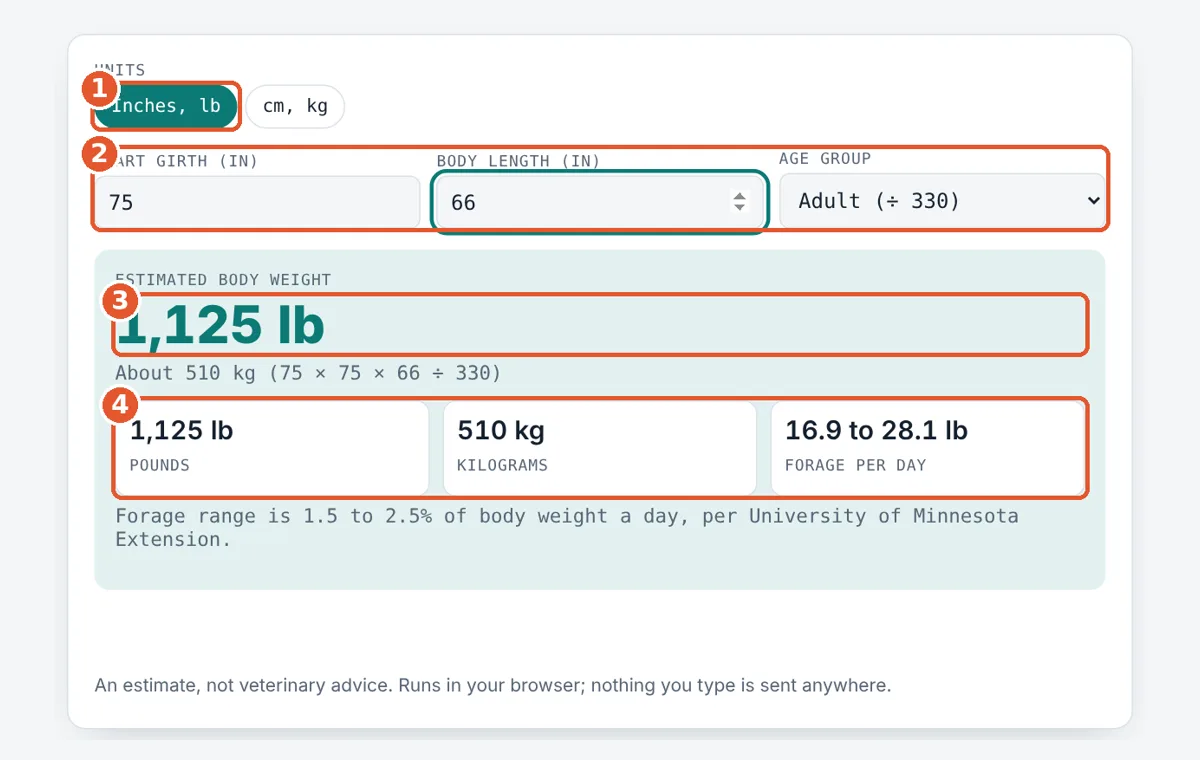
Pick your units
Tap Inches, lb or cm, kg to match your tape measure.
Enter the measurements
Type heart girth and body length, then pick adult, yearling or weanling.
Read the weight
The big number is the estimated weight, with the other unit below.
Check forage per day
The boxes show pounds, kilograms and a daily forage range.
Frequently Asked Questions
How much does an average horse weigh?
Most light riding horses weigh about 900 to 1,200 lb, or 410 to 545 kg. Ponies are often 400 to 800 lb, while draft breeds can top 1,800 lb. Use the formula above with your own horse's measurements for a better figure.
Does the formula work for ponies and foals?
It works less well. The 330 divisor was built for adult horses, and ponies, minis and foals have different body shapes. Use the yearling or weanling setting for young stock, and weigh small or growing animals on a scale when doses matter.
How much hay should my horse eat per day?
University of Minnesota Extension advises 1.5 to 2.5% of body weight in forage a day, and at least 1%. A 1,125 lb horse needs about 16.9 to 28.1 lb of hay or pasture dry matter daily.
Why does the metric formula use 11,880?
It comes from Carroll and Huntington's 1988 study, which found about 11,877 for weight in kg with girth and length in cm. Converting the 330 imperial divisor exactly gives about 11,922, so the two versions differ by less than half a percent.
How often should I weigh my horse?
Every 2 to 4 weeks is a good routine, and more often during a diet, after illness, or for growing youngsters. Measure at the same time of day, with the same tape and the same helper, so the changes you see are real.
Can I use horse weight to dose wormer?
You can use it to choose a dose, but ask your vet first. Most labels dose by weight bands, and underdosing helps worms become resistant. If your horse sits near the top of a band, dose for the next band up.
Sources and Further Reading
- Oregon State University Extension: Livestock weight calculator
- University of Arkansas Cooperative Extension: Estimating a horse's weight
- University of Minnesota Extension: Estimating horse bodyweight
- University of Minnesota Extension: Ten things to know about feeding the mature horse
Related Tools
Last reviewed: October 2026