Convert grams to cups for flour, sugar, butter, oats, rice and 20 more baking ingredients, using measured USDA cup weights. Choose a metric cup (250 ml) or a US cup, or switch direction to turn cups into grams.
Cup weights are averages of real measurements, and how you fill the cup changes them. For baking, a kitchen scale is always more accurate.

This grams to cups converter is for home bakers who need to move between a recipe written in weights and one written in cups: a UK or Irish cook using an American recipe, someone with an Australian or Canadian metric cup set, or anyone without a scale to hand. Grams measure weight and cups measure volume, so there is no single answer. The converter uses the weight of a measured cup for each ingredient, taken from a United States Department of Agriculture study, and shows the result in both metric and US cups.
How many grams are in a cup?
It depends on the ingredient. A US cup (236.6 ml) holds about 126 g of spooned plain flour, 196 g of granulated sugar and 237 g of water, according to USDA measurements. To convert grams to cups, divide the grams by the ingredient’s grams per cup: 250 g of flour is about 2 US cups.
What is the formula for converting grams to cups?
Divide the weight by the ingredient’s density to get its volume, then divide by the size of your cup. The density comes from the measured weight of one US cup of that ingredient.
Cups = grams ÷ density ÷ cup size in ml
Grams = cups × cup size in ml × density
For plain flour, 126 ÷ 236.6 gives 0.53 g per ml. So 250 g of flour is 250 ÷ 0.53 = 469 ml, which is 1.88 metric cups of 250 ml or 1.98 US cups. The USDA report itself notes that to move from its 237 ml cup to a 250 ml metric cup you multiply the weight by about 1.055, which is exactly what the converter does when you pick the metric cup.
Grams per cup chart for common ingredients
Average weight of one level cup, with dry ingredients spooned lightly into the cup unless stated:
| Ingredient | US cup (236.6 ml) | Metric cup (250 ml) | Cups per 100 g (US) |
|---|---|---|---|
| Plain flour, spooned | 126 g | 133 g | 0.79 |
| Plain flour, sifted | 116 g | 123 g | 0.86 |
| Plain flour, scooped | 143 g | 151 g | 0.70 |
| Strong (bread) flour | 123 g | 130 g | 0.81 |
| Self-raising flour | 127 g | 134 g | 0.79 |
| Wholemeal flour | 120 g | 127 g | 0.83 |
| Granulated sugar | 196 g | 207 g | 0.51 |
| Caster sugar | 197 g | 208 g | 0.51 |
| Brown sugar, packed | 211 g | 223 g | 0.47 |
| Icing sugar, unsifted | 113 g | 119 g | 0.88 |
| Cocoa powder | 86 g | 91 g | 1.16 |
| Rolled oats | 75 g | 79 g | 1.33 |
| White rice, uncooked | 192 g | 203 g | 0.52 |
| Block margarine | 225 g | 238 g | 0.44 |
| Cooking oil | 209 g | 221 g | 0.48 |
| Whole milk | 241 g | 255 g | 0.41 |
| Honey | 325 g | 343 g | 0.31 |
| Table salt | 292 g | 309 g | 0.34 |
US cup figures are the averages in USDA Home Economics Research Report No. 41, Average Weight of a Measured Cup of Various Foods. Metric cup figures are scaled to 250 ml. The study measured regular margarine rather than butter, so the converter labels it clearly and you can use it for firm butter as a close guide.
Worked example: a British recipe in American cups
Niamh in Galway is sending her chocolate cake recipe to a friend in Boston who only has US measuring cups. The recipe calls for 300 g plain flour, 200 g caster sugar and 50 g cocoa powder. Flour: 300 ÷ 126 = 2.38 US cups, which the converter writes as 2 1/3 cups + 1 tbsp. Caster sugar: 200 ÷ 197 = 1.02, so 1 cup. Cocoa: 50 ÷ 86 = 0.58, or 1/2 cup + 1 tbsp. She also converts the oven temperature with the Celsius to Fahrenheit converter: 180 °C is 356 °F, usually rounded to 350 °F on American ovens.
Why does the way you fill the cup change the weight?
Flour compresses, so the same cup can hold very different weights. In the USDA tests, a cup of plain flour weighed 116 g when sifted and spooned, 126 g when spooned straight from the bag and 143 g when the cup was dipped into the bag and levelled. That is a spread of 23 percent, enough to turn a soft cake into a dry one. The USDA study used the spoon and level method for dry ingredients: spoon the flour lightly into the cup, then level it off with a straight edge. Brown sugar was measured the opposite way, packed firmly into the cup. If the recipe does not say, use the spooned value.
What size is a cup in the UK, Europe and the US?
A US customary cup is 236.6 ml, and the US cup used on nutrition labels is 240 ml. Australia, Canada and New Zealand use a 250 ml metric cup, about 5 percent larger. There is no imperial measuring cup: older British recipes that say “a cup” usually meant an ordinary drinking cup or teacup. Across Europe, recipes normally weigh dry ingredients in grams, so cups only matter when you follow a recipe from North America or Australia. For liquids, the volume in the result is all you need, and the liters to gallons converter covers larger amounts.
How Do You Use the Grams to Cups Converter?
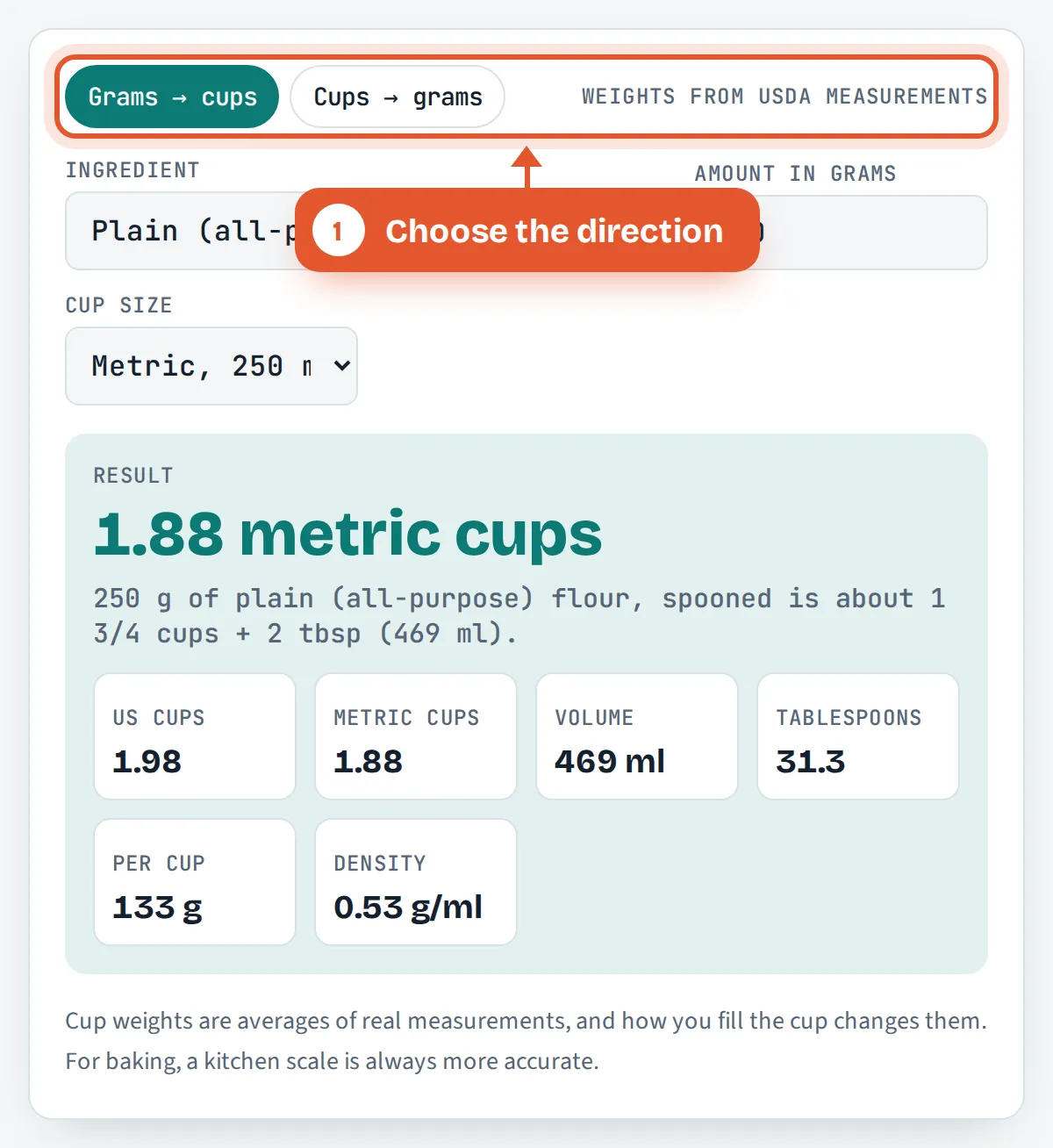
Choose the direction
Leave Grams → cups selected, or tap Cups → grams when your recipe is in cups and you want to weigh instead.

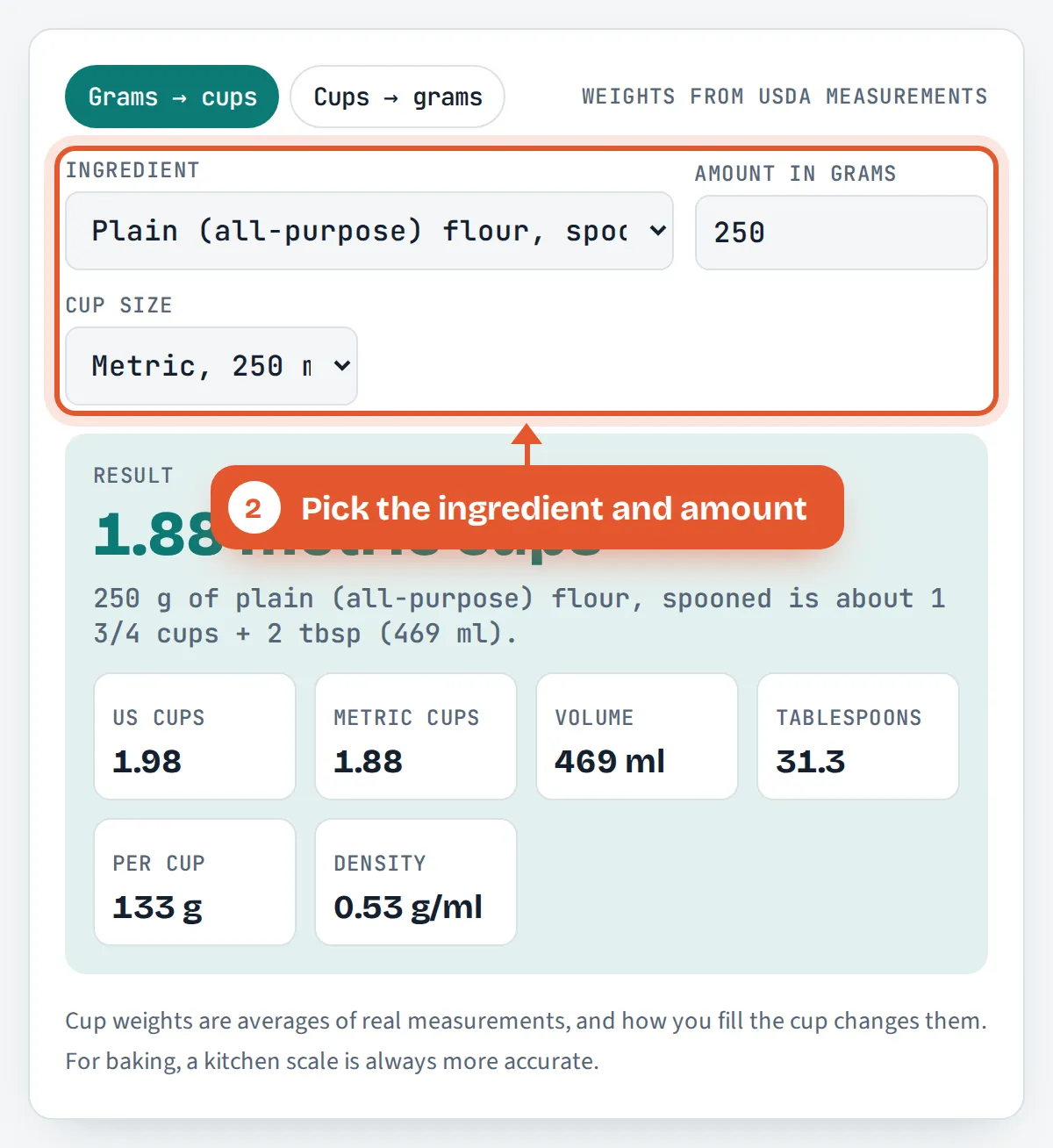
Pick the ingredient and amount
Select the ingredient, including how the flour is filled, then type the amount. Fractions like 1 1/2 work for cups.
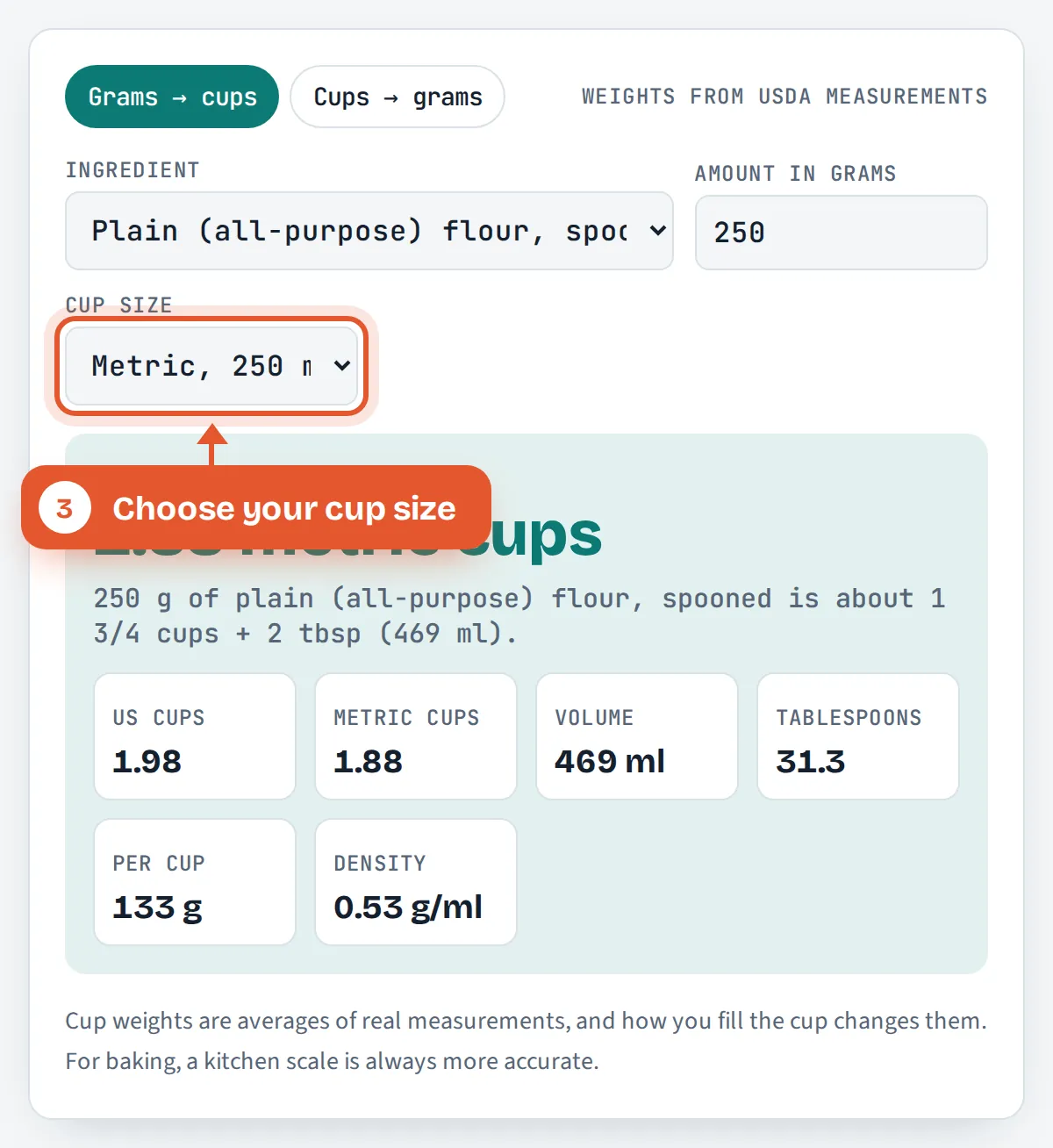
Choose your cup size
Pick the metric cup of 250 ml for Australian, Canadian or New Zealand recipes and 250 ml cup sets, or the US cup for American recipes.
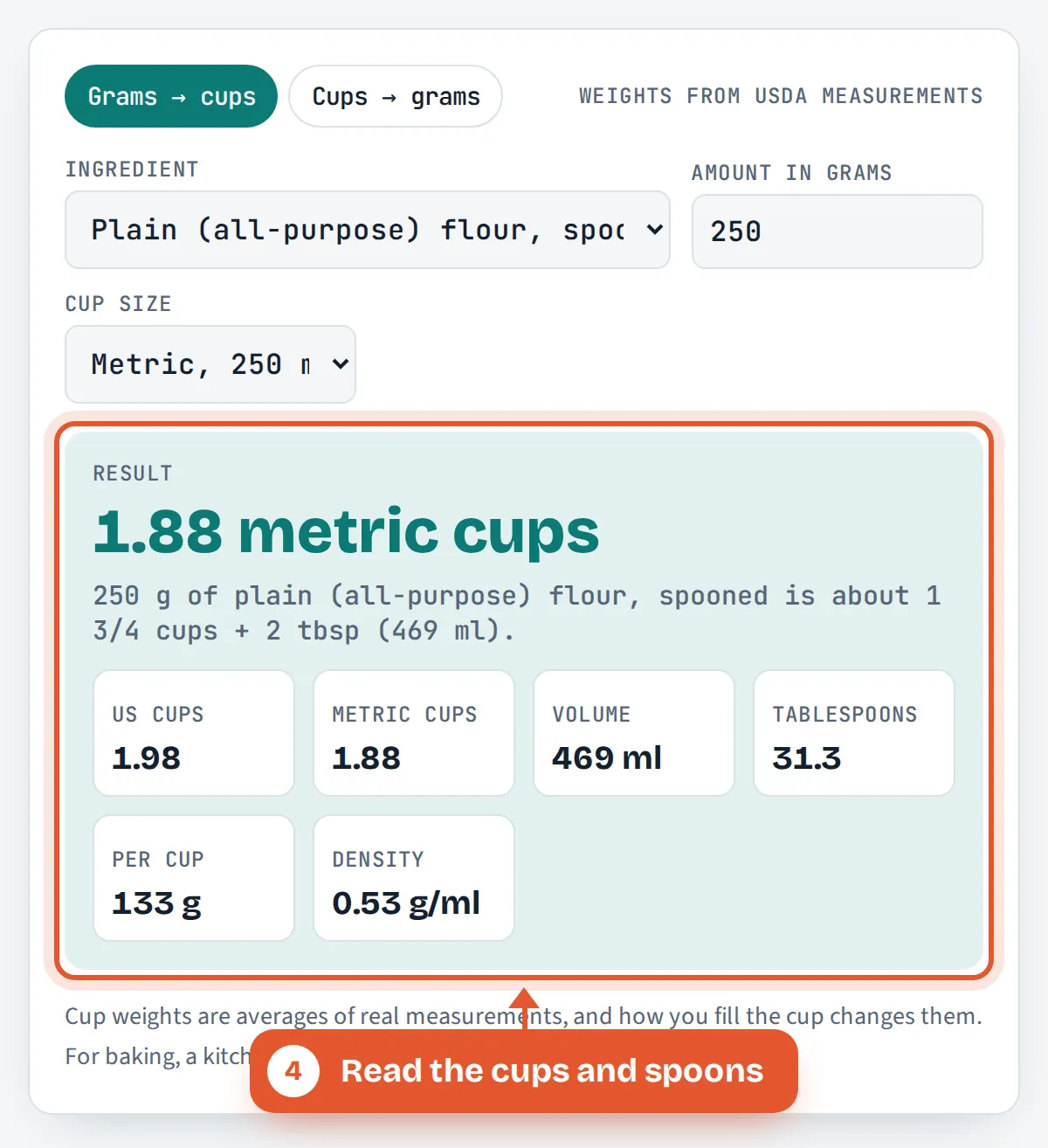
Read the cups and spoons
The result shows the exact cups, a practical measure in cups and tablespoons, and the same amount in US cups, metric cups and milliliters.
Frequently Asked Questions
How many cups is 100 g of flour?
100 g of spooned plain flour is about 0.79 US cups, a little over 3/4 cup, or 0.75 metric cups of 250 ml. If you scoop the cup straight into the bag, 100 g is only about 0.7 cups, because packed flour is heavier.
How many cups is 200 g of sugar?
200 g of granulated sugar is about 1.02 US cups, so one level cup is close enough for most recipes. In a 250 ml metric cup it is 0.97 cups. Packed brown sugar is heavier, so 200 g of it is about 0.95 US cups.
How many grams of butter are in a cup?
The USDA study measured block margarine at 225 g per US cup, and firm butter is close to this. In a 250 ml metric cup that is about 238 g. Butter is easier to weigh than to pack into a cup, so use the scale where you can.
Is a UK cup the same as a US cup?
There is no official UK or imperial measuring cup. A recipe that says cup means either a US cup of 236.6 ml or a metric cup of 250 ml, as used in Australia, Canada and New Zealand. They differ by about 5 percent, so check where the recipe comes from.
Why do different websites give different grams per cup?
Because the weight depends on how the cup is filled and on the cup size. Sifted, spooned and scooped flour differ by up to 23 percent, and some sites use 240 ml or 250 ml cups. This converter shows the measured method and lets you pick the cup.
Should I weigh or use cups for baking?
Weighing is more accurate, because a gram is the same whatever the ingredient or the way you fill a cup. Cups are fine for forgiving recipes like pancakes or flapjacks, but for bread, cakes and pastry a digital kitchen scale gives far more consistent results.
Sources and Further Reading
- Cup (unit): US, metric and other cup sizes, Wikipedia
- Cooking weights and measures, Wikipedia
- Fulton, Matthews and Davis, Average Weight of a Measured Cup of Various Foods, Home Economics Research Report No. 41, Agricultural Research Service, US Department of Agriculture, 1977
Related Tools
Last reviewed: October 2026