
Convert a date and time from one zone to another. Daylight saving is handled for the exact date, and all US zones plus big world cities are in the list.

This time zone converter came out of one too many calls where somebody showed up an hour early. Booking a chat with a client in London, a supplier in Shanghai or your aunt in Karachi isn’t hard math, but daylight saving makes it sneaky. The US and Europe change clocks on different weekends. Arizona mostly doesn’t bother at all. And India? Half an hour off from everyone, just to keep you humble. Pick a date, a time, two zones. Done. It leans on your browser’s own time zone database, so you get the offset that was (or will be) real on that exact day, not some rough average.
How do I convert time between time zones?
Take the start time back to UTC by subtracting its offset, then add the other place’s offset on top. Two steps. The time zone converter does both steps using whatever offsets apply on your date, so 9:00 AM in New York on October 5, 2026 (EDT, UTC−4) comes out as 2:00 PM in London (BST, UTC+1). Karachi’s at 6 PM by then, and over in India it’s 6:30.
The formula behind it
Target time = UTC time + UTC offset of the target zone
West of Greenwich the offsets go negative, and taking away a negative means adding. Nine in the morning at UTC−4 turns into 1 PM UTC. Yes, I still scribble this on a sticky note when it’s late and my brain’s mush.
US time zones and UTC offsets
| Zone | Standard time | Daylight time | Example city |
|---|---|---|---|
| Eastern | UTC−5 (EST) | UTC−4 (EDT) | New York |
| Central | UTC−6 (CST) | UTC−5 (CDT) | Chicago |
| Mountain | UTC−7 (MST) | UTC−6 (MDT) | Denver |
| Arizona | UTC−7 (MST) | No DST | Phoenix |
| Pacific | UTC−8 (PST) | UTC−7 (PDT) | Los Angeles |
| Alaska | UTC−9 (AKST) | UTC−8 (AKDT) | Anchorage |
| Hawaii | UTC−10 (HST) | No DST | Honolulu |
Same 9 AM New York call, three different dates
| City | Mon, Oct 5, 2026 | Wed, Oct 28, 2026 | Fri, Jan 15, 2027 |
|---|---|---|---|
| Los Angeles | 6:00 AM | 6:00 AM | 6:00 AM |
| London | 2:00 PM | 1:00 PM | 2:00 PM |
| India | 6:30 PM | 6:30 PM | 7:30 PM |
| Tokyo | 10:00 PM | 10:00 PM | 11:00 PM |
| Sydney | 12:00 AM (Tue) | 12:00 AM (Thu) | 1:00 AM (Sat) |
Funny thing about a recurring 9 AM call. It doesn’t sit still for everyone. London drifts an hour for one awkward week at the end of October, India and Tokyo shift once New York falls back in November, and Sydney does its own thing entirely since their summer is our winter. Got a standing meeting? I’d peek at one date per season before you hit save.
Watch the daylight saving gaps
The US jumps ahead on the second Sunday of March and drops back the first Sunday of November. Britain and the EU? Last Sunday of March, last Sunday of October. Different weekends, see. In 2026 that leaves New York only 4 hours behind London from March 8 to 28, and again October 25 to 31. I’ve been burned by that October week. Twice. Hawaii and most of Arizona never switch, and neither do Pakistan, India, China or Japan.
One more trap. On spring-forward night in the US, clocks jump from 1:59 AM straight to 3:00 AM, so 2:30 AM simply doesn’t happen that day. In November the 1 AM hour happens twice. Got something scheduled in one of those slots? Move it.
How to use the Time Zone Converter
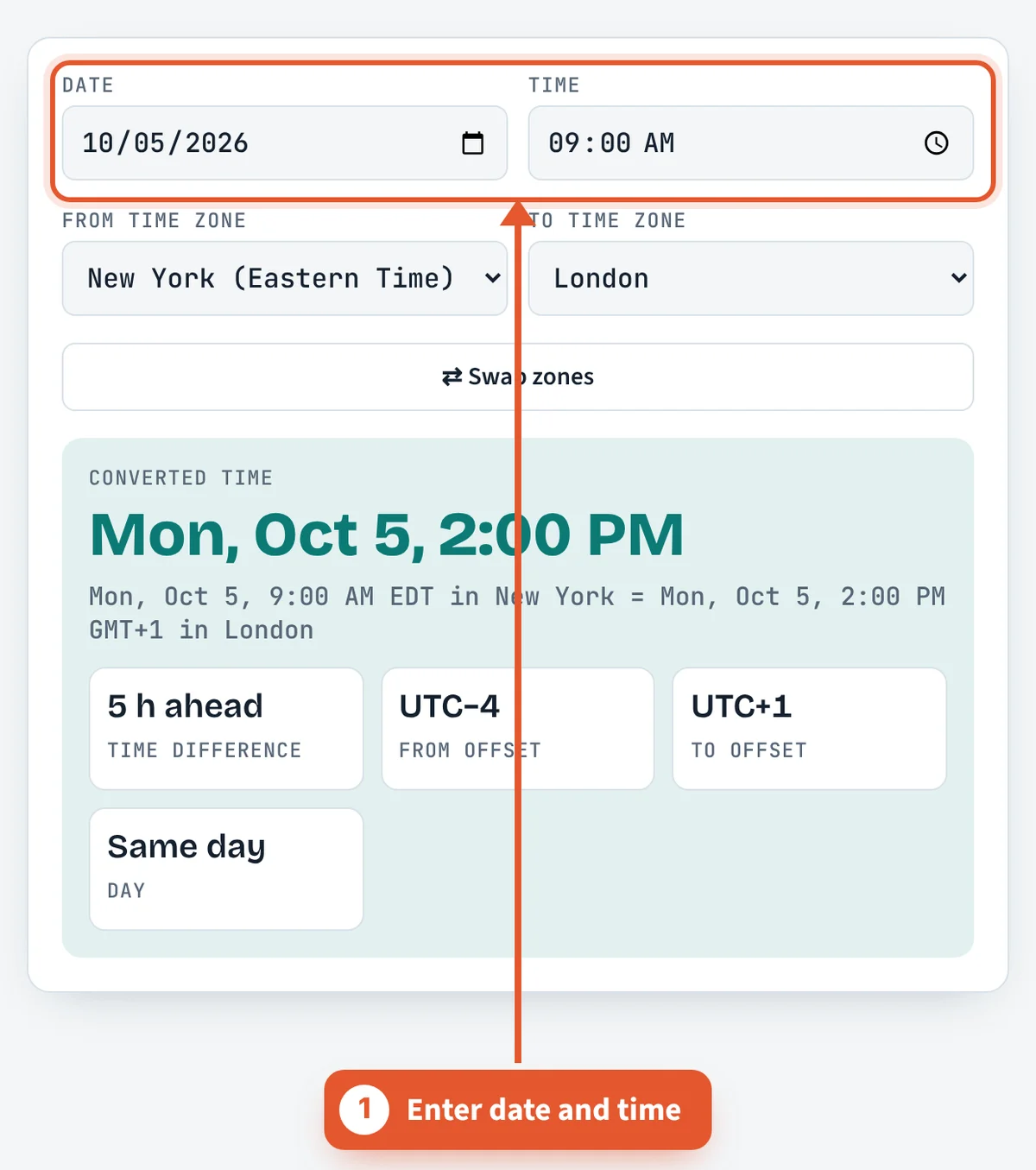
Enter the date and time
Day first, then the clock time you’re starting from. Please don’t skip the date. It’s literally the thing that decides if daylight saving kicks in.

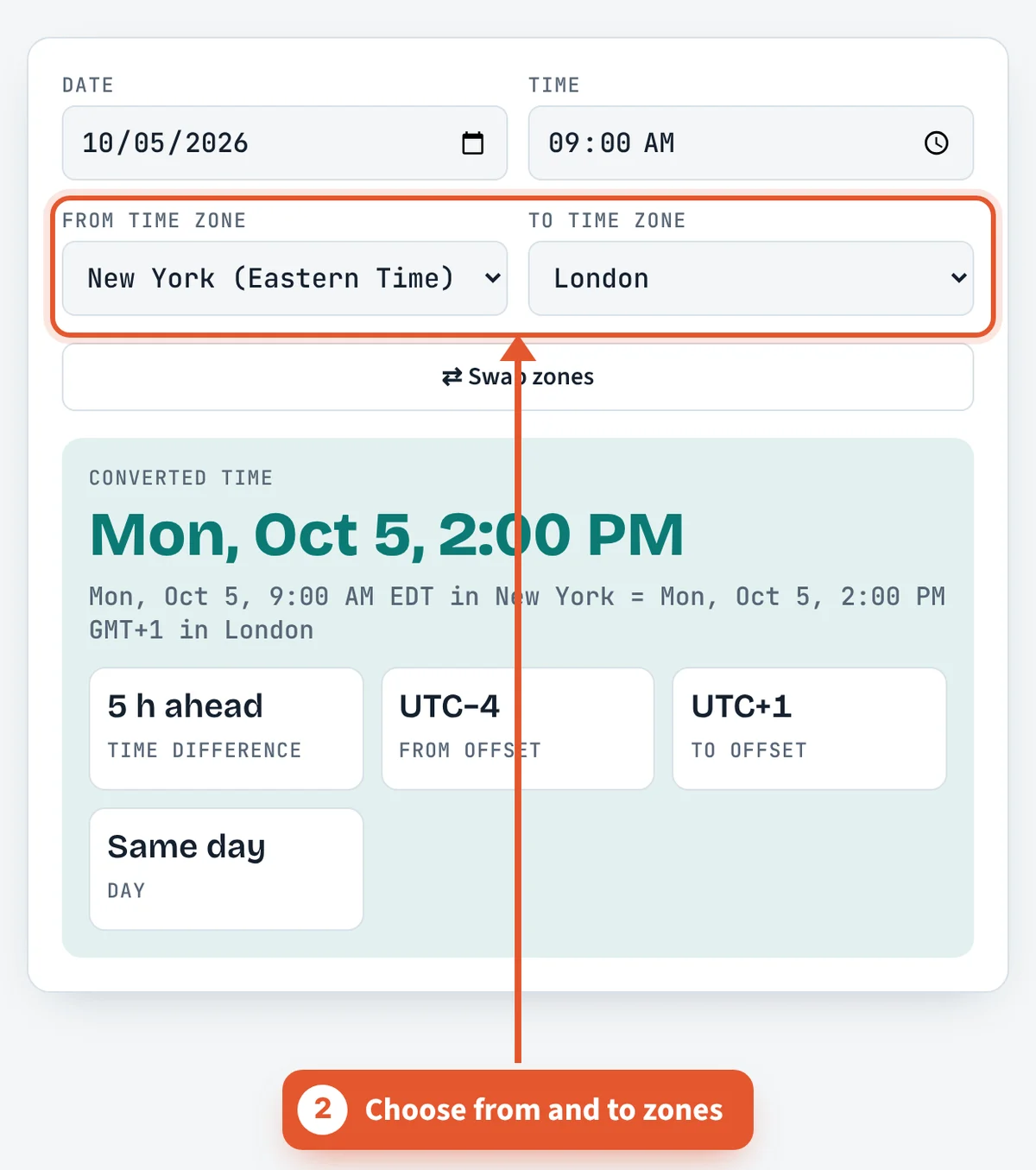
Choose both time zones
Set the zone the time is in, then the zone you want it shown in. Swap flips them if you got it backwards.
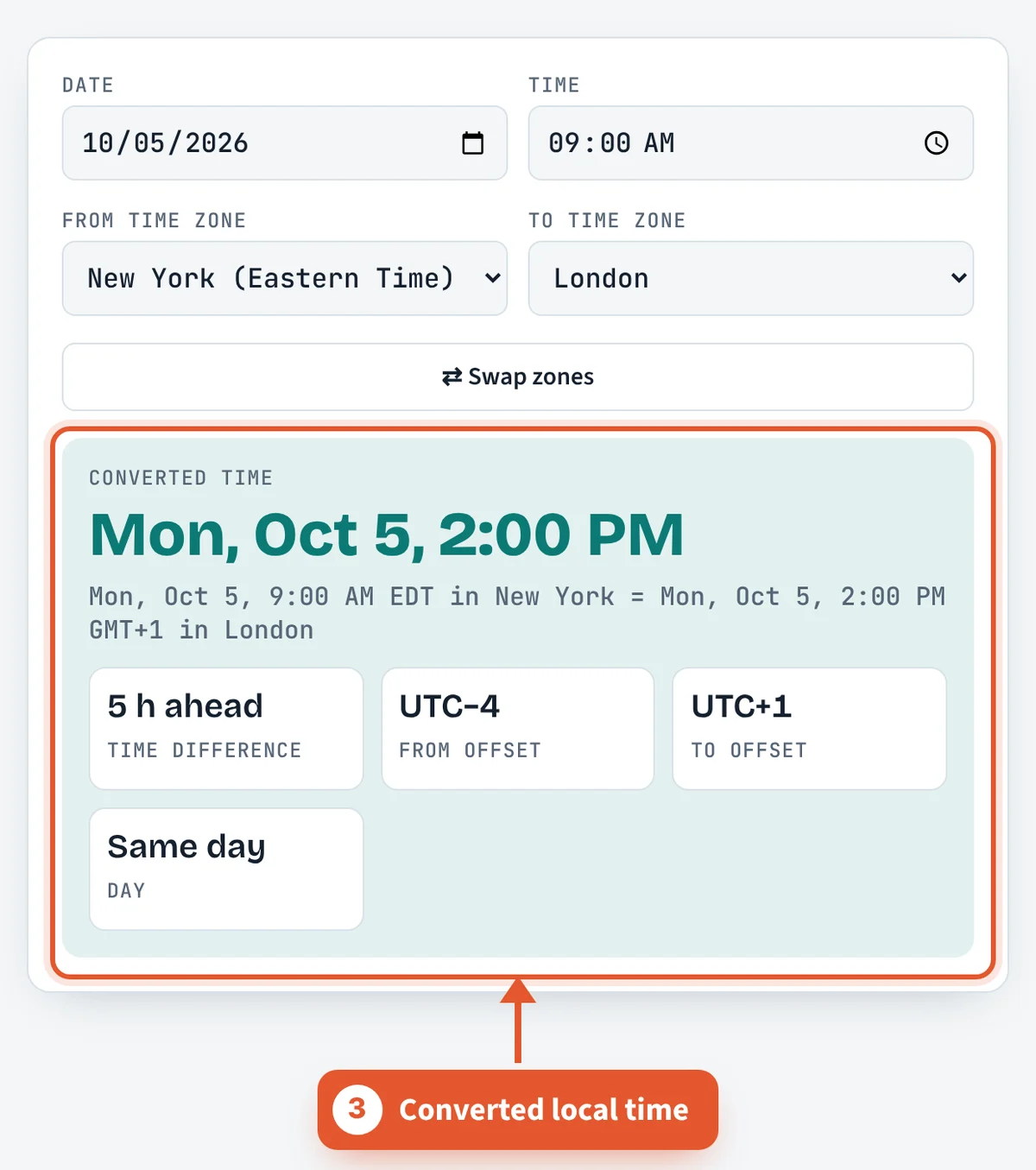
Read the converted time
You’ll see the local time on the other end, how many hours apart the places are, both UTC offsets and whether it’s already tomorrow there.
Why do time zone names like America/New_York matter?
Abbreviations are ambiguous. IST can mean India Standard Time (UTC+5:30), Israel Standard Time (UTC+2) or Irish Standard Time (UTC+1). CST can be US Central or China Standard Time. Software avoids this by using the IANA time zone database, also called the tz database or Olson database after its founder Arthur David Olson.
Each entry is named for a region and its largest city, such as America/New_York, Europe/London or Asia/Karachi. Behind each name sits the full history of that place’s offsets and daylight saving rules, so a conversion for a date in 1995 uses the rules that applied in 1995. The database is maintained by volunteers, coordinated by Paul Eggert, and published by IANA. Linux, macOS, Android and most programming languages read it.
Governments still change their rules, sometimes with short notice, which is why phones and servers receive tz updates several times a year. When you schedule a meeting, give the city or the UTC offset rather than a three-letter code. For stored log times, the Unix timestamp converter avoids zone confusion entirely.
Which time zones are not a whole hour from UTC?
Most zones sit a whole number of hours from Coordinated Universal Time (UTC), but several are offset by 30 or 45 minutes. These catch people out when they convert in their head, because adding a whole number of hours gives an answer that is off by half an hour or more.
| Place | Standard offset |
|---|---|
| Newfoundland, Canada | UTC−3:30 |
| Iran | UTC+3:30 |
| Afghanistan | UTC+4:30 |
| India and Sri Lanka | UTC+5:30 |
| Nepal | UTC+5:45 |
| Myanmar | UTC+6:30 |
| South Australia and Northern Territory | UTC+9:30 |
| Chatham Islands, New Zealand | UTC+12:45 |
Newfoundland, South Australia and the Chatham Islands also observe daylight saving time, so their offsets shift by an hour for part of the year, while the Northern Territory does not. Pakistan, by contrast, uses a whole-hour offset of UTC+5 all year. If you track hours worked across these zones, the hours calculator handles the minutes cleanly.
Frequently asked questions
What time is 9 AM Eastern in London?
2 PM, most of the year. Except for roughly three weeks in March and a single week in late October, when it’s 1 PM, since the clocks change on different weekends over there.
Does the converter handle daylight saving time?
It does, and that’s kind of the whole point of it. Your browser knows when each place switches, so EDT vs EST, BST vs GMT, all of that gets picked for the day you typed in. You don’t have to remember a thing.
How many hours ahead is Pakistan from New York?
Depends on the season, since only one side moves. Pakistan sits on UTC+5 all year long. While New York’s on summer time that’s a 9-hour gap, and in winter it stretches to 10.
What's a good meeting time for New York and India?
Early morning in New York, pretty much. 8 AM Eastern is 5:30 PM in India during US summer time, 6:30 PM in winter. Push past 10 AM Eastern and somebody in Delhi is missing dinner.
What happens to 2:30 AM when the clocks spring forward?
Poof, gone. Second Sunday in March, US clocks leap from 1:59 straight to 3:00, so there’s no 2:30 that night at all. If your backup job or your alarm lives there, move it.
Why is Arizona different?
They mostly opted out of daylight saving, and with Phoenix summers who can blame them. So Arizona sits on Mountain Standard Time year-round, which lines it up with Los Angeles in summer. The Navajo Nation is the exception, it does change its clocks.
What is UTC?
Coordinated Universal Time, basically the clock everybody else is measured against. New York in winter is UTC−5, India is UTC+5:30, and so on. Pilots and server logs love it.
Sources and further reading
Related tools
Last reviewed: October 2026