
Paste a list of numbers to get the mean, median, mode and range, along with the count, sum, smallest and largest values.

Averages come up with test scores, monthly bills, race times, sales figures and fantasy football points. The word “average” usually means the mean, but the median and mode can tell a different story, especially when one number is way out of line. Drop your list into this average calculator and you’ll get all three at once, plus the range, count, sum and the smallest and largest values. You can paste a column straight from a spreadsheet, since line breaks work as separators.
How do I calculate the average of a set of numbers?
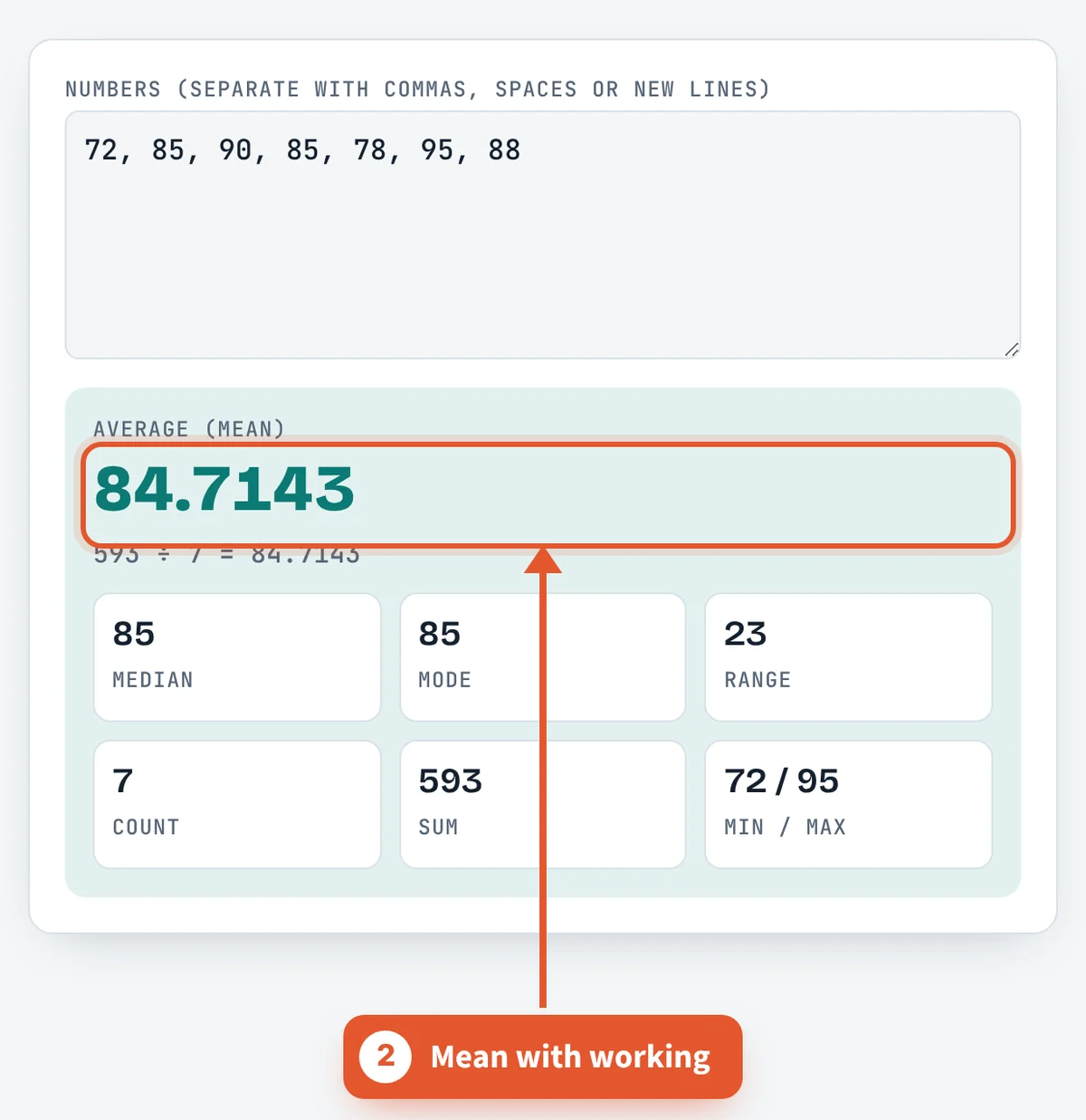
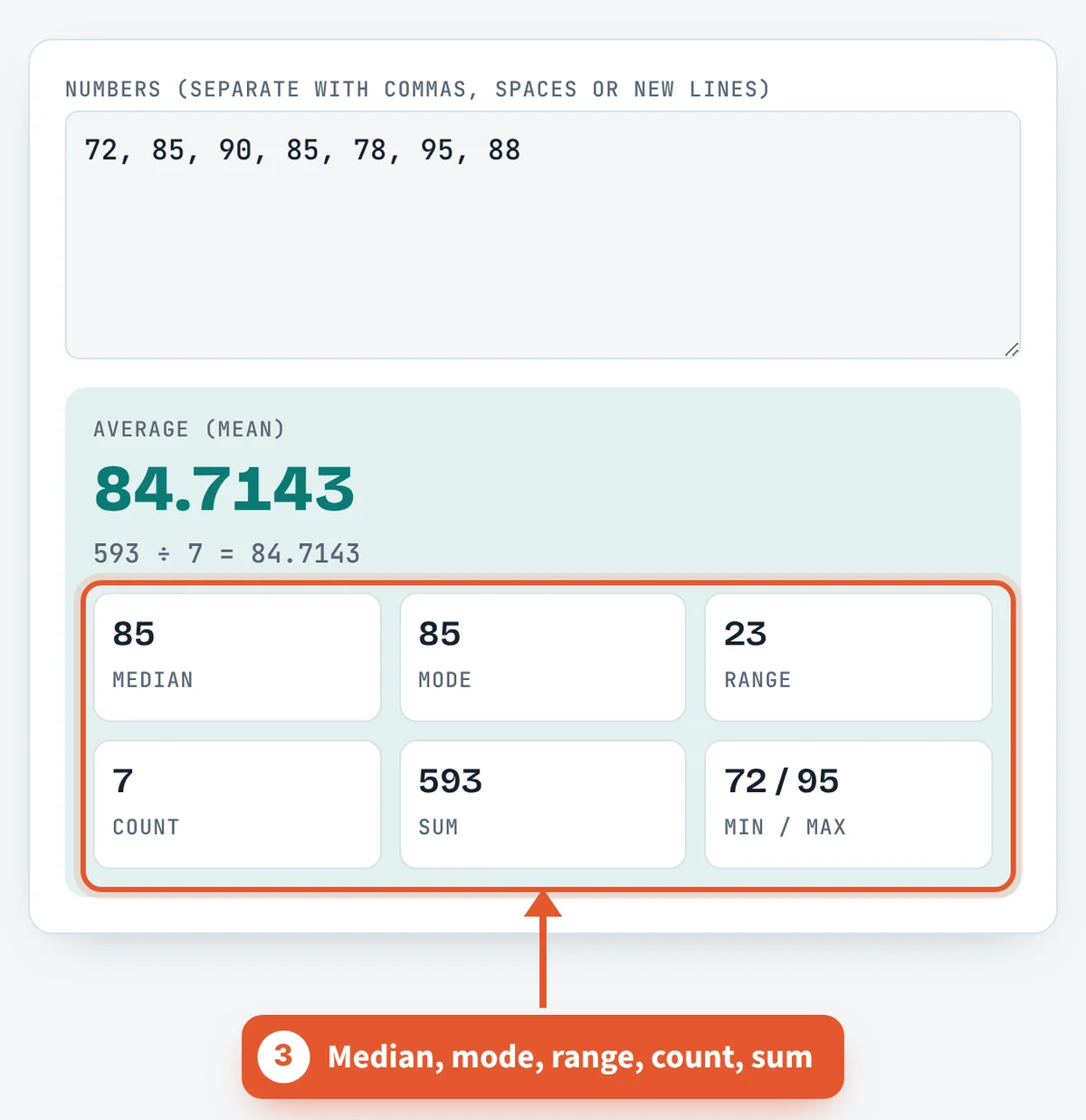
Add all the numbers together, then divide by how many there are. That’s the mean. For example, seven test scores of 72, 85, 90, 85, 78, 95 and 88 add up to 593. Divide 593 by 7 and the average is 84.71. Sorted, the middle score is 85, so the median is 85, and 85 is also the mode because it appears twice.
Mean, median, mode and range formulas
Median = middle value of the sorted list (average of the two middle values if the count is even)
Mode = the value that appears most often
Range = largest value − smallest value
Worked example
| Measure | Scores: 72, 78, 85, 85, 88, 90, 95 |
|---|---|
| Count | 7 |
| Sum | 593 |
| Mean | 593 ÷ 7 = 84.71 |
| Median | 4th value = 85 |
| Mode | 85 (appears twice) |
| Range | 95 − 72 = 23 |
When the median is the better average
The mean gets pulled toward extreme values, while the median doesn’t. Say five homes on a street sold for $250,000, $275,000, $300,000, $320,000 and $1,200,000. The mean price is $469,000, which is higher than four of the five sales. The median, $300,000, is a much fairer picture of a typical home. That’s why home prices and household incomes are usually reported as medians.
How to use the Average Calculator
Enter your numbers
Type or paste your values. Commas, spaces, semicolons and new lines all work as separators.

Check the count
Make sure the count matches the number of values you meant to enter. Anything that isn’t a number is skipped and flagged.
Read the results
See the mean with its working, plus the median, mode, range, count, sum, and the smallest and largest values.

How do you calculate a weighted average?
A weighted mean gives some values more influence than others. Multiply each value by its weight, add the products, then divide by the sum of the weights:
weighted mean = (w1x1 + w2x2 + ... + wnxn) ÷ (w1 + w2 + ... + wn)
The most familiar example is a grade point average, where each grade is weighted by course credits.
| Course | Grade points | Credits | Points × credits |
|---|---|---|---|
| Biology | 4.0 | 4 | 16 |
| History | 3.0 | 3 | 9 |
| Lab | 2.0 | 1 | 2 |
The weighted average is 27 ÷ 8 = 3.375. A plain average of 4.0, 3.0 and 2.0 would be 3.0, which understates the effect of the 4-credit A.
Weighted averages also appear in course grades with category weights, stock indexes and inventory costing. For grades, the GPA calculator and grade calculator apply the weights for you.
When should you use a geometric or harmonic mean?
The ordinary arithmetic mean is one of three classic Pythagorean means. The other two fix specific mistakes.
The geometric mean is the nth root of the product of n values. Use it for growth rates and returns. If an investment gains 50% one year and loses 50% the next, the arithmetic average return is 0%, yet $100 becomes $150 and then $75. The geometric mean of the growth factors 1.5 and 0.5 is the square root of 0.75, about 0.866, a real average loss of 13.4% per year. The compound annual growth rate is built on this idea.
The harmonic mean is n divided by the sum of reciprocals. Use it for rates over equal distances. Driving 60 mph out and 40 mph back over the same route averages 2 ÷ (1/60 + 1/40) = 48 mph, not 50, because you spend more time at the slower speed.
For positive numbers, the AM-GM inequality guarantees arithmetic mean ≥ geometric mean ≥ harmonic mean, with equality only when all values are the same.
To see how growth compounds over many periods, try the compound interest calculator.
Frequently asked questions
What is the difference between mean and average?
In everyday use they’re the same thing. “Average” can also refer to the median or mode, so the calculator shows all three.
How do I find the median of an even set of numbers?
Sort the numbers and average the two in the middle. For 3, 7, 9 and 12, the median is (7 + 9) ÷ 2 = 8.
What if no number repeats?
Then there’s no mode, and the calculator says “None”. If two or more values tie for most frequent, it lists each of them.
How do I calculate a weighted average?
Multiply each value by its weight, add those up, and divide by the total weight. A 90 worth 40% and an 80 worth 60% gives 0.4 × 90 + 0.6 × 80 = 84.
Can I paste numbers with thousands separators?
Remove the commas inside numbers first, since commas also split values. Type 1500 rather than 1,500.
Sources and further reading
Related tools
Last reviewed: October 2026