Estimate the calories you burned on a ride from your average speed and weight, or from the average power your bike computer shows. Works in km/h and kg or mph and lb.
Runs in your browser. Nothing you type is sent anywhere.
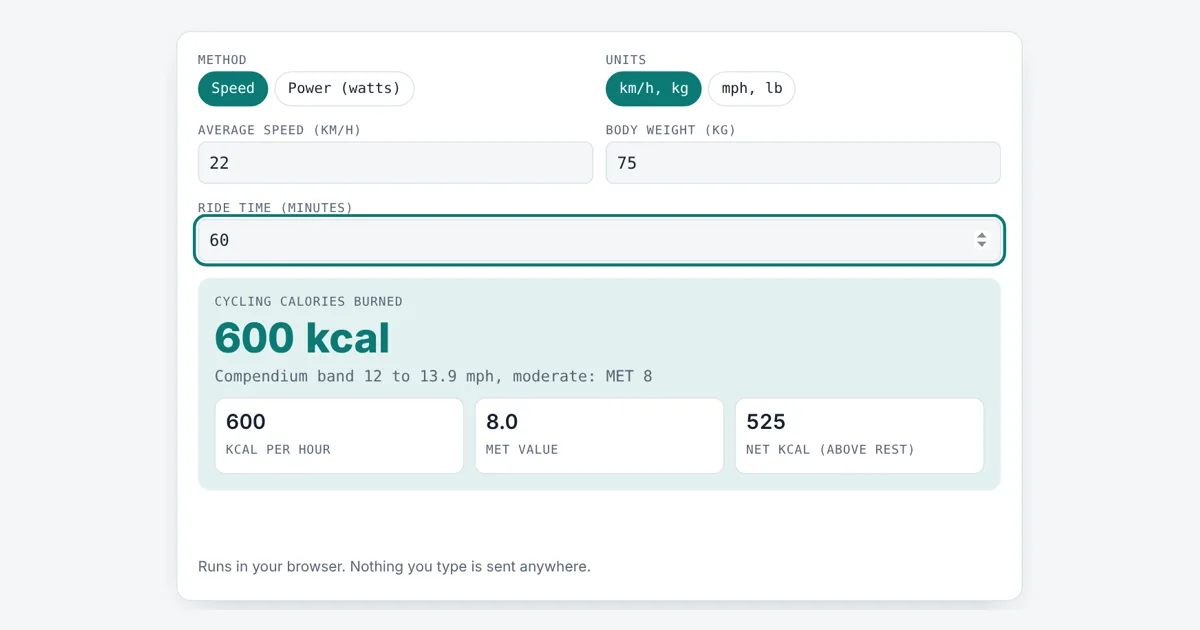
This cycling calories calculator is for road riders, commuters and indoor trainers who want a fair calorie figure for a ride. It gives two methods: a speed method based on Compendium MET bands, and a power method that turns kilojoules of work from a power meter into calories.
How Do You Work Out Cycling Calories Burned?
Multiply the MET value for your speed by your weight in kg and the hours ridden. For example, a 75 kg rider at 22 km/h (13.7 mph, 8 METs) for one hour burns 8 × 75 × 1 = 600 kcal. With a power meter, 180 watts for an hour is 648 kJ of work, which is about 648 kcal.
How Many Calories Does Cycling Burn per Hour?
Cycling burns about 400 to 1,000 kcal per hour for most adults, depending mainly on speed and body weight. The speed method uses MET values (metabolic equivalents, where 1 MET is about 1 kcal per kg per hour at rest) from the Compendium of Physical Activities. The Compendium groups outdoor road cycling into speed bands, each with its own MET value. Results from this tool for one hour:
| Speed band | Metric | MET | 60 kg | 90 kg |
|---|---|---|---|---|
| Under 10 mph | under 16.1 km/h | 4.0 | 240 | 360 |
| 10 to 11.9 mph | 16.1 to 19.2 km/h | 6.8 | 408 | 612 |
| 12 to 13.9 mph | 19.3 to 22.4 km/h | 8.0 | 480 | 720 |
| 14 to 15.9 mph | 22.5 to 25.6 km/h | 10.0 | 600 | 900 |
| 16 to 19.9 mph | 25.7 to 32.1 km/h | 12.0 | 720 | 1,080 |
| 20 mph or more | 32.2 km/h or more | 15.8 | 948 | 1,422 |
Power method: kJ = average watts × seconds ÷ 1000, and kcal ≈ kJ
Why Do Kilojoules of Work Equal Calories Burned?
Kilojoules of work roughly equal calories burned because two numbers cancel out: one food calorie is 4.184 kJ, and the body turns only about 20 to 25% of food energy into pedal work. This share is called gross efficiency. At about 24% efficiency, each kJ the power meter records costs close to 1 kcal of food (1 ÷ 0.24 ÷ 4.184 ≈ 1.0). So a ride with 648 kJ of work burned about 648 kcal. Fitter riders can be slightly more efficient and burn a little less.
Is the Speed or Power Method More Accurate?
The power method is more accurate, because watts measure the real work you did, while speed is affected by wind, hills, drafting, tyres and bike type. Riding 25 km/h into a headwind is far harder than the same speed with a tailwind, but the speed method gives both the same MET. Use power whenever you have a power meter or a smart trainer. Use the speed method for flat, steady rides on a road bike.
Does Body Weight Change Calories Burned Cycling?
Yes, in the speed method a heavier rider burns more at the same speed, in direct proportion to weight. In the power method weight is not needed, since watts already include the effort of moving your mass. For walking instead of riding, try the walking calories burned calculator. To fit the ride into your daily energy needs, use the calorie calculator, and to compare riding speeds in other units, the mph to km/h converter helps.
These are estimates, not medical advice. Talk to a doctor before hard training if you have a heart condition.
Worked Example
Chris weighs 75 kg and rides for 60 minutes at 22 km/h. With Speed and km/h, kg picked, the tool puts him in the 12 to 13.9 mph band at 8 METs and shows 600 kcal, with 525 net kcal above rest. On the trainer the next day he holds 180 W for an hour: in Power mode the tool shows 648 kJ of work, so about 648 kcal. A 165 lb rider averaging 17 mph for 90 minutes gets about 1,347 kcal in the 16 to 19.9 mph band.
How Do You Use the Cycling Calories Calculator?
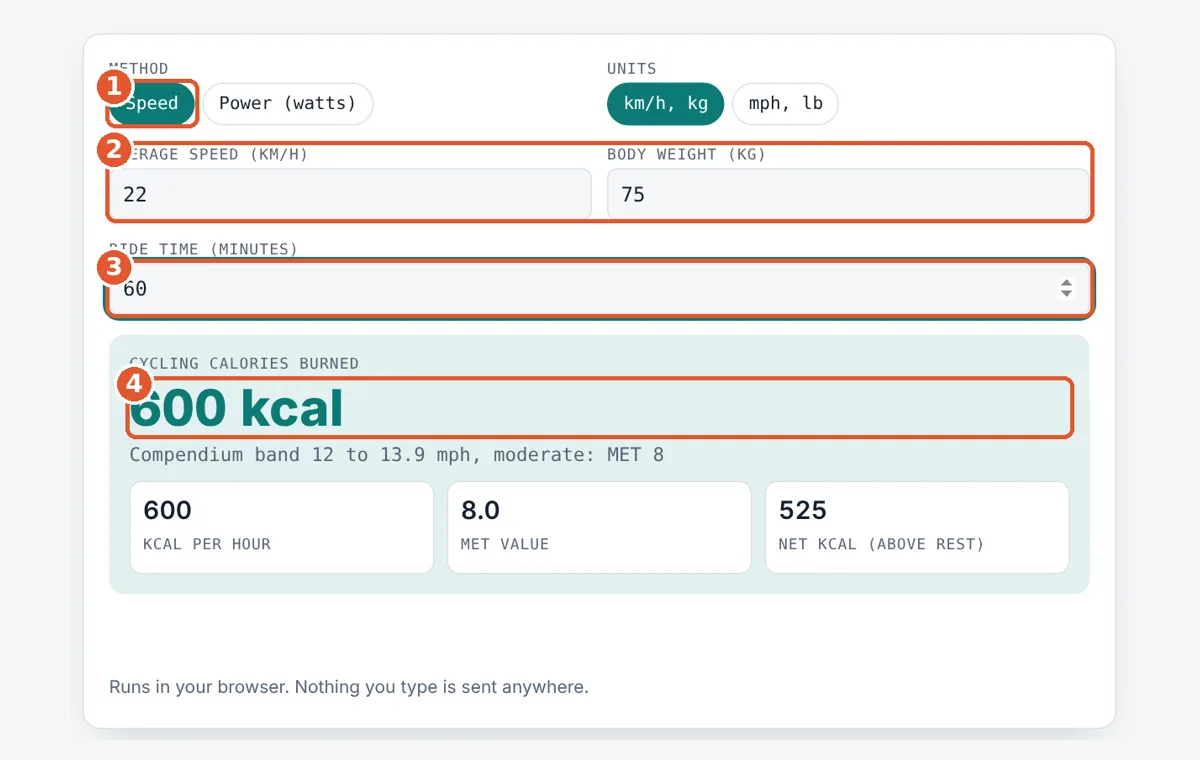
Pick a method and units
Tap Speed or Power (watts), then choose km/h and kg or mph and lb.
Enter speed and weight
In Speed mode, type your average moving speed and body weight. In Power mode, type average watts.
Add ride time
Type how many minutes you rode. Results update as you type.
Read your calories
The big number is calories burned. The boxes show kcal per hour, the MET or kJ, and net calories or watts.
Frequently Asked Questions
How many calories does a 30 minute bike ride burn?
At a moderate 12 to 13.9 mph (8 METs), a 70 kg rider burns about 280 kcal in 30 minutes. A slower leisure ride under 10 mph (4 METs) burns about 140 kcal for the same rider.
Is 1 kJ really equal to 1 calorie when cycling?
Very close. One kcal is 4.184 kJ, but your muscles are only about 24% efficient, so 1 kJ of pedal work costs about 1 kcal of food energy. The match is an approximation that works well for most trained and untrained riders.
Does an exercise bike burn the same calories as outdoor cycling?
It can. The Compendium lists general stationary cycling at 7 METs, close to a moderate outdoor ride. If your exercise bike shows watts, use the Power method for the most reliable figure.
Why does my bike computer show different calories?
Many bike computers estimate from heart rate or use their own models, while this tool uses MET bands or kJ of work. Heart rate methods can drift in heat or with stress. A power meter reading is usually the most dependable.
Do hills change calories burned cycling?
Yes. Climbing takes more power, so you burn more even though speed drops. The speed method cannot see this and may underestimate hilly rides, which is why the power method is better for mixed terrain.
What MET value is mountain biking?
The 2011 Compendium lists general mountain biking at 8.5 METs. For a 75 kg rider, an hour of mountain biking burns about 638 kcal, close to a moderate road ride in the 12 to 13.9 mph band.
Sources and Further Reading
- Ainsworth BE et al. 2011 Compendium of Physical Activities: a second update of codes and MET values (PubMed)
- 2011 Compendium of Physical Activities, full table of codes and MET values (PDF)
- NIST: Guide for the Use of the International System of Units, calorie and joule conversions
Related Tools
Last reviewed: October 2026