List what you own and what you owe. You get your net worth, your home equity and your debt to asset ratio, all updating as you type.
Moderate debt load: you owe 65.71 cents for every 1 of assets.
Runs in your browser. Nothing you type is sent anywhere. Blank boxes count as 0.
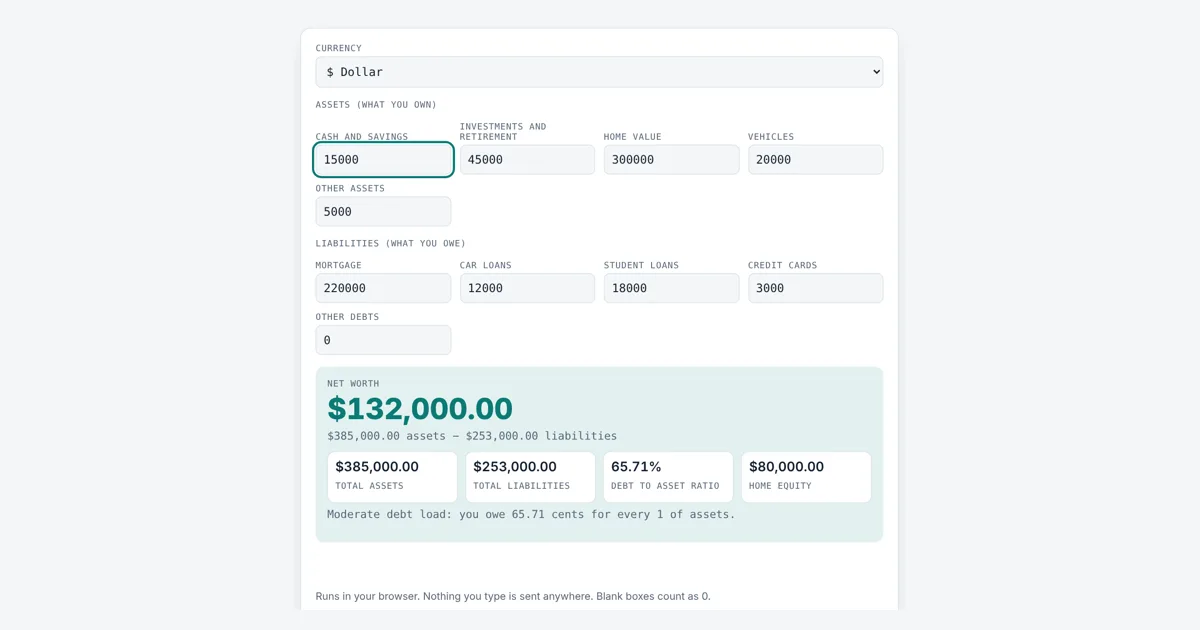
This net worth calculator is for anyone who wants a clear snapshot of their finances, from a student with a loan to a family planning retirement. Enter your assets and liabilities in any currency and it shows your net worth, how much of your home you really own, and how heavy your debt is compared with what you own.
How Do You Calculate Net Worth?
Net worth is total assets minus total liabilities. Add up everything you own, such as cash, investments, your home and car, then subtract everything you owe. For example, assets of $385,000 and debts of $253,000 give a net worth of $132,000 and a debt to asset ratio of 65.71%.
What Counts as Assets and Liabilities in Net Worth?
Assets are things you own that have money value, and liabilities are debts you owe, such as a mortgage, car loan, student loan or credit card balance.
debt to asset ratio = total liabilities ÷ total assets × 100
home equity = home value − mortgage balance
Value assets at what you could sell them for today, not what you paid. Liquid assets are cash or things you can turn into cash within days, like a savings account or shares. A house or a pension is far less liquid. Your home equity is the part of your home you own outright. Leave out everyday items such as clothes and furniture, since they sell for little. To see what your debts cost each month, check the credit card payoff calculator or the mortgage calculator.
What Is a Good Debt to Asset Ratio?
A lower debt to asset ratio is safer, and many people treat under 30% as low, 30% to 70% as moderate and over 100% as a sign that debts are bigger than assets.
The debt to asset ratio shows what share of your assets is funded by borrowing. These bands are rules of thumb, not official limits. A young homeowner with a new mortgage will often sit near 70% to 80%, and that is normal. The ratio falls as you pay down debt and as your assets grow.
| Assets | Liabilities | Net worth | Debt to asset ratio |
|---|---|---|---|
| $10,000 | $30,000 | -$20,000 | 300% |
| $50,000 | $10,000 | $40,000 | 20% |
| $120,000 | $90,000 | $30,000 | 75% |
| $385,000 | $253,000 | $132,000 | 65.71% |
| $400,000 | $150,000 | $250,000 | 37.5% |
| $900,000 | $100,000 | $800,000 | 11.11% |
Can Your Net Worth Be Negative?
Yes, your net worth is negative when you owe more than you own, which is common for recent graduates with student loans.
A negative number is a starting point, not a verdict. Paying off high interest debt first and saving a little each month moves it up. The savings goal calculator shows how fast regular saving adds up, and the compound interest calculator shows how invested money grows over time.
What Is the Average Net Worth in the US?
The Federal Reserve‘s 2022 Survey of Consumer Finances put median US family net worth at $192,900, while the mean was about $1,063,700.
The mean is much higher because a small number of very wealthy families pull it up, so the median is the fairer comparison. Net worth also rises strongly with age. Comparing yourself with your own number a year ago is more useful than comparing with others. This tool is for personal tracking and is not financial advice.
Worked Example
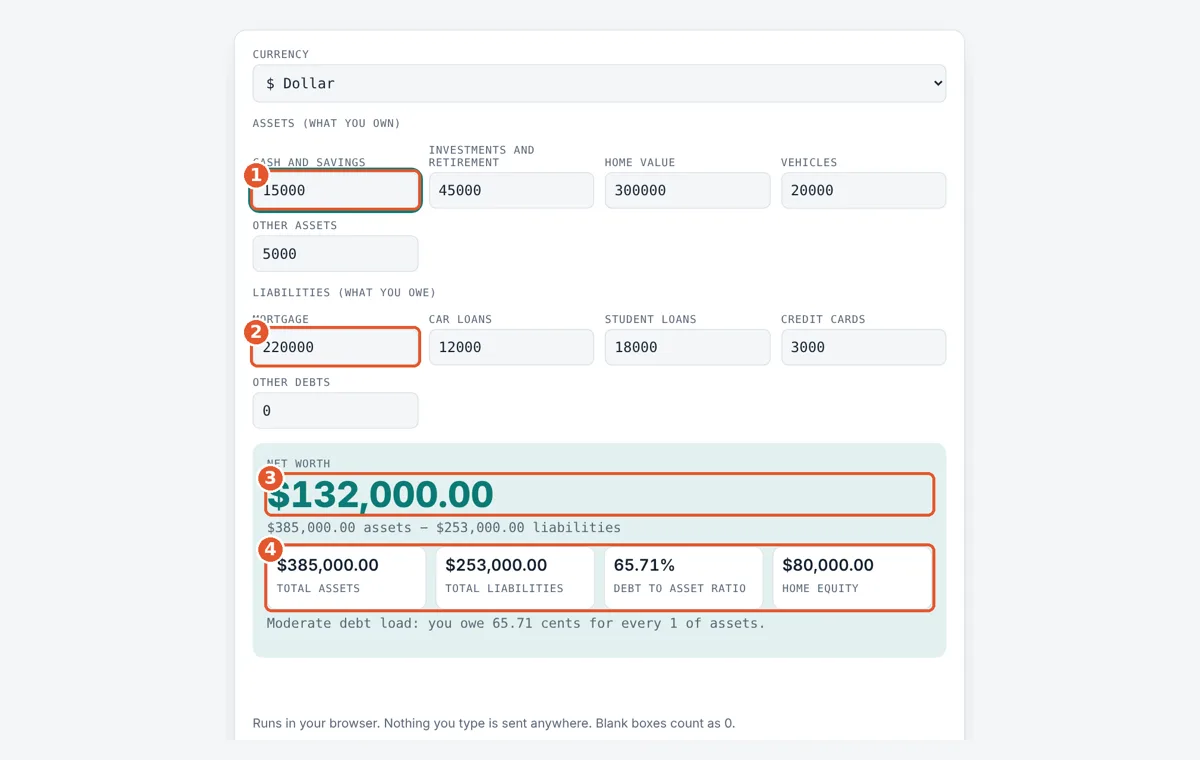
Maria lists $15,000 in savings, $45,000 in investments and retirement accounts, a $300,000 home, a $20,000 car and $5,000 of other assets. She owes $220,000 on her mortgage, $12,000 on a car loan, $18,000 in student loans and $3,000 on credit cards. The tool shows total assets of $385,000.00, total liabilities of $253,000.00 and a net worth of $132,000.00. Her home equity is $80,000.00 and her debt to asset ratio is 65.71%, a moderate debt load. If she clears the $3,000 card balance from savings, net worth stays the same but the ratio falls to 65.45%.
How Do You Use the Net Worth Calculator?
Enter your assets
Pick a currency, then type today's value of your cash, investments, home, vehicles and other assets. Blanks count as 0.
Enter your liabilities
Type the balance still owed on your mortgage, car loans, student loans, cards and other debts.
Read your net worth
The big number is total assets minus total liabilities. It turns negative if you owe more than you own.
Check the ratio boxes
The boxes show both totals, your debt to asset ratio and your home equity, with a short note on your debt load.
Frequently Asked Questions
Should I include my car in my net worth?
Yes, include your car at its current resale value, not the price you paid. A car bought for $30,000 might be worth $20,000 after three years. Then list any car loan balance as a liability so the two offset each other.
Do retirement accounts count toward net worth?
Yes. A 401(k), IRA, UK pension pot or other retirement account is an asset you own. Some people subtract the tax they will owe on withdrawal to get a more cautious figure, for example counting $100,000 as about $80,000.
How often should I calculate my net worth?
Once every 3 to 12 months is enough for most people. Checking too often shows normal market swings rather than progress. Use the same method each time, such as current resale values, so the numbers compare fairly.
Is my income part of my net worth?
No. Income is money flowing in over time, while net worth is a snapshot of what you own minus what you owe on one day. A $90,000 salary adds to net worth only through the part you save or invest.
Does paying off debt increase net worth?
Paying debt with cash leaves net worth unchanged, because assets and liabilities both fall by the same amount. Paying $3,000 of card debt from savings keeps net worth at $132,000. Net worth rises over time because you stop paying interest.
What is the difference between net worth and liquid net worth?
Liquid net worth counts only assets you can turn into cash quickly, such as savings and shares, minus your debts. It leaves out your home and retirement accounts, so it is usually much lower and shows how well you could handle an emergency.
Sources and Further Reading
- Federal Reserve: Survey of Consumer Finances
- Federal Reserve Bulletin: Changes in U.S. Family Finances from 2019 to 2022
- Investor.gov (SEC): Compound interest calculator
Related Tools
Last reviewed: October 2026