Enter your income and monthly debts to see a suggested maximum rent under four common rules, and check whether a flat you are eyeing fits your budget.
Runs in your browser. A rule of thumb, not financial advice. Nothing you type is sent anywhere.
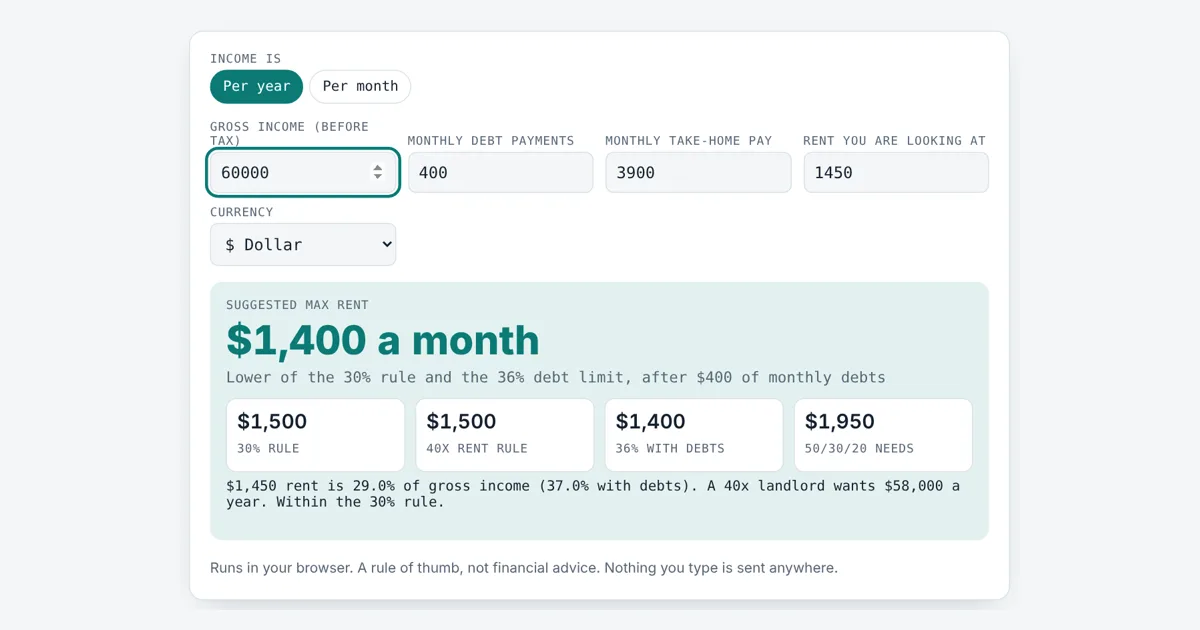
This rent affordability calculator is for renters setting a budget and for anyone checking if they will pass a landlord income test. It compares the 30% rule, the 40x rent rule, a 36% limit that counts your debts and the 50/30/20 budget, then tells you what share of income a given rent takes.
How Much Rent Can I Afford?
A common guide is to spend no more than 30% of gross monthly income on rent. On a $60,000 salary that is $5,000 a month, so about $1,500 in rent. With $400 of monthly debt payments, keeping rent plus debts under 36% lowers the suggested limit to $1,400.
What Is the 30% Rule for Rent?
The 30% rule says rent should be no more than 30% of your gross income, the amount you earn before tax. It comes from US housing policy: the Department of Housing and Urban Development (HUD) calls households that pay more than 30% of income for housing cost burdened, and those paying more than 50% severely cost burdened.
40x rule: max rent = gross annual income ÷ 40
With debts: max rent = gross monthly income × 0.36 − monthly debts
What Is the 40x Rent Rule Landlords Use?
The 40x rule means a landlord wants your gross yearly income to be at least 40 times the monthly rent, so a $1,500 flat needs $60,000 a year. It gives exactly the same answer as the 30% rule, because one 40th of a year’s pay equals 30% of a month’s pay. Some landlords use a stricter 3x monthly rent test, which allows about 33% of income.
| Gross yearly income | Monthly income | Max rent (30% or 40x) | Max with $400 debts (36%) |
|---|---|---|---|
| $30,000 | $2,500 | $750 | $500 |
| $40,000 | $3,333 | $1,000 | $800 |
| $50,000 | $4,167 | $1,250 | $1,100 |
| $60,000 | $5,000 | $1,500 | $1,400 |
| $75,000 | $6,250 | $1,875 | $1,850 |
| $100,000 | $8,333 | $2,500 | $2,600 |
How Do Debts Change Your Rent Affordability?
Debts lower the rent you can comfortably pay, because car loans, student loans and card minimums come out of the same income. The calculator borrows the debt-to-income ratio idea from mortgage lending, where Fannie Mae’s base limit for manually underwritten loans is 36% of income. Rent plus debts under 36% is a safer target than 30% alone. To plan a faster payoff, try the credit card payoff calculator or the car loan calculator.
How Does the 50/30/20 Budget Treat Rent?
The 50/30/20 budget puts 50% of your take-home pay toward needs such as rent, utilities, groceries and minimum debt payments, 30% toward wants and 20% toward savings. It uses take-home pay, the amount after tax, so its numbers are tighter than rules based on gross income. If rent alone eats most of the 50%, little is left for other needs. Converting a wage first? Use the hourly to salary calculator.
Worked Example
Sam earns $60,000 a year, pays $400 a month on a car loan and takes home $3,900 a month. The calculator shows a 30% rule limit of $1,500 and a 40x rule limit of $1,500, but with debts counted the suggested maximum is $1,400 a month. His 50/30/20 needs budget is $1,950 for everything essential. A flat at $1,450 is 29.0% of gross income, or 37.0% with the car loan, and a 40x landlord would want $58,000 a year, which he meets.
How Do You Use the Rent Affordability Calculator?
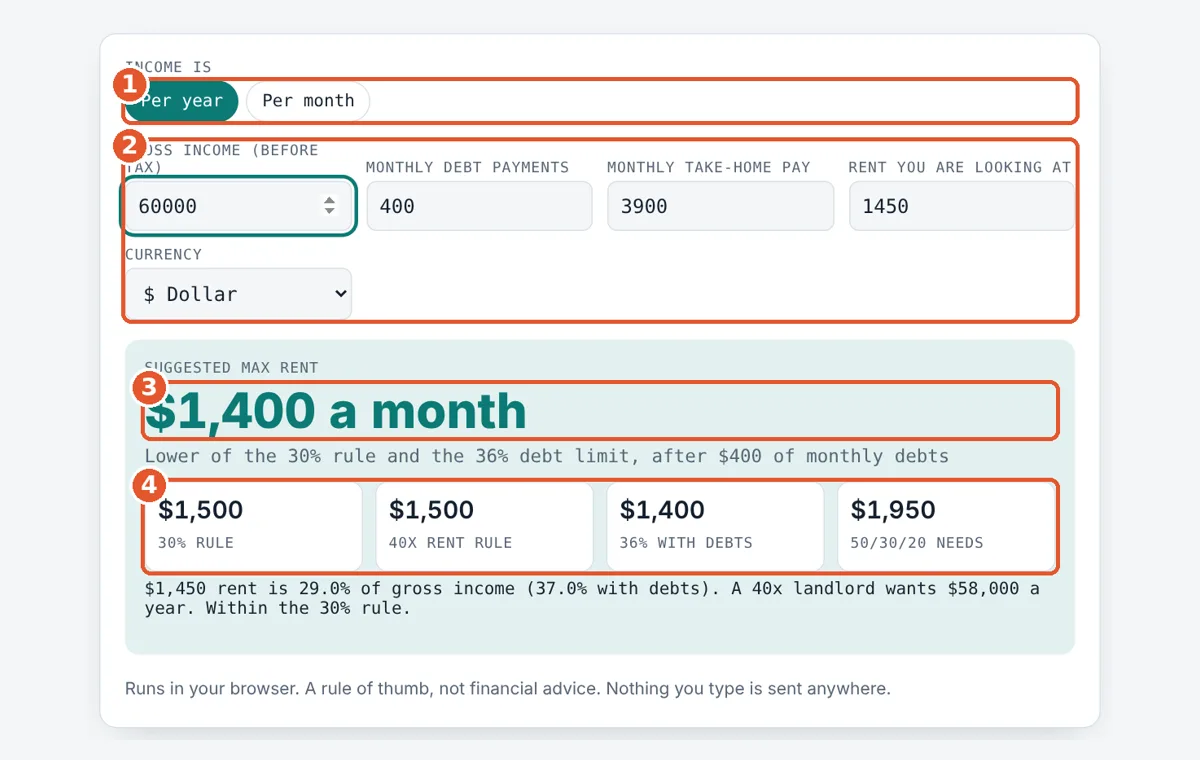
Pick yearly or monthly
Choose whether your income figure is per year or per month.
Enter income and debts
Add gross income, monthly debt payments, take-home pay and a rent you are checking.
Read the suggested rent
The big number is the lower of the 30% rule and the 36% limit after debts.
Compare the rules
The boxes show each rule side by side, with a check on the rent you entered.
Frequently Asked Questions
How much rent can I afford on $50,000 a year?
Under the 30% rule, $50,000 a year allows about $1,250 a month in rent. The 40x landlord test gives the same $1,250. If you also pay $400 a month on debts, a 36% limit suggests about $1,100.
Is the 30% rule based on gross or net income?
The classic 30% rule uses gross income, before tax and deductions. That makes it looser than it looks, because 30% of gross can be 40% or more of take-home pay. Check the 50/30/20 view, which uses take-home pay, as a second test.
What income do I need for $2,000 rent?
A landlord using the 40x rule wants $80,000 a year for $2,000 rent. The 30% rule gives the same $80,000. Under a 3x monthly test, you need $6,000 a month, which is $72,000 a year.
Can a guarantor help if I fail the 40x test?
Yes, many landlords accept a guarantor who promises to pay if you do not. Guarantors are often asked to earn 80 times the monthly rent, so a $1,500 flat could need a guarantor earning $120,000 a year.
Should I include utilities in my rent budget?
Many guides count rent plus basic utilities as housing cost, and HUD's cost burden measure includes utilities. If your lease excludes them, subtract a realistic monthly estimate from the suggested maximum before you choose a flat.
Does this calculator work outside the US?
Yes. The maths works in any currency, so pick pounds, euros, rupees or another option. Landlord rules differ by country, though; UK agents often use 30 times monthly rent, so check the local test before you apply.
Sources and Further Reading
- HUD User: Rental burdens, rethinking affordability measures
- Fannie Mae Selling Guide B3-6-02: Debt-to-Income Ratios
- Consumer Financial Protection Bureau: What is a debt-to-income ratio?
Related Tools
Last reviewed: October 2026