Enter your age, and your resting heart rate if you know it, to get your moderate and vigorous exercise heart rate ranges in beats per minute.
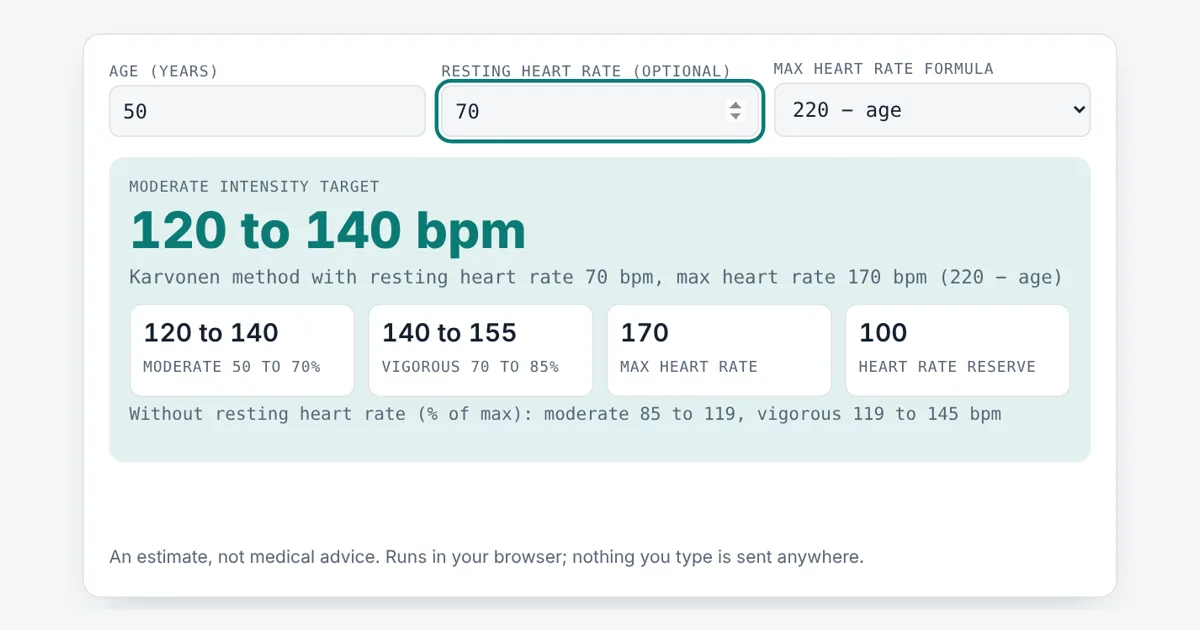
Without resting heart rate (% of max): moderate 85 to 119, vigorous 119 to 145 bpm
An estimate, not medical advice. Runs in your browser; nothing you type is sent anywhere.
This target heart rate calculator is for walkers, runners, gym goers and anyone starting an exercise plan who wants a simple number to aim for. You get a moderate and a vigorous range in beats per minute (bpm), your estimated maximum heart rate, and a choice of two age formulas. Add a resting heart rate and the tool switches to the Karvonen method, which fits your own fitness better. These are estimates, not medical advice. If you have a heart condition or take heart rate medicine, ask your doctor for your own range.
How Do You Calculate Target Heart Rate?
Estimate your maximum heart rate as 220 minus your age, then take 50 to 70% of it for moderate exercise and 70 to 85% for vigorous exercise. For a 50 year old, max heart rate is 170 bpm, so the moderate zone is 85 to 119 bpm and the vigorous zone is 119 to 145 bpm.
What Is the Formula for Target Heart Rate?
Target heart rate is a percentage of your estimated maximum heart rate: 50 to 70% for moderate activity and 70 to 85% for vigorous activity, as used by the American Heart Association.
target = max heart rate × intensity %
Karvonen: target = (max − resting) × intensity % + resting
Maximum heart rate is the highest number of beats per minute your heart can reach in all out effort. The “220 minus age” rule is the classic shortcut. In 2001, Tanaka, Monahan and Seals pooled data from 351 studies and a lab study and published 208 − 0.7 × age in the Journal of the American College of Cardiology. It gives similar results around age 40 but slightly higher maximums for older adults, for example 159 bpm instead of 150 at age 70. Both are averages, and your real maximum can differ by 10 bpm or more.
What Is the Karvonen Method?
The Karvonen method sets your zones on your heart rate reserve, the gap between your maximum and resting heart rate, so a fitter person with a low resting pulse gets ranges that suit them. It comes from a 1957 study by Martti Karvonen and colleagues. A 50 year old with a resting rate of 70 bpm has a reserve of 170 − 70 = 100 beats, so 50% intensity is 100 × 0.5 + 70 = 120 bpm. For most adults a resting rate between 60 and 100 bpm is normal. Measure it sitting still in the morning, counting beats for 60 seconds.
Target Heart Rate by Age Chart
Percent of max values from this tool, with the Tanaka maximum for comparison:
| Age | Max (220 − age) | Moderate 50 to 70% | Vigorous 70 to 85% | Max (Tanaka) |
|---|---|---|---|---|
| 20 | 200 bpm | 100 to 140 bpm | 140 to 170 bpm | 194 bpm |
| 30 | 190 bpm | 95 to 133 bpm | 133 to 162 bpm | 187 bpm |
| 40 | 180 bpm | 90 to 126 bpm | 126 to 153 bpm | 180 bpm |
| 50 | 170 bpm | 85 to 119 bpm | 119 to 145 bpm | 173 bpm |
| 60 | 160 bpm | 80 to 112 bpm | 112 to 136 bpm | 166 bpm |
| 70 | 150 bpm | 75 to 105 bpm | 105 to 128 bpm | 159 bpm |
How Much Exercise Should You Do in Your Target Zone?
Adults should aim for at least 150 minutes a week of moderate-intensity activity, or 75 minutes of vigorous-intensity activity, or a mix of both, under the Physical Activity Guidelines for Americans, and the World Health Organization sets the same 150 minute minimum. In the moderate zone you can talk but not sing; in the vigorous zone you can say only a few words before pausing for breath. For five training zones used in running and cycling, try the heart rate zone calculator, and to set a running speed for each zone, the pace calculator helps.
Worked Example
Linda is 50 and her resting heart rate is 70 bpm. With the 220 − age formula, the tool shows a max heart rate of 170 bpm and a heart rate reserve of 100. Using Karvonen, her moderate zone is 120 to 140 bpm and her vigorous zone is 140 to 155 bpm. If she clears the resting heart rate box, the simple percent of max method gives 85 to 119 bpm moderate and 119 to 145 bpm vigorous. Switching to the Tanaka formula raises her max to 173 bpm and her Karvonen moderate zone to 122 to 142 bpm. To see how many calories a brisk walk in that zone burns, use the walking calories burned calculator.
How Do You Use the Target Heart Rate Calculator?
Enter your age
Type your age in years. The tool works for ages 15 to 100.
Add resting heart rate
Optional: type your resting pulse to switch to the Karvonen method, or leave it empty.
Pick a formula
Choose 220 − age or the Tanaka formula for your max heart rate.
Read your zones
The big number is your moderate range; the boxes show vigorous, max and reserve.

Frequently Asked Questions
What is a good target heart rate for a 40 year old?
Using 220 minus age, a 40 year old has a max of 180 bpm. The moderate zone is 90 to 126 bpm and the vigorous zone is 126 to 153 bpm. The Tanaka formula gives the same 180 bpm maximum at age 40.
Is 220 minus age accurate?
It is a rough average. Real maximum heart rates can be 10 to 20 bpm higher or lower than the formula. The Tanaka formula, 208 minus 0.7 times age, fits large data sets better for older adults. A supervised exercise test is the only way to measure it.
What is a normal resting heart rate?
For most adults, a normal resting heart rate is 60 to 100 bpm, according to the American Heart Association. Well trained athletes can sit at 40 to 60 bpm. A lower resting rate often means better aerobic fitness.
Should I use the Karvonen method or percent of max?
Use Karvonen if you know your resting heart rate, since it adjusts for your fitness. For a 30 year old with a resting rate of 60, Karvonen gives a moderate zone of 125 to 151 bpm, versus 95 to 133 bpm by percent of max.
Do blood pressure medicines change my target heart rate?
Yes. Beta blockers and some other drugs lower your heart rate, so the usual zones may be too high to reach. Ask your doctor for a personal target, or use how hard the effort feels instead.
How do I check my heart rate during exercise?
Use a watch or chest strap, or press two fingers on the inside of your wrist and count beats for 15 seconds, then multiply by 4. For example, 32 beats in 15 seconds is 128 bpm.
Sources and Further Reading
- American Heart Association: target heart rates chart
- Tanaka, Monahan and Seals 2001, JACC: age-predicted maximal heart rate revisited
- Karvonen, Kentala and Mustala 1957: the effects of training on heart rate
- US Department of Health and Human Services: Physical Activity Guidelines for Americans
Related Tools
Last reviewed: October 2026