Work out the fuel cost of any car journey in euros, pounds or dollars. Enter the distance, your car’s economy in L/100 km or mpg and the pump price per liter, and see the total, the liters needed and the cost per person.
Fuel only.
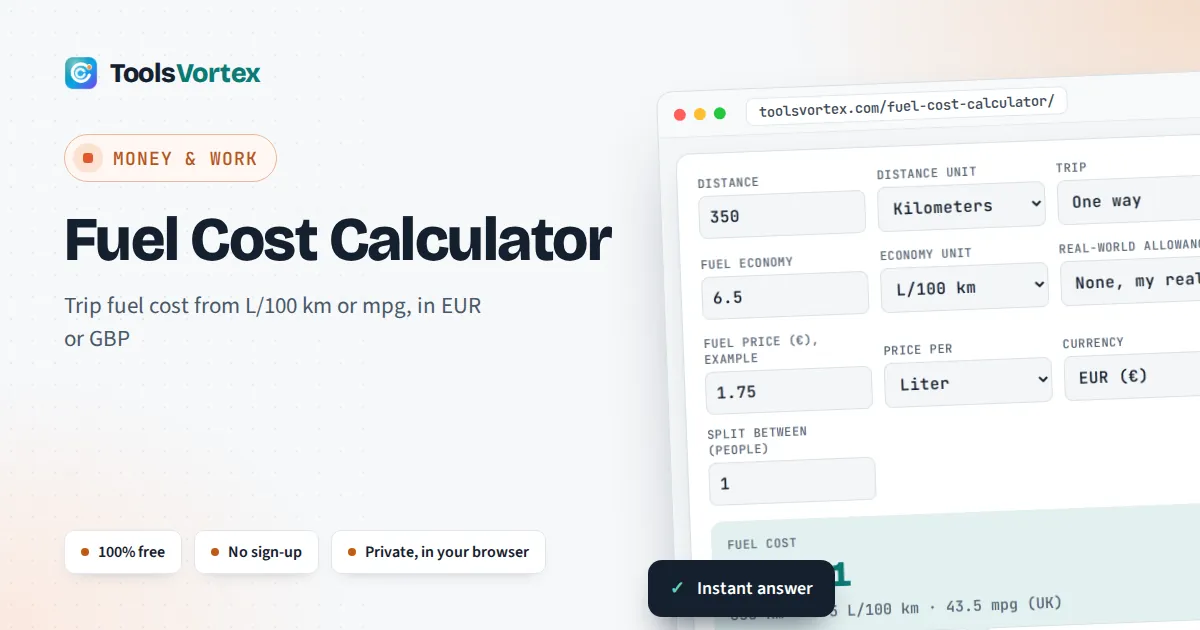
This fuel cost calculator is for drivers planning a road trip, a daily commute or a shared lift who want to know what the fuel will cost before they set off. It works the European way, with kilometers, liters and L/100 km, and also accepts miles and UK or US miles per gallon, so a British car’s mpg figure and a French pump price in euros can go into the same sum. The price is always yours to edit, because pump prices change every week.
How do I calculate the fuel cost of a trip?
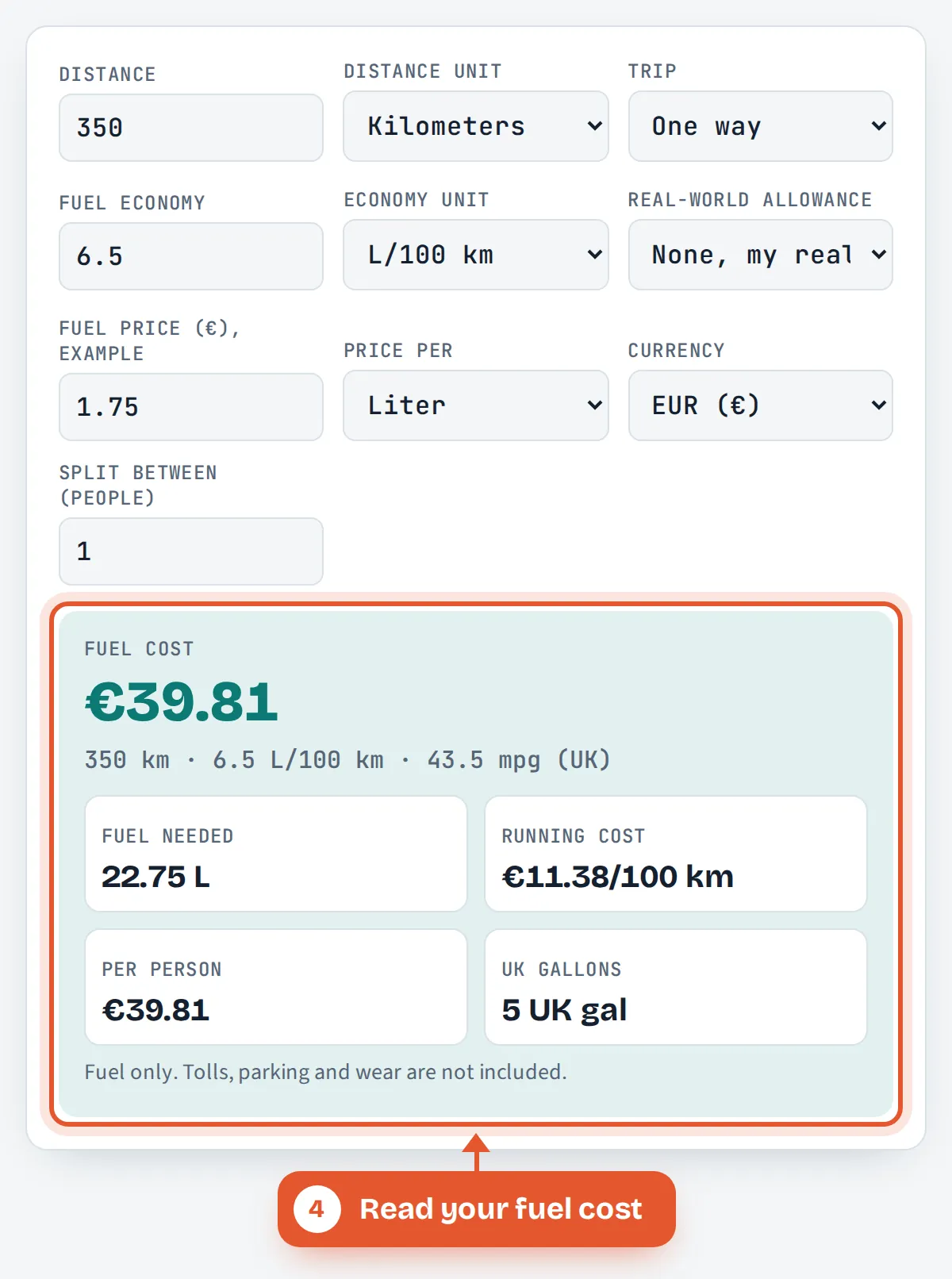
Multiply the distance in km by your consumption in L/100 km, divide by 100 to get liters, then multiply by the price per liter. A fuel cost calculator does this instantly. A 350 km trip in a car using 6.5 L/100 km needs 22.75 liters, which costs €39.81 at €1.75 a liter.
What Is the Fuel Cost Formula?
The fuel cost formula is liters used multiplied by the price per liter, and the only work is getting the liters right from your car’s economy figure:
Liters from UK mpg = miles ÷ mpg × 4.54609
Liters from US mpg = miles ÷ mpg × 3.785411784
Fuel cost = liters × price per liter
Cost per person = fuel cost ÷ people sharing
The numbers 4.54609 and 3.785411784 are the exact sizes of the imperial (UK) gallon and the US gallon in liters. Mixing them up is the most common mistake on fuel calculators: a car rated at 50 mpg in the UK only does about 41.6 mpg in US gallons, because a US gallon is about 17% smaller. If you need other conversions, our liters to gallons converter and km to miles converter handle them.
How Do You Convert mpg to L/100 km?
Divide 282.48 by UK mpg, or 235.21 by US mpg, to get liters per 100 km. Note that the scales run in opposite directions: a higher mpg is better, while a lower L/100 km is better. This table covers typical car figures:
| L/100 km | mpg (UK) | mpg (US) | km/L |
|---|---|---|---|
| 4.0 | 70.6 | 58.8 | 25.0 |
| 5.0 | 56.5 | 47.0 | 20.0 |
| 6.0 | 47.1 | 39.2 | 16.7 |
| 7.0 | 40.4 | 33.6 | 14.3 |
| 8.0 | 35.3 | 29.4 | 12.5 |
| 10.0 | 28.2 | 23.5 | 10.0 |
| 12.0 | 23.5 | 19.6 | 8.3 |
EU and UK new car brochures quote WLTP figures, in L/100 km on the continent and mpg in the UK. Your car’s trip computer usually lets you switch between the two.
Worked Examples: UK and Eurozone Trips
Sophie in the UK drives a 400 mile round trip in a petrol car that does 50 mpg. 400 ÷ 50 = 8 UK gallons, and 8 × 4.54609 = 36.37 liters. At £1.73 a liter, close to the UK average petrol price of 173.46p in the government’s weekly figures for 28 September 2026, the trip costs £62.92, or about 16p a mile.
Lukas in Germany drives 600 km in a car that uses 6.0 L/100 km. 600 × 6 ÷ 100 = 36 liters. At an example price of €1.80 a liter, the fuel costs €64.80. If 6.0 L/100 km is the official WLTP figure rather than his own, adding the 20% EU average real-world gap gives 43.2 liters and €77.76. Shared between three friends, that is €25.92 each.
Why Is My Real Fuel Use Higher Than the Official Figure?
Real fuel use is usually higher because the official WLTP test is run in a lab, while real driving includes motorway speeds, traffic, cold starts, heating and air conditioning, roof boxes and extra weight. The European Commission’s analysis of on-board fuel consumption data, collected from cars in 2022, found that real-world fuel use and CO2 emissions of petrol and diesel cars were on average around 20% higher than the WLTP figures. For petrol cars registered in 2021 the gap was 19.8%, and for diesels 18.2%.
That is why the calculator has a real-world allowance. If you enter the figure from your own trip computer, leave it at “None”. If you only know the brochure figure, choose +20% for a more realistic budget.
Where Can I Check Current Fuel Prices in the UK and EU?
In the UK, the government publishes average pump prices for petrol and diesel every week on GOV.UK. Across the EU, the European Commission’s Weekly Oil Bulletin publishes weekly consumer prices for petroleum products in every EU country, with and without taxes, including maps of Euro-super 95 and diesel prices. Prices differ a lot between neighboring countries, so on a long European drive it can pay to check the bulletin and fill up before you cross a border. In the UK, diesel has recently cost more per liter than petrol: on 28 September 2026 the weekly average was 197.58p for diesel against 173.46p for petrol.
To compare the cost of a trip with other spending, the percentage calculator shows how much a price rise adds, and our money calculators cover budgets and loans.
How Do You Use the Fuel Cost Calculator?
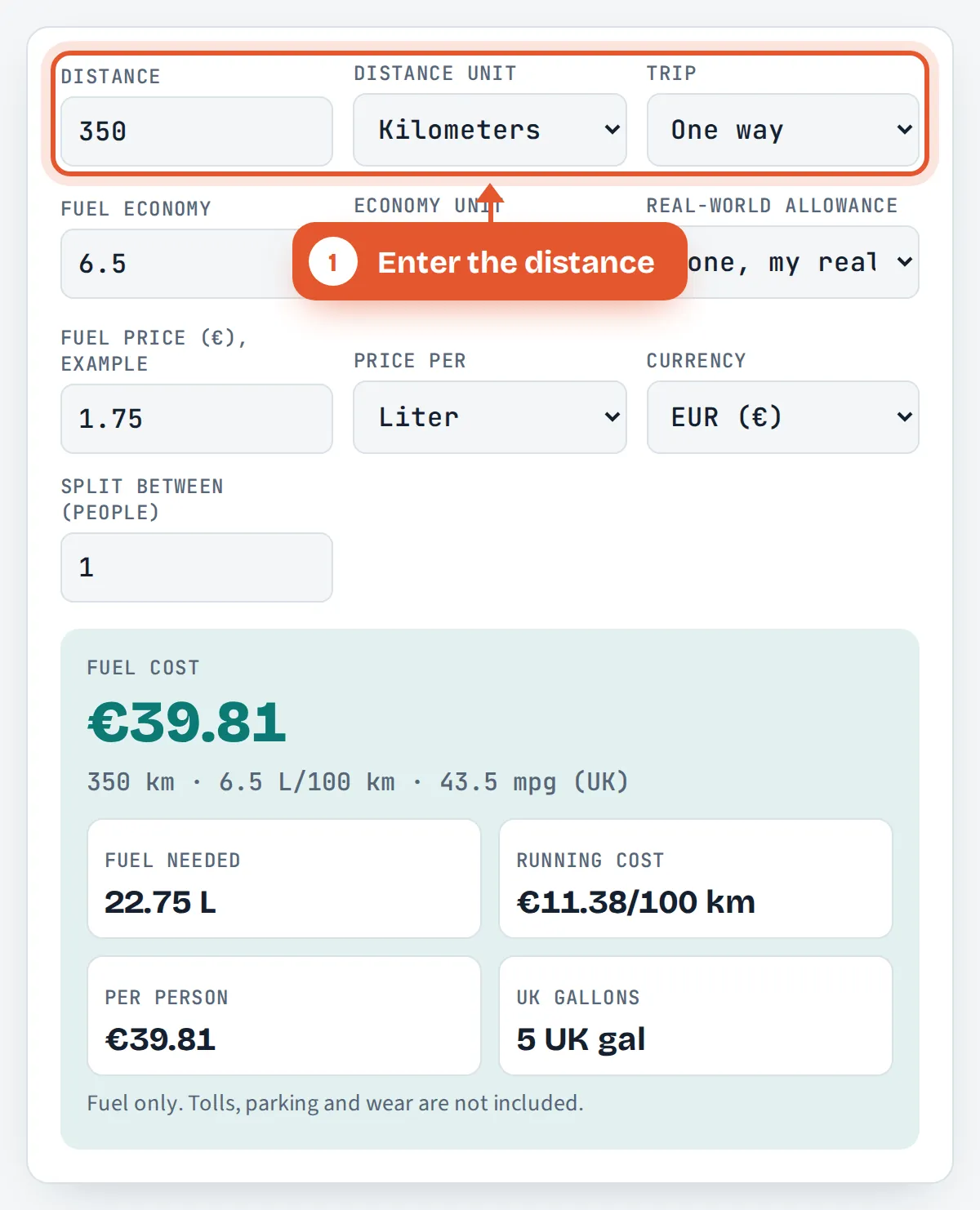
Enter the distance
Type the trip distance in kilometers or miles and choose one way or return.

Add your fuel economy
Enter L/100 km, UK mpg, US mpg or km/L. Add a real-world allowance if you are using the brochure figure.
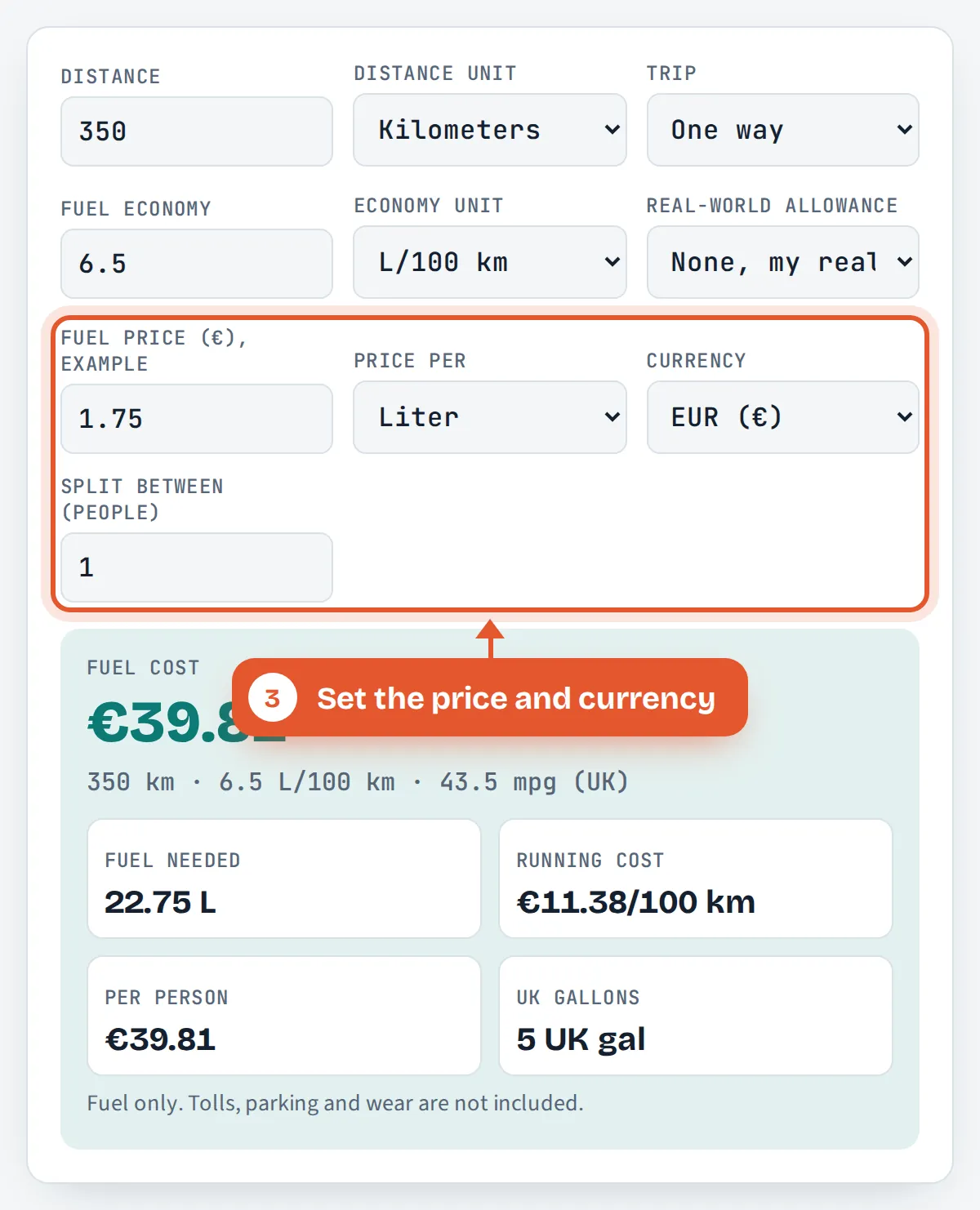
Set the price and currency
Type today’s pump price, choose EUR, GBP or USD, and say how many people are sharing the cost.
Read your fuel cost
See the total cost, liters needed, cost per 100 km or per mile and each person’s share.

Frequently Asked Questions
How much fuel does a 100 km trip use?
Exactly your L/100 km figure. A car rated at 6 L/100 km uses about 6 liters for 100 km, which costs €10.50 at €1.75 a liter. In UK terms, 6 L/100 km is about 47 mpg.
Is UK mpg the same as US mpg?
No. A UK (imperial) gallon is 4.54609 liters and a US gallon is 3.785411784 liters, so the same car shows a higher mpg in UK gallons. Multiply UK mpg by 0.833 to get US mpg, or divide US mpg by 0.833 to get UK mpg.
How do I calculate fuel cost per mile?
Divide the price per gallon by your mpg. In the UK, multiply the price per liter by 4.54609 first. At £1.73 a liter and 50 mpg, that is £7.86 a gallon divided by 50, or about 15.7p a mile.
How do I work out the fuel cost of a return trip?
Double the one-way distance, or choose “Return” in the calculator. A 175 km drive each way is 350 km in total, so at 6.5 L/100 km you need 22.75 liters, which costs €39.81 at €1.75 a liter.
Does driving faster use more fuel?
Yes, at motorway speeds. Air resistance rises sharply with speed, so most cars use noticeably more fuel at 130 km/h than at 100 km/h. Steady driving, correct tyre pressures and removing roof boxes all bring your real figure closer to the official one.
Can I use this for a diesel or LPG car?
Yes. The formula works for any liquid fuel sold by the liter: just enter that fuel’s price and your car’s consumption. For an electric car you need kWh per 100 km and the price per kWh instead, which this calculator does not cover.
Sources and Further Reading
- Real-world CO2 emissions and fuel consumption of cars and vans collected in 2022, European Commission
- Weekly Oil Bulletin, European Commission
- Gallon (imperial and US definitions), Wikipedia
Related Tools
Last reviewed: October 2026