Convert mph to km/h with the exact 1.609344 factor, or switch to km/h to mph with one tap. See the quick mental shortcut, meters per second, knots and the time to cover a kilometer or a mile.
Calculated in your browser with the exact international mile. Commas work as decimal points, so 62,5 reads as 62.5.
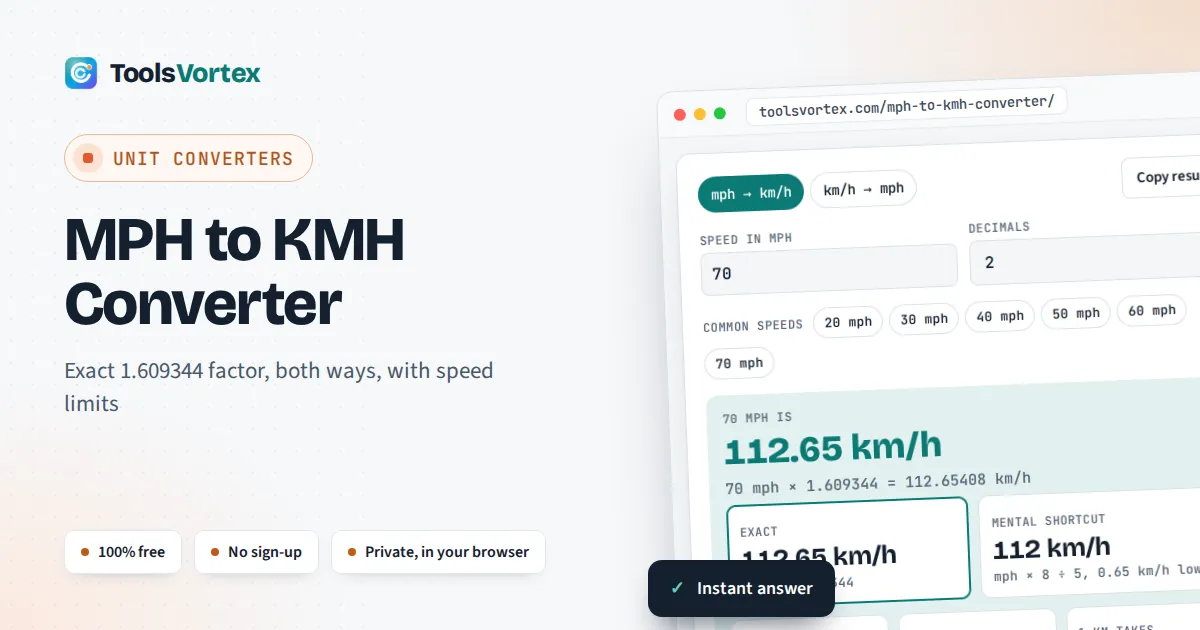
This mph to km/h converter is for drivers crossing between the UK and Ireland or mainland Europe, renting a car abroad, reading a British or American car review, or checking a running or cycling speed. Type the speed and the answer updates as you type, in either direction, with the exact figure and an easy mental rule you can use at the wheel.
How do you convert mph to km/h?
Multiply miles per hour by 1.609344 to get kilometers per hour, because one mile is exactly 1.609344 km. For example, 70 mph × 1.609344 = 112.65 km/h. To convert mph to km/h the other way round, divide by 1.609344 or multiply by 0.621371, so 100 km/h is 62.14 mph.
What is the formula for mph to km/h?
mph = km/h ÷ 1.609344 (or × 0.621371)
m/s = mph × 0.44704 = km/h ÷ 3.6
The factor is exact. The international mile is 1,760 yards and the yard is exactly 0.9144 meters, a definition the UK’s Weights and Measures Act 1985 also uses, so a mile is 1,609.344 meters. Because both speeds are “per hour”, the hours cancel and the conversion is the same as for km to miles.
For a quick estimate in your head, multiply mph by 8 and divide by 5 (the same as × 1.6). It is only about 0.6 percent low: 50 mph becomes 80 km/h against an exact 80.47. Going back, multiply km/h by 5 and divide by 8, which is about 0.6 percent high.
mph to km/h conversion chart
Exact values rounded to two decimals, with the mental shortcut beside them so you can see how close it gets:
| mph | km/h (exact) | m/s | Shortcut × 8 ÷ 5 |
|---|---|---|---|
| 5 | 8.05 | 2.24 | 8 |
| 10 | 16.09 | 4.47 | 16 |
| 15 | 24.14 | 6.71 | 24 |
| 20 | 32.19 | 8.94 | 32 |
| 25 | 40.23 | 11.18 | 40 |
| 30 | 48.28 | 13.41 | 48 |
| 40 | 64.37 | 17.88 | 64 |
| 50 | 80.47 | 22.35 | 80 |
| 60 | 96.56 | 26.82 | 96 |
| 70 | 112.65 | 31.29 | 112 |
| 80 | 128.75 | 35.76 | 128 |
| 100 | 160.93 | 44.70 | 160 |
What are the UK speed limits in km/h?
The UK national limits for cars and motorcycles are 30 mph in built-up areas, 60 mph on single carriageways and 70 mph on dual carriageways and motorways, which is 48.28, 96.56 and 112.65 km/h exactly. Wales uses 20 mph (32.19 km/h) as the default in built-up areas. GOV.UK rounds these down to 48, 32, 96 and 112 km/h in its own table, so the exact values in the chart above are slightly higher.
The limits are signed in mph across Great Britain and Northern Ireland, so a European car with a km/h speedometer needs the conversion. A handy set to remember: 30 mph is about 48 km/h, 60 mph about 97 km/h and 70 mph about 113 km/h.
What are the speed limits in Ireland in mph?
Ireland has used km/h for speed limits since 20 January 2005. The default limits are 120 km/h on motorways (74.56 mph), 100 km/h on national roads (62.14 mph), 80 km/h on regional roads (49.71 mph) and 50 km/h in built-up areas (31.07 mph). On 7 February 2025 the default on many rural local roads fell from 80 to 60 km/h (37.28 mph), and the government has recommended cutting national secondary roads from 100 to 80 km/h and urban cores to 30 km/h (18.64 mph).
| Road | Ireland | Northern Ireland and GB |
|---|---|---|
| Motorway | 120 km/h (74.56 mph) | 70 mph (112.65 km/h) |
| Main single road | 100 km/h (62.14 mph) | 60 mph (96.56 km/h) |
| Built-up area | 50 km/h (31.07 mph) | 30 mph (48.28 km/h) |
Crossing the border: a worked example
Ciarán drives from Dublin to Belfast in a car with an Irish km/h speedometer. On the M1 motorway south of the border the limit is 120 km/h. Once he crosses into Northern Ireland the signs switch to mph, and on the A1 dual carriageway the limit is 70 mph. Converting, 70 × 1.609344 = 112.65 km/h, so his limit drops by about 7.3 km/h even though the road looks much the same. With the shortcut, 70 × 8 ÷ 5 = 112, close enough to set his cruise control just under 112 km/h.
The same maths works for running. A 10 km/h jog is 6.21 mph and takes 6 minutes per km, or 9 minutes 39 seconds per mile. For full race splits, use the pace calculator.
How Do You Use the MPH to KMH Converter?
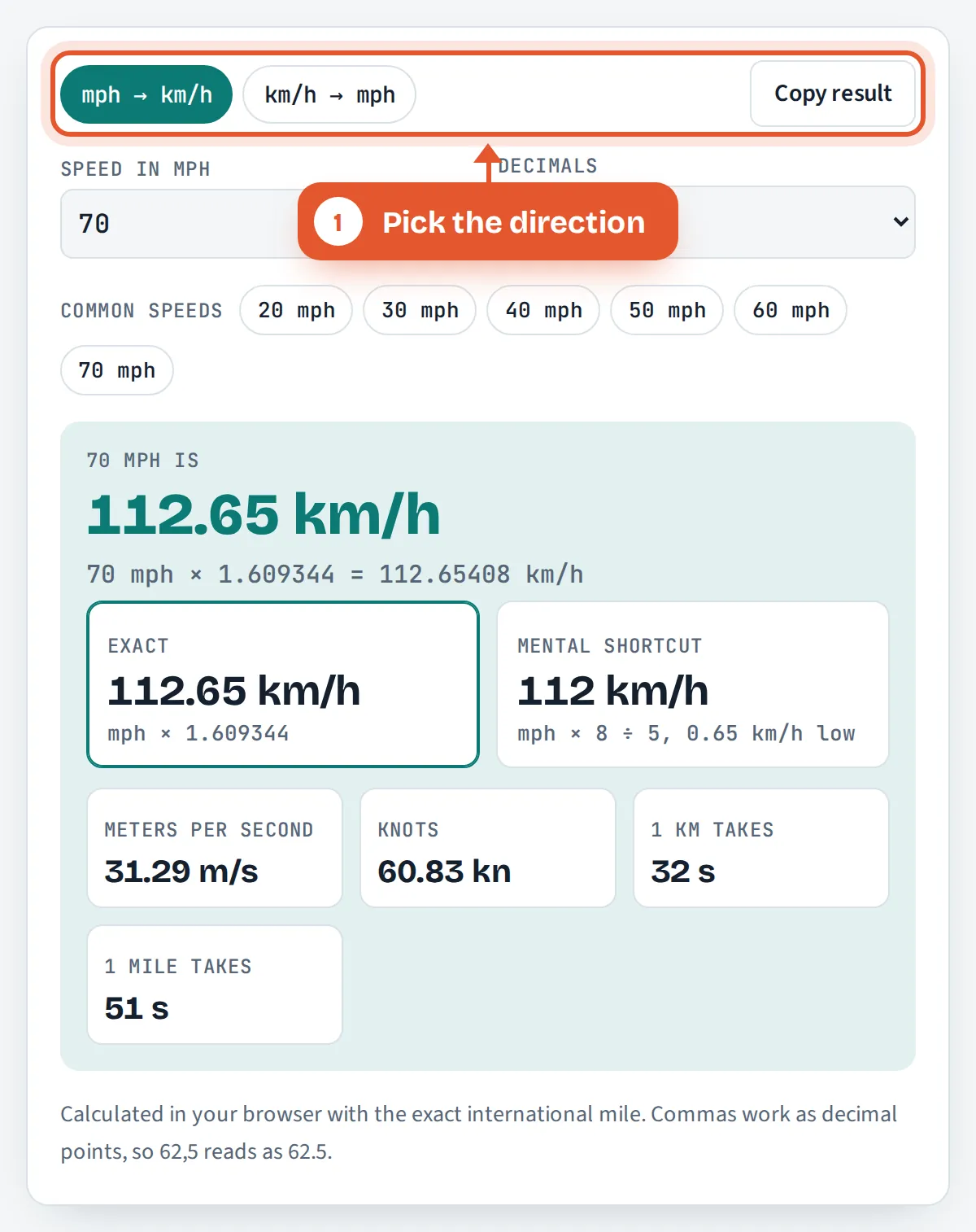
Pick the direction
Leave mph → km/h selected, or tap km/h → mph to go the other way. Your last result is carried across.

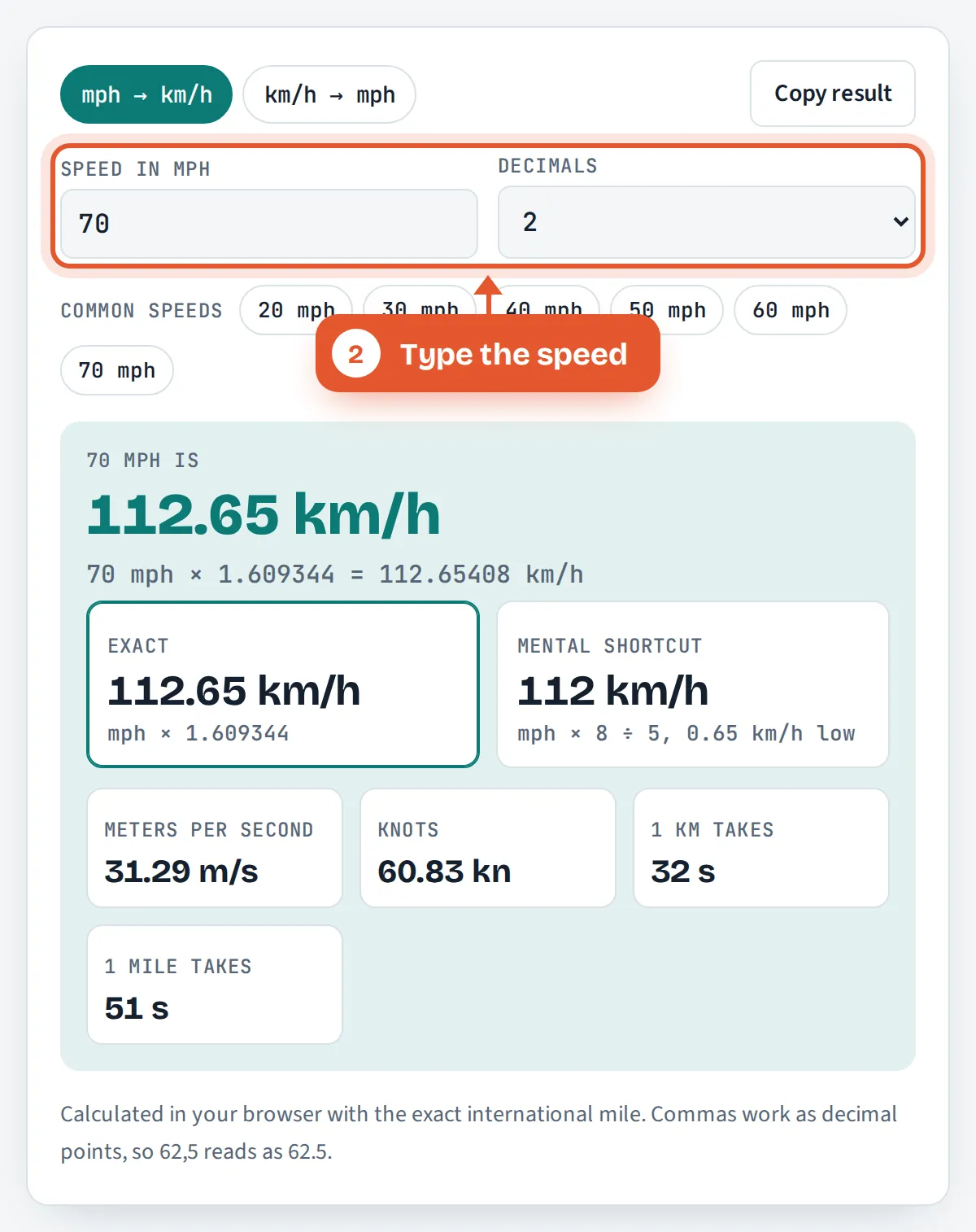
Type the speed
Enter any speed in mph and choose how many decimals you want. Decimals with a point or a comma both work.
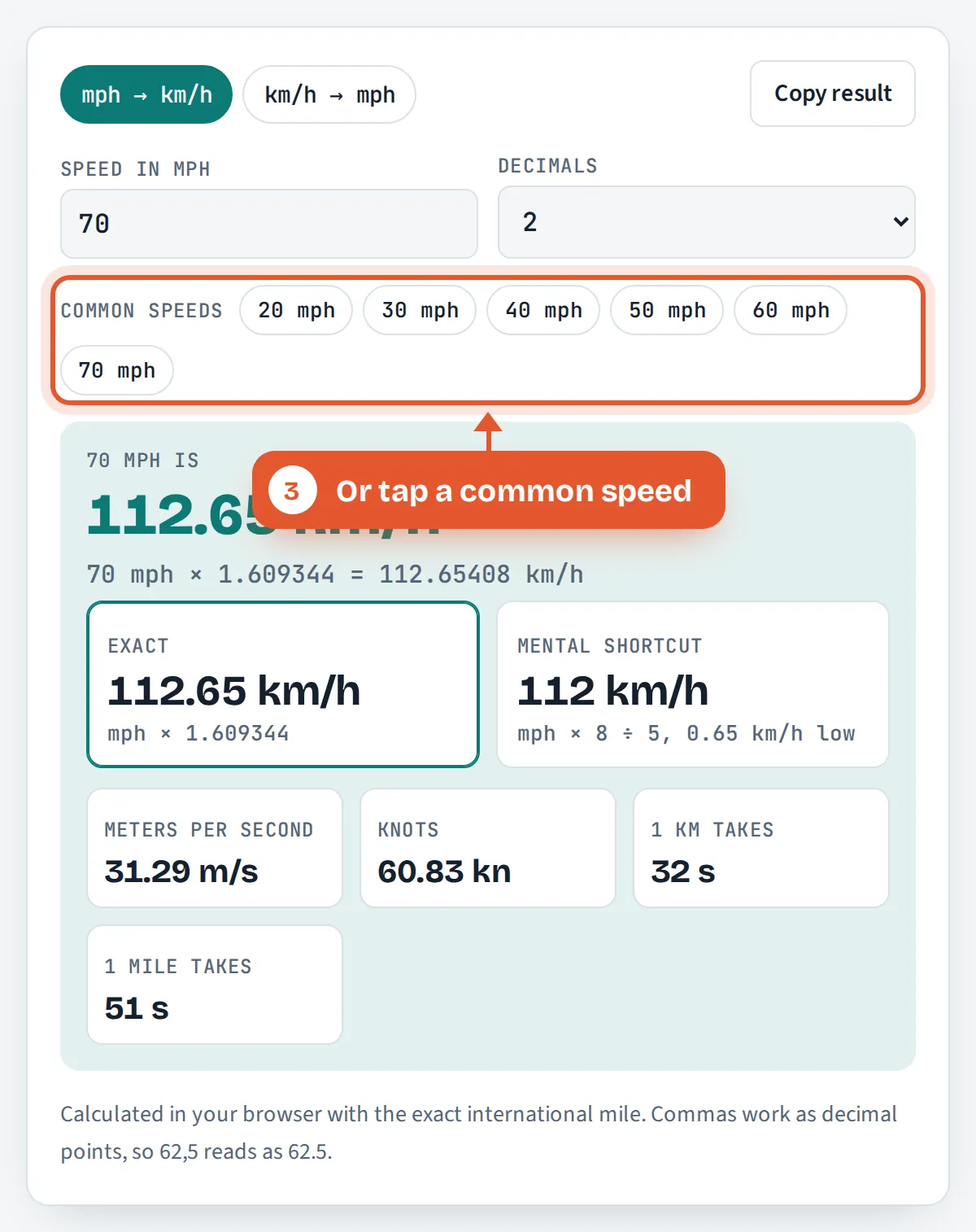
Or tap a common speed
Use the quick buttons for UK limits such as 30, 60 and 70 mph, or Irish and European limits in km/h after switching direction.
Read the result
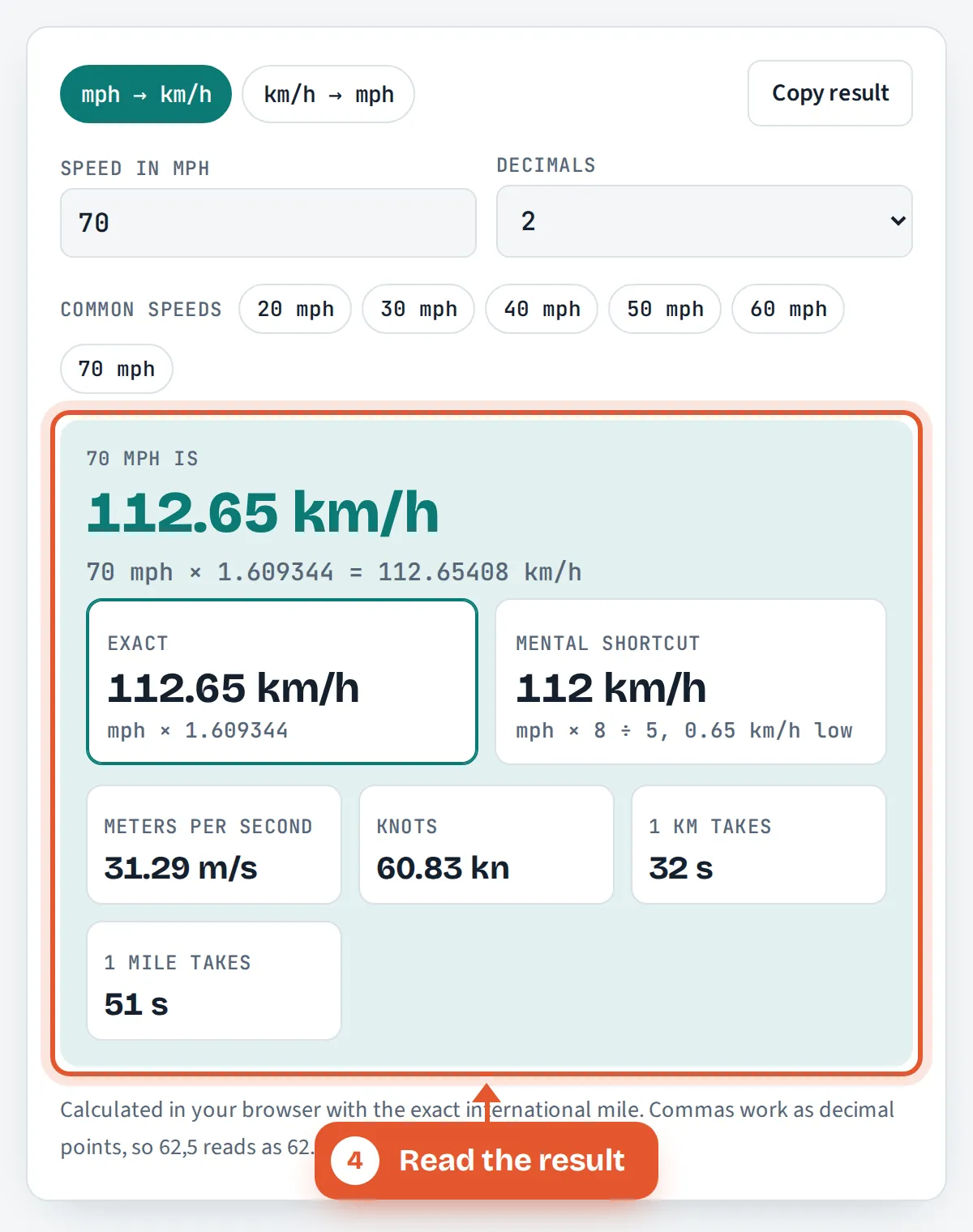
The exact answer appears in large type with the working, next to the mental shortcut and its error, plus m/s, knots and the time to cover 1 km and 1 mile.
Frequently Asked Questions
How many km/h is 1 mph?
One mile per hour is exactly 1.609344 km/h, because the international mile is defined as 1,609.344 meters. In the other direction, 1 km/h is about 0.621371 mph. Rounded to two decimals that is 1.61 km/h per mph and 0.62 mph per km/h.
How fast is 70 mph in km/h?
70 mph is 112.65 km/h. It is the national speed limit for cars on UK motorways and dual carriageways. GOV.UK shows it as 112 km/h in its table, and the quick × 8 ÷ 5 rule gives 112 km/h, under the exact value by about 0.65 km/h.
What is 100 km/h in mph?
100 km/h is 62.14 mph. It is the default speed limit on national roads in Ireland, so it is a figure worth remembering for drivers from the UK. Multiplying by 5 and dividing by 8 gives 62.5 mph, which is close enough for a quick check.
Is km/h the same as kph?
Yes. km/h, kph and km/hr all mean kilometers per hour. The usual symbol is km/h, which is what you will see on Irish speed limit signs and in official documents. In the same way, mph is sometimes written mi/h.
How do I convert mph to m/s?
Multiply mph by 0.44704, which is exact. For example, 30 mph is 13.41 m/s. From km/h, divide by 3.6, so 100 km/h is 27.78 m/s. Meters per second is the SI unit of speed, used in physics and engineering.
When did Ireland switch to km/h?
Ireland changed its speed limits from mph to km/h on 20 January 2005, when about 35,000 signs were replaced. Northern Ireland, as part of the UK, still uses mph, so drivers crossing the border need to switch units and should watch for the change in signs.
Sources and Further Reading
Related Tools
Last reviewed: October 2026