Convert millimeters to inches as a decimal and as the nearest fraction, from 1/8 to 1/64 inch, with the rounding error shown in mm. Switch to inches to mm with one tap.
| Millimeters | Inches |
|---|
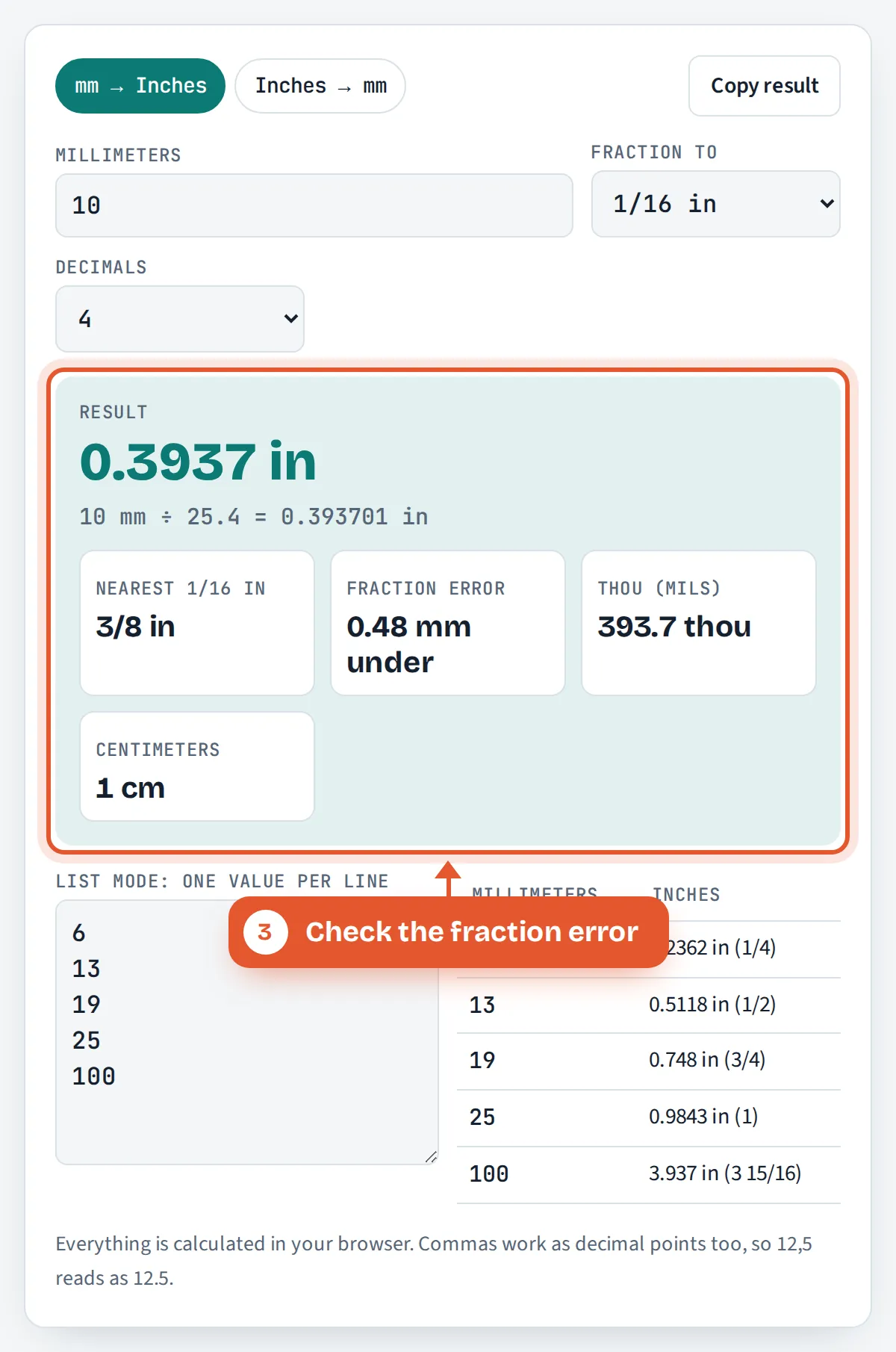
Everything is calculated in your browser. Commas work as decimal points too, so 12,5 reads as 12.5.
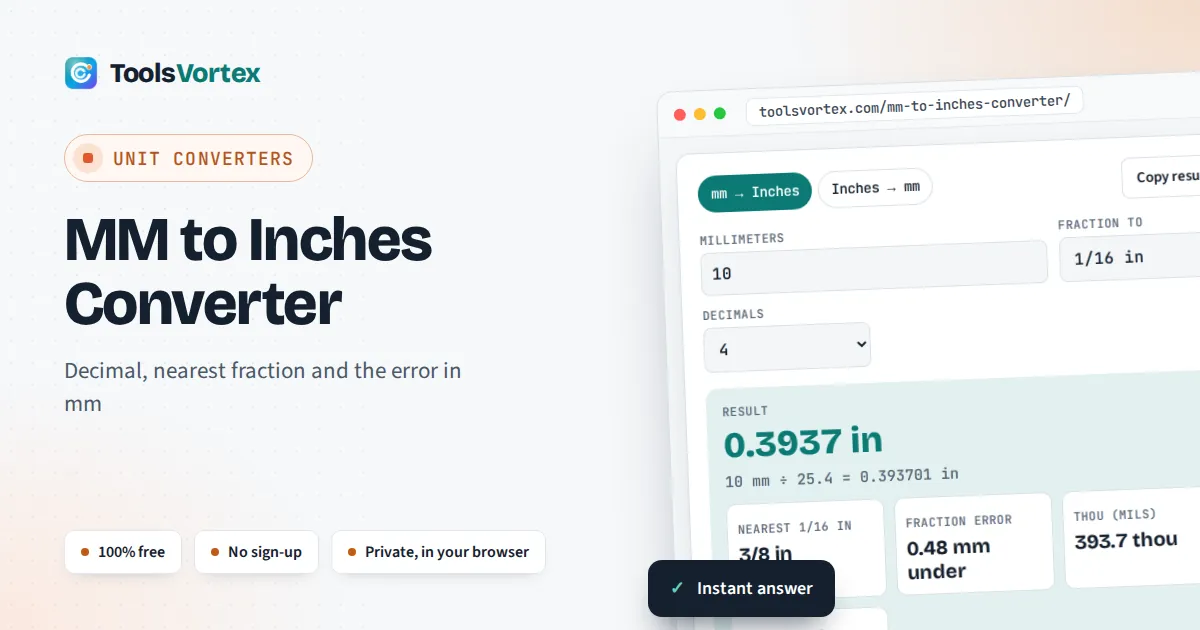
This mm to inches converter turns millimeters into decimal inches and the nearest tape measure fraction for DIYers, engineers, makers and anyone matching a metric part to an imperial drawing, tool or product. Most of Europe works in millimeters while plenty of tools, fittings and US product specs still use inches, so it helps to know not just the nearest fraction but how far off it is.
How do you convert mm to inches?
Divide the millimeters by 25.4 to get inches, because one inch is defined as exactly 25.4 mm. For example, 100 mm ÷ 25.4 = 3.937 inches, just under 3 15/16 inches. To convert mm to inches quickly, multiply by 0.03937. For inches to mm, multiply by 25.4 instead.
What is the mm to inches formula?
mm = inches × 25.4
fraction numerator = round(inches × 16), over 16
The 25.4 is exact. Since 1959 the inch has been defined from the metric system as precisely 25.4 millimeters, so the only rounding happens when you turn the answer into a decimal or a fraction. Multiplying by 0.03937 is a shortcut that reads very slightly low, by less than 0.01 thou per 100 mm, so it is safe for almost any job.
For a fraction, multiply the inches by the fraction size you want (16 for sixteenths), round to a whole number and reduce. If you already have a decimal and just want it as a fraction, the decimal to fraction calculator does that step on its own.
mm to inches conversion chart
Decimal inches, nearest 1/16 inch and how far that fraction is from the true size:
| mm | Inches | Nearest 1/16 | Fraction error |
|---|---|---|---|
| 1 | 0.0394 | 1/16 | 0.59 mm over |
| 2 | 0.0787 | 1/16 | 0.41 mm under |
| 3 | 0.1181 | 1/8 | 0.18 mm over |
| 5 | 0.1969 | 3/16 | 0.24 mm under |
| 6 | 0.2362 | 1/4 | 0.35 mm over |
| 8 | 0.315 | 5/16 | 0.06 mm under |
| 10 | 0.3937 | 3/8 | 0.48 mm under |
| 12 | 0.4724 | 1/2 | 0.70 mm over |
| 13 | 0.5118 | 1/2 | 0.30 mm under |
| 16 | 0.6299 | 5/8 | 0.13 mm under |
| 19 | 0.748 | 3/4 | 0.05 mm over |
| 20 | 0.7874 | 13/16 | 0.64 mm over |
| 22 | 0.8661 | 7/8 | 0.23 mm over |
| 25 | 0.9843 | 1 | 0.40 mm over |
| 30 | 1.1811 | 1 3/16 | 0.16 mm over |
| 40 | 1.5748 | 1 9/16 | 0.31 mm under |
| 50 | 1.9685 | 1 15/16 | 0.79 mm under |
| 100 | 3.937 | 3 15/16 | 0.01 mm over |
| 150 | 5.9055 | 5 7/8 | 0.78 mm under |
| 200 | 7.874 | 7 7/8 | 0.03 mm over |
| 300 | 11.811 | 11 13/16 | 0.04 mm over |
| 500 | 19.685 | 19 11/16 | 0.06 mm over |
| 1,000 | 39.3701 | 39 3/8 | 0.13 mm over |
Will a 1/2 inch socket fit a 13 mm bolt? A worked example
Tomasz is fixing a bike in his garage in Leeds. The bolt head is 13 mm, and his socket set is imperial. 13 ÷ 25.4 = 0.5118 inches, and half an inch is only 0.5 inches, which is 12.7 mm. The 1/2 inch socket is 0.3 mm too small, so it will not go on. The next imperial size up, 9/16 inch, is 14.29 mm, which is 1.29 mm too big and would round off the bolt. The safe answer is a 13 mm socket.
Which metric and imperial sizes are close but not the same?
Some pairs are near enough to swap and others only look it. A 19 mm part and 3/4 inch (19.05 mm) differ by just 0.05 mm, so they are usually interchangeable for drilling and spanners. A 6 mm bit is 0.35 mm smaller than 1/4 inch (6.35 mm), 10 mm is 0.475 mm bigger than 3/8 inch (9.525 mm), and 25 mm is 0.4 mm short of 1 inch (25.4 mm).
For a hole that has to be a snug fit, those fractions of a millimeter matter. Use the fraction error in the converter to decide, and switch to 1/32 or 1/64 when you need a closer match.
How precise does a mm to inches conversion need to be?
It depends on the job. One sixteenth of an inch is 1.5875 mm, so a 1/16 rounding can be up to about 0.8 mm off, which is fine for woodwork or curtains. A thirty second (0.79 mm) halves that, and a sixty fourth (0.40 mm) halves it again. For engineering, people skip fractions and work in thou, where one thou is 0.0254 mm, close to the limit of what the eye can see at around 0.02 to 0.04 mm.
At that level, temperature matters too. Materials expand as they warm, which is why the ISO 1 standard fixes the reference temperature for precision length measurement at 20 °C.
Why do the UK and EU measure in millimeters?
EU law, through Directive 80/181/EEC, requires SI units for measurement in trade, and an inch figure may appear only as a supplementary indication next to the metric value, never alone and never larger. The UK follows the same pattern for trade and has defined its imperial units from the metric system since the yard was fixed at 0.9144 meters. So European drawings, timber, tiles and fittings are labelled in millimeters, while inch sizes survive on items like screens, wheel rims and some tools. For room dimensions in larger units, see the cm to feet converter.
How Do You Use the MM to Inches Converter?
Choose the direction
Leave mm → Inches selected, or tap Inches → mm. Your current value is carried across when you switch.

Enter the size and precision
Type the millimeters, then pick the fraction size (1/8 to 1/64 inch) and how many decimals you want.
Check the fraction error
Read the decimal inches, the nearest fraction, how far that fraction is from the true size, the thou and the centimeters.
Convert a list
Paste several sizes, one per line, to convert a parts list or a set of drill bits at once.



Frequently Asked Questions
How many inches is 1 mm?
One millimeter is about 0.03937 inches, or 39.37 thou. Put another way, it takes exactly 25.4 mm to make one inch, so a millimeter is a little under 1/25 of an inch. On a tape measure it falls between 1/32 and 1/16 of an inch.
How many mm is 1 inch?
One inch is exactly 25.4 millimeters. This has been the definition since the international yard and pound agreement of 1959, so it is not a rounded figure. Half an inch is 12.7 mm, a quarter inch is 6.35 mm and an eighth is 3.175 mm.
Is 13 mm the same as 1/2 inch?
No. Half an inch is 12.7 mm, so 13 mm is 0.3 mm larger. That gap is enough for a 1/2 inch spanner or socket to be too tight on a 13 mm bolt head, so use the matching metric tool where you can.
What is 100 mm in inches?
100 mm is 3.937 inches, which is just under 3 15/16 inches on a tape measure, only 0.01 mm short. That is also 10 cm. For a quick estimate, 100 mm is roughly 4 inches, but that reads about 1.6 mm too long.
How do I convert mm to a fraction of an inch?
Divide the millimeters by 25.4, multiply the decimal part by 16 (or 32 or 64) and round to the nearest whole number. That gives the numerator. For 10 mm: 0.3937 × 16 = 6.3, so 6/16, which reduces to 3/8 inch.
What is a thou?
A thou is one thousandth of an inch, 0.0254 mm, also called a mil in the United States. Machinists and 3D printing users quote tolerances in thou. Do not confuse the American mil with a millimeter, which is almost 40 times larger.
Sources and Further Reading
- Millimetre, Wikipedia
- ISO 1 standard reference temperature, Wikipedia
- Units of measurement in the EU, EUR-Lex summary
Related Tools
Last reviewed: October 2026