Work out how many grams of dog food to feed each day. Enter your dog’s weight, life stage and the energy value from the food label, and get daily calories, grams per day and grams per meal.
A starting point, not a prescription. Weigh your dog every 2 to 4 weeks and ask your vet for individual advice.
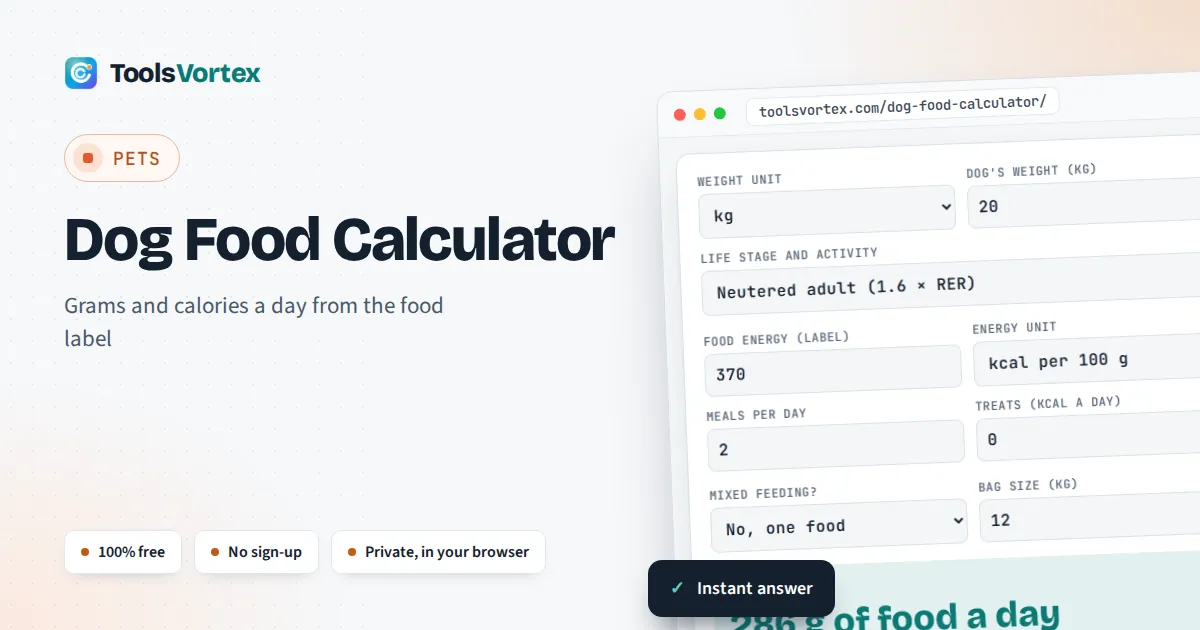
This dog food calculator tells owners how many grams of a specific food to give each day, using the same energy equations vets use and the calorie figure printed on your bag or tin. Feeding guides on packs are written for an average dog and usually give a wide band, so two dogs of the same weight can be told to eat very different amounts. Working from calories lets you compare foods fairly, split the total into meals, take treats into account and mix dry with wet food.
How much food should I feed my dog a day?
Start with the resting energy requirement, 70 × weight in kg to the power 0.75, then multiply by 1.6 for a neutered adult. A 20 kg dog needs about 1,060 kcal a day, which is about 290 g of a dry food with 365 kcal per 100 g. A dog food calculator then splits this into meals.
How Does the Dog Food Calculator Work?
It uses two steps from veterinary nutrition. First it estimates the energy your dog burns at rest, then it multiplies that by a factor for life stage and activity. The result in kilocalories is divided by the energy density of your food.
Daily energy = RER × factor, minus treat calories
Grams a day = daily energy ÷ (kcal per 100 g) × 100
kcal per 100 g = kJ per 100 g ÷ 4.184 = kcal per kg ÷ 10
The factors in the selector follow the Pet Nutrition Alliance chart used by vets: 1.0 for weight loss (calculated at the ideal weight), 1.2 to 1.4 for inactive or obesity prone dogs, 1.6 for a neutered adult, 1.8 for an intact adult, and 2 to 3 for growing puppies, with needs falling from around 4 months. For hard working dogs the calculator uses the activity levels in the European FEDIAF nutritional guidelines: 125 kcal × weight0.75 for 1 to 3 hours of high impact exercise a day and 150 kcal × weight0.75 for working dogs such as sheepdogs.
The calculator also shows the range from the World Small Animal Veterinary Association (WSAVA) chart of calories for an average healthy adult dog in ideal condition. If your dog’s weight is in kilograms on an old vet record but you think in pounds, the kg to lbs converter helps.
How Many Calories Does a Dog Need by Weight?
Adult maintenance estimates below. The last column assumes a dry food with 370 kcal per 100 g as an example, fed to a neutered adult with no treats.
| Weight | RER (kcal) | Neutered adult, 1.6 × RER | WSAVA chart range | Dry food at 370 kcal/100 g |
|---|---|---|---|---|
| 5 kg | 234 | 374 kcal | 280 to 351 kcal | 101 g |
| 10 kg | 394 | 630 kcal | 470 to 590 kcal | 170 g |
| 15 kg | 534 | 854 kcal | 640 to 800 kcal | 231 g |
| 20 kg | 662 | 1,059 kcal | 790 to 993 kcal | 286 g |
| 25 kg | 783 | 1,252 kcal | 940 to 1,174 kcal | 338 g |
| 30 kg | 897 | 1,436 kcal | 1,080 to 1,346 kcal | 388 g |
| 40 kg | 1,113 | 1,781 kcal | 1,340 to 1,670 kcal | 481 g |
Why Is the WSAVA Range Lower Than the Formula?
The WSAVA chart describes average pet dogs, and its figures work out at roughly 1.2 to 1.5 times RER, while 1.6 is a textbook factor for a neutered adult with normal activity. WSAVA notes that dogs are individuals and some need more or fewer calories to stay trim. Because the chart is built for typical companion dogs, it is a useful lower check if your dog is not especially active. Treat any number here as a first estimate: weigh your dog, feed for 2 to 4 weeks, then adjust the portion in small steps until weight stays steady at an ideal body condition.
Worked Example: How Much Should Bella Eat?
Bella is a neutered 20 kg Border Collie cross in Dublin who gets about an hour of walks a day. Her owner feeds a dry food labelled 365 kcal per 100 g, in two meals.
- RER: 200.75 = 9.46, so 70 × 9.46 = 662 kcal
- Daily energy: 662 × 1.6 = 1,059 kcal
- Grams a day: 1,059 ÷ 365 × 100 = 290 g, or 145 g per meal
- Check: the WSAVA chart gives 790 to 993 kcal for a 20 kg adult, which is 216 to 272 g of this food
A sensible plan is to start at about 270 to 290 g, weigh Bella every fortnight and drop towards the WSAVA figure if her waist starts to disappear. If she gets 60 kcal of treats a day, enter them and the calculator takes them off the meal portions. If Bella later needs to lose weight, choose the weight loss option and enter her ideal weight. The calculator then feeds RER at the ideal weight, which for 18 kg is about 611 kcal.
How Do I Know if My Dog Is a Healthy Weight?
Use a body condition score rather than the scale alone, because the right weight depends on frame and muscle. WSAVA’s 9 point chart puts the ideal at 4 to 5 out of 9: ribs easy to feel with only a thin fat cover, a waist visible behind the ribs from above, and the belly tucked up when seen from the side. At 6 the ribs have a slight excess fat cover, and at 7 they are hard to feel. If your dog scores 6 or more, pick the weight loss option and ask your vet for a target weight. For puppies, use the puppy settings and let your vet check growth at vaccinations.
How Do I Read the Calories on a Dog Food Label?
Look for the energy or metabolisable energy figure, usually printed as kcal per 100 g, kcal per kg or kJ per 100 g. Choose the matching unit in the calculator and it converts for you. Dry foods are energy dense, so a small change in grams makes a big change in calories. Wet foods contain much more water, so you feed a far larger weight for the same energy. If no energy figure is printed, the manufacturer can tell you. Always follow the feeding guide on the food label as a starting range, and use this calculator to fine tune within it.
How Do You Use the Dog Food Calculator?
Enter weight and life stage
Type your dog’s current weight in kg or lb and choose the life stage and activity that fits best.

Add the food’s energy value
Copy the energy figure from the bag or tin and pick its unit, then set meals per day and any treat calories.
Mix foods and set bag size
If you feed wet and dry food together, set the wet food energy and its share. Enter the bag size to see how long it lasts.
Read grams per day and per meal
The daily grams appear in large text, with calories, grams per meal, the WSAVA range and how long a bag lasts.


Frequently Asked Questions
How many grams of dry food should a 10 kg dog eat?
A neutered 10 kg adult needs roughly 470 to 630 kcal a day. With a dry food of 370 kcal per 100 g that is about 127 to 170 g a day. Start in the middle, check weight every few weeks and follow the label as a guide.
What is RER in dogs?
RER, the resting energy requirement, is the energy a dog uses at rest in a comfortable environment. Vets calculate it as 70 × body weight in kg to the power 0.75, then multiply it by a factor for life stage and activity to estimate daily needs.
Should I use my dog’s current or ideal weight?
Use the current weight if your dog is in ideal condition. If your dog is overweight, vets base the plan on the ideal weight instead, often at 1.0 × RER. Choose the weight loss option and enter the target weight your vet agrees with you.
Do neutered dogs need fewer calories?
Yes. Vet charts use about 1.6 × RER for a neutered adult and 1.8 × RER for an intact adult, roughly 11% less. Many dogs gain weight after neutering if portions stay the same, so recheck weight in the months after the operation.
How much should a puppy eat compared with an adult?
Puppies need about 3 × RER until around 4 months, then about 2 × RER until they are fully grown. Feed a complete growth food, split the total into several small meals, and let your vet check growth.
Is a dog food calculator better than the feeding guide on the bag?
It is a useful cross check rather than a replacement. The label is written for that exact food, so follow it as your starting range. The calculator explains where your dog sits in that range and handles treats, mixed feeding and weight loss. Ask your vet for individual advice.
Sources and Further Reading
- Calorie ranges for an average healthy adult dog, WSAVA (PDF)
- Body condition score chart for dogs, WSAVA (PDF)
- Global Nutrition Guidelines and toolkit, WSAVA
Related Tools
Last reviewed: October 2026