Convert inches to centimeters instantly. Type decimals, fractions like 5 3/8 or feet and inches like 5 ft 7 in, switch to cm to inches with one tap, or paste a whole list.
| Inches | Centimeters |
|---|
Everything is calculated in your browser. Commas work as decimal points too, so 12,5 reads as 12.5.
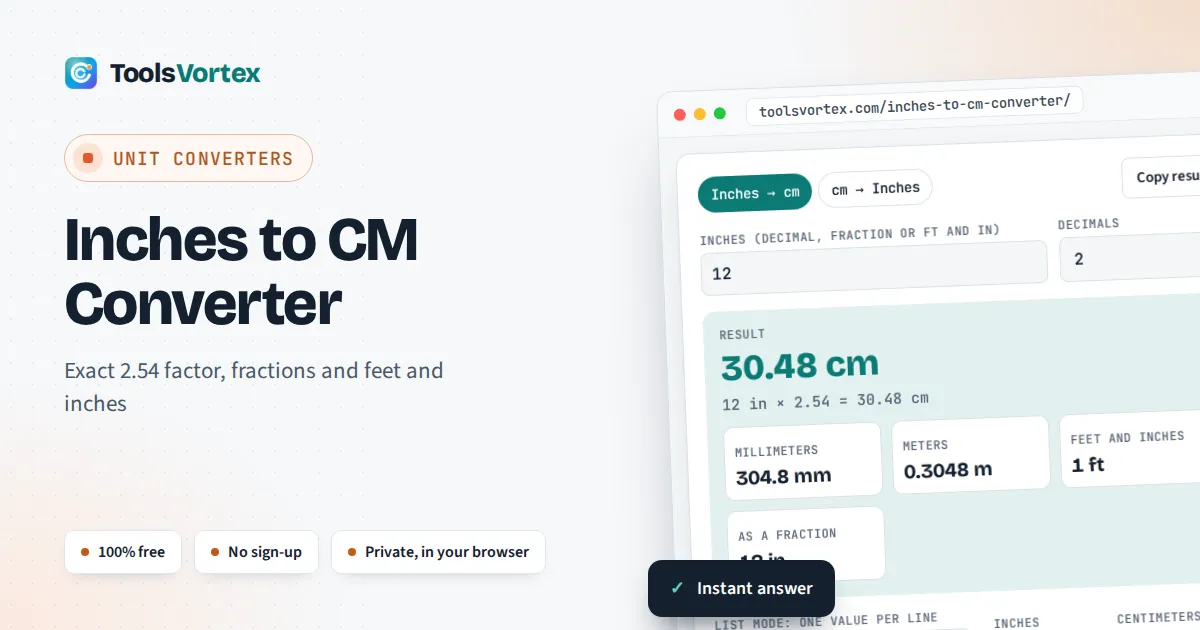
This inches to cm converter turns any inch measurement into centimeters for shoppers, DIYers, students and anyone reading a size written in imperial units. It is built for the way inches actually turn up in Europe: TV and monitor sizes, bike and car wheels, US product listings, sewing patterns and heights given in feet and inches. Type the number the way you see it, and the result updates as you type.
How do you convert inches to cm?
Multiply the number of inches by 2.54 to get centimeters, because one inch is defined as exactly 2.54 cm (25.4 mm). For example, 12 inches × 2.54 = 30.48 cm. To convert inches to cm in reverse, divide centimeters by 2.54. The factor is exact, so rounding only happens in the final answer.
What is the formula for inches to cm?
inches = cm ÷ 2.54
mm = inches × 25.4
The 2.54 is not an approximation. Since the international yard and pound agreement of 1959, the yard has been defined as exactly 0.9144 meters, and an inch is 1/36 of a yard, which works out to exactly 25.4 mm. The United States adopted the new value on 1 July 1959 and the United Kingdom applied it from 1 January 1964. The British Standards Institution had already used a 25.4 mm inch for industry since 1930.
In the UK the same definitions sit in Schedule 1 of the Weights and Measures Act 1985: the yard is 0.9144 metre, the foot is 1/3 yard and the inch is 1/36 yard. Across the EU, Directive 80/181/EEC lets traders show imperial units only as a supplementary indication next to the metric value, never alone and never more prominent. That is why a European shop lists a monitor as 68.6 cm with “27 inch” in brackets.
Inches to cm conversion chart
Exact values for the fractions on a tape measure and for common whole inch lengths:
| Inches | Centimeters | Millimeters |
|---|---|---|
| 1/16 | 0.15875 | 1.5875 |
| 1/8 | 0.3175 | 3.175 |
| 1/4 | 0.635 | 6.35 |
| 3/8 | 0.9525 | 9.525 |
| 1/2 | 1.27 | 12.7 |
| 5/8 | 1.5875 | 15.875 |
| 3/4 | 1.905 | 19.05 |
| 7/8 | 2.2225 | 22.225 |
| 1 | 2.54 | 25.4 |
| 2 | 5.08 | 50.8 |
| 3 | 7.62 | 76.2 |
| 4 | 10.16 | 101.6 |
| 5 | 12.7 | 127 |
| 6 | 15.24 | 152.4 |
| 8 | 20.32 | 203.2 |
| 10 | 25.4 | 254 |
| 12 (1 foot) | 30.48 | 304.8 |
| 18 | 45.72 | 457.2 |
| 24 | 60.96 | 609.6 |
| 36 (1 yard) | 91.44 | 914.4 |
| 48 | 121.92 | 1,219.2 |
| 60 | 152.4 | 1,524 |
| 72 (6 feet) | 182.88 | 1,828.8 |
Will a 55 inch TV fit? A worked example
Aoife in Cork has a 125 cm wide alcove and is looking at a 55 inch television. Screen sizes are measured on the diagonal, so 55 × 2.54 gives 139.7 cm, which sounds too big. The width is what matters. For a standard 16:9 screen, the width is the diagonal × 16 ÷ √337, which is 47.94 inches or 121.8 cm, and the height is 26.96 inches or 68.5 cm. The panel fits with about 3 cm to spare, before the frame. Check the frame size on the spec sheet, then work out other screen shapes with the aspect ratio calculator.
Where are inches still used in the UK and Europe?
Inches are still the worldwide standard for display screens, so TVs, monitors, laptops and phones are sold by their diagonal in inches across the UK, Ireland and the EU. Common sizes convert like this: a 15.6 inch laptop is 39.62 cm, a 24 inch monitor is 60.96 cm, a 27 inch monitor is 68.58 cm and a 32 inch TV is 81.28 cm.
Wheel rims are the other big one. A 17 inch car alloy is 43.18 cm across the rim, and mountain bikes come with 27.5 or 29 inch wheels (69.85 cm and 73.66 cm). In the UK, people still give their height in feet and inches, which you can convert here directly or with the cm to feet converter for the reverse.
How do you read fractions of an inch on a tape measure?
The longest line between two inch marks is the 1/2 inch, the next longest are the 1/4 marks, then the 1/8 marks, and the shortest are usually 1/16 of an inch, which is 1.5875 mm. Count the small lines past the last whole inch and reduce the fraction: 6 sixteenths is 3/8. Type it as 5 3/8 and the converter returns 13.65 cm. When you convert cm to inches, the tool shows the nearest 1/16 inch so you can find the mark on an imperial tape.
How Do You Use the Inches to CM Converter?
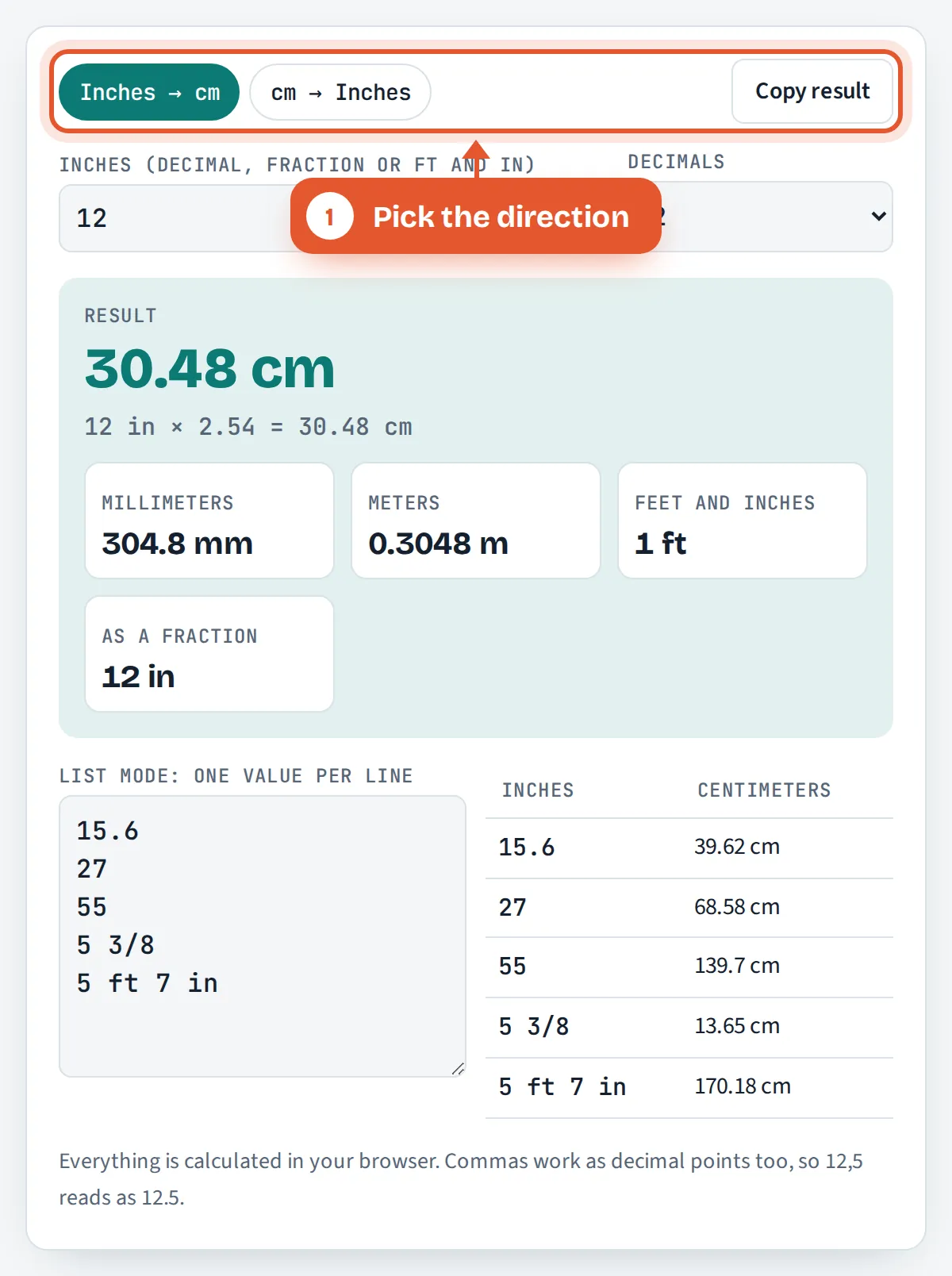
Pick the direction
Leave Inches → cm selected, or tap cm → Inches to go the other way. Your current value is carried across.

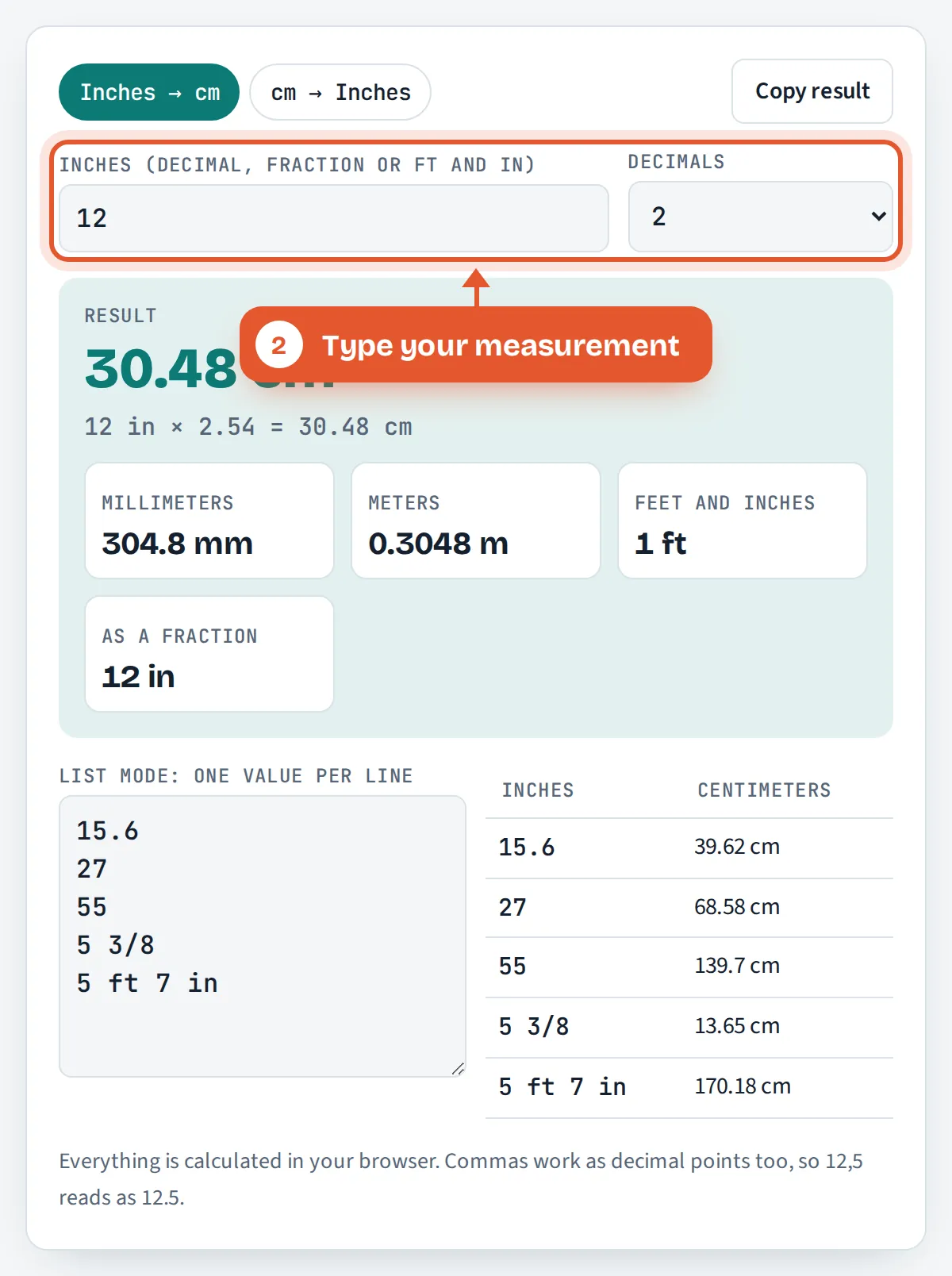
Type your measurement
Enter a decimal such as 15.6, a fraction such as 5 3/8, or feet and inches such as 5 ft 7 in. Choose how many decimals you want.
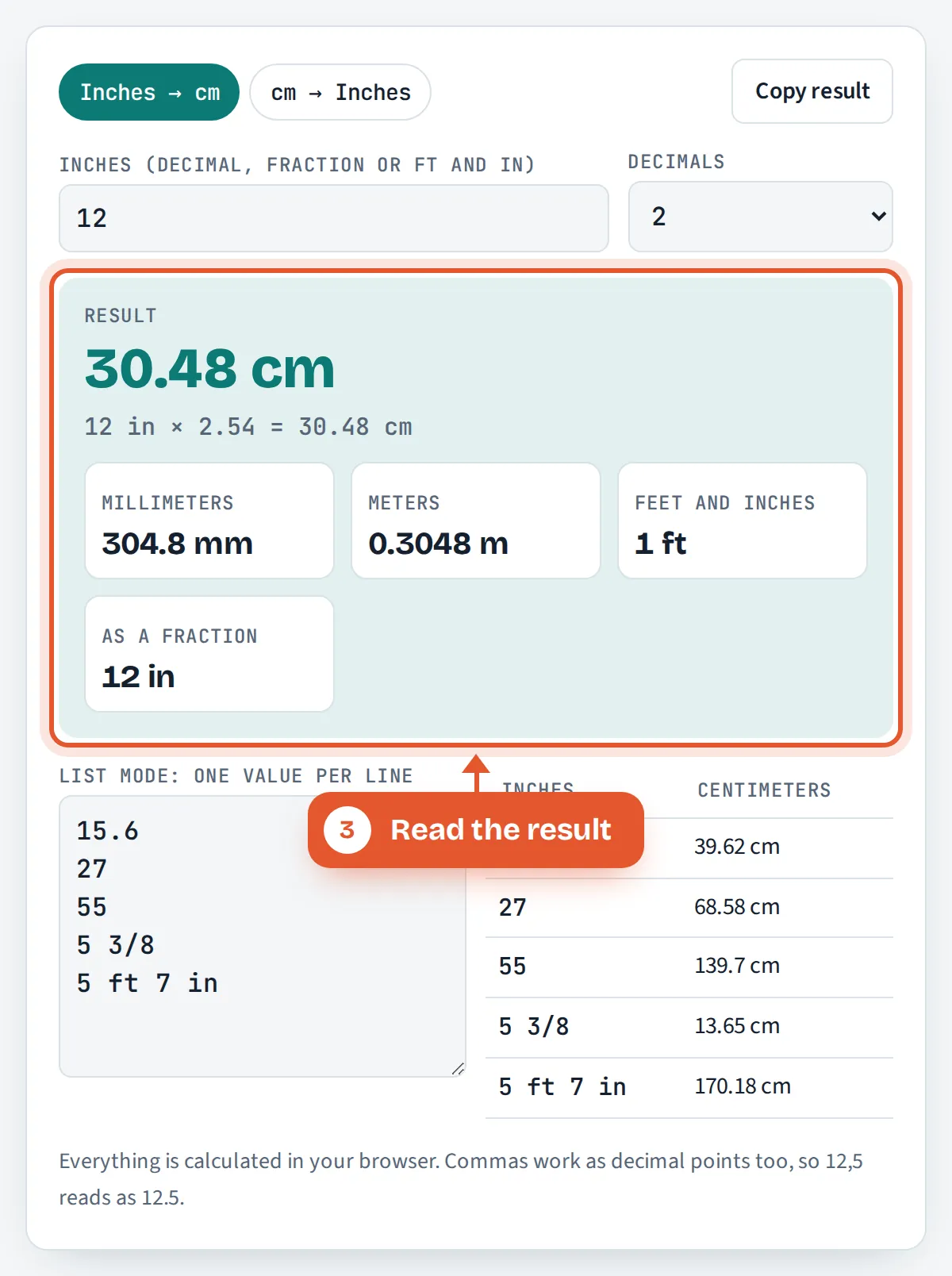
Read the result
The centimeters appear in large type with the exact working underneath, plus millimeters, meters, feet and inches and the fraction.
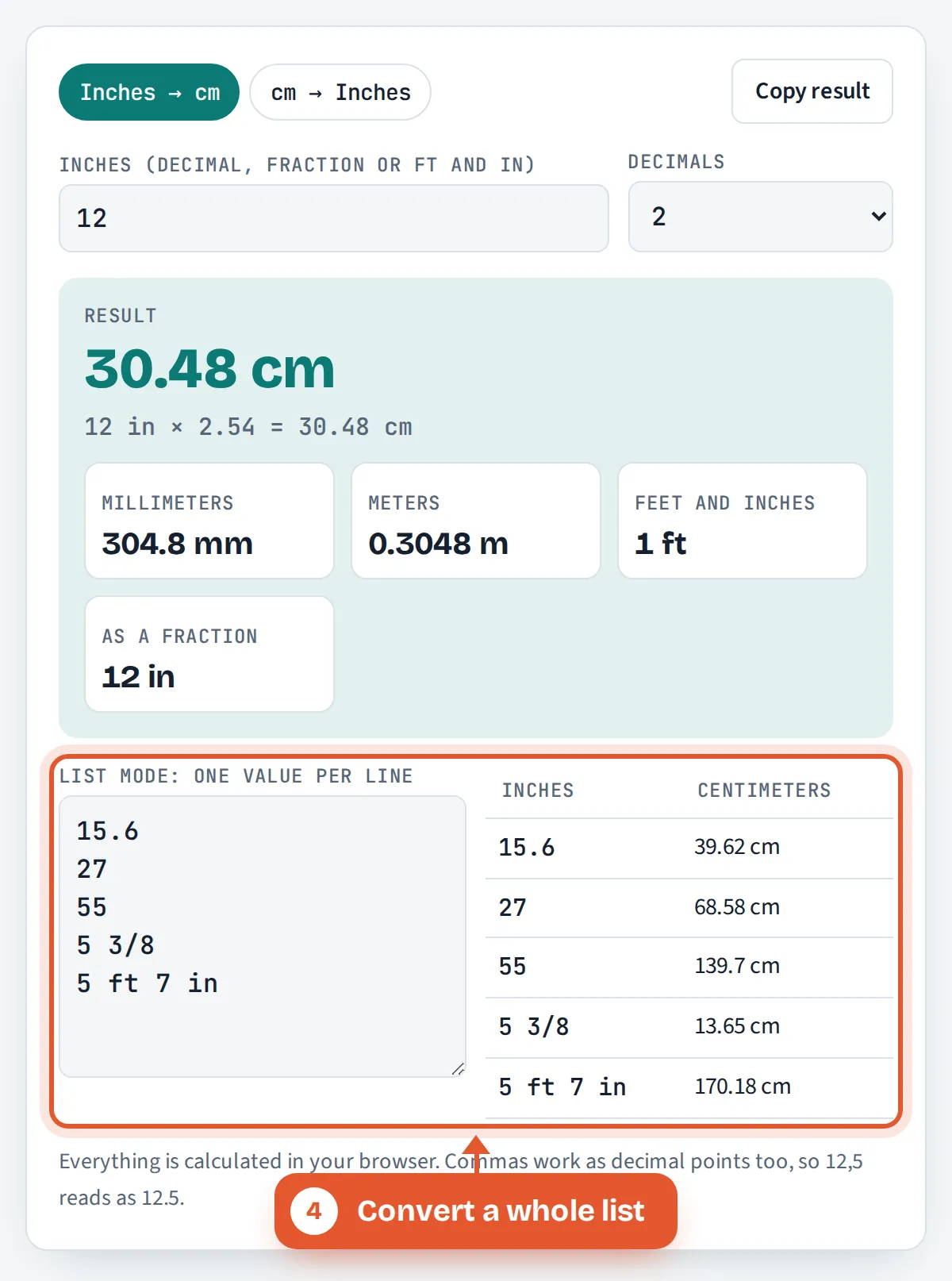
Convert a whole list
Paste several sizes into list mode, one per line, to convert a spec sheet or shopping list in one go.
Frequently Asked Questions
How many cm is 1 inch?
One inch is exactly 2.54 centimeters, or 25.4 millimeters. This is a defined value, not a rounded one, set by the 1959 international yard agreement and written into UK law through the yard of 0.9144 meters. Any rounding you see happens in the answer, never in the factor.
How many cm is 12 inches?
Twelve inches, which is one foot, equals exactly 30.48 cm. That is why a 12 inch school ruler is marked with 30 cm on the other edge, with a little to spare. Three feet, or 36 inches, is one yard and equals 91.44 cm.
How many inches is 30 cm?
Thirty centimeters is about 11.81 inches, or just under 11 13/16 inches on a tape measure. Divide by 2.54 to get the figure. A 30 cm ruler is therefore 0.48 cm shorter than a 12 inch ruler.
Is it centimeters or centimetres?
Both spellings are correct and mean the same unit. Centimetres is the British, Irish and international spelling used by the SI brochure, while centimeters is the American spelling. The symbol is always cm in lowercase, with no full stop and no plural s.
How do I convert 5 feet 7 inches to cm?
Turn the feet into inches first: 5 × 12 = 60, plus 7 makes 67 inches. Then multiply by 2.54 to get 170.18 cm. You can type 5 ft 7 in or 5′ 7″ straight into the converter above and it does both steps.
Why does my conversion show a long decimal?
Because 2.54 has two decimal places, multiplying it by a fraction like 1/16 inch gives up to five decimals, for example 0.15875 cm. Use the decimals selector to round to what your task needs: one decimal for body measurements, two for crafts, and millimeters for engineering.
Sources and Further Reading
- Inch: definition and history, Wikipedia
- Weights and Measures Act 1985, Schedule 1, legislation.gov.uk
- Units of measurement in the EU, EUR-Lex summary
Related Tools
Last reviewed: October 2026