Add VAT to a net price or remove it from a gross price. Choose the UK or any of the 27 EU countries and get the net price, VAT and total instantly.
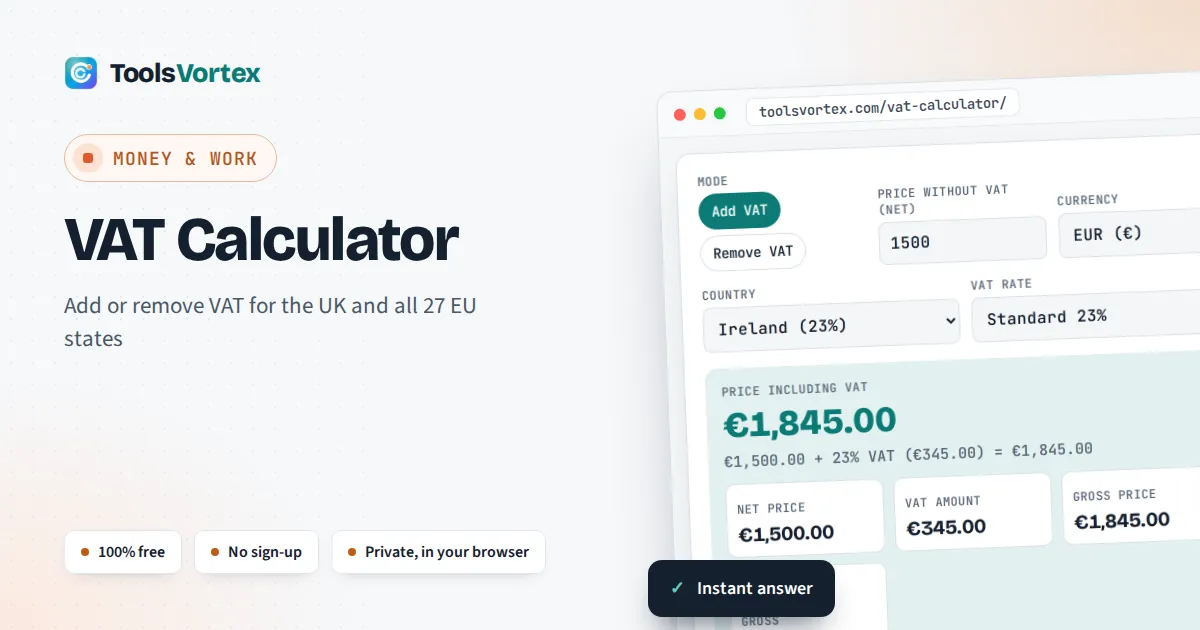
This VAT calculator adds VAT to a net price or removes it from a gross price for freelancers, small businesses and shoppers in the UK, Ireland and every EU country. Pick a country and the tool loads its current standard, reduced, super reduced and parking rates, then shows the net price, the VAT and the total side by side. Need US sales tax instead? Use the sales tax calculator.
How Do You Calculate VAT?
To add VAT, multiply the net price by 1 plus the rate: × 1.20 for the UK 20% rate or × 1.23 for Ireland’s 23%. To remove VAT, divide the gross price by that same figure instead of subtracting the percentage. A VAT calculator does both: £120 including 20% VAT is £100 net plus £20 VAT.
What Are the VAT Formulas?
There are two formulas, one for each direction. The rate is written as a decimal, so 23% becomes 0.23.
Remove VAT: net = gross ÷ (1 + rate) and VAT = gross − net
The VAT inside a gross price is always rate ÷ (1 + rate) of that price. At 20% this is 0.2 ÷ 1.2, or one sixth, which is why UK bookkeepers call it the “VAT fraction”. At Ireland’s 23% it is 23/123, about 18.70%. The calculator shows this share in the “VAT share of gross” box so you can check receipts quickly.
Why Can’t You Just Subtract 20% to Remove VAT?
Subtracting 20% from a gross price takes off too much, because the VAT was calculated on the smaller net price, not on the total. Take a £120 bill: 20% of £120 is £24, which would leave £96, but the real net price is £120 ÷ 1.2 = £100 and the VAT is £20. The same trap works in reverse for percentage increases: adding 20% and then removing 20% never returns you to the start.
| Rate | Add VAT | Remove VAT | VAT share of gross | Where it applies |
|---|---|---|---|---|
| 5% | × 1.05 | ÷ 1.05 | 4.76% | UK reduced rate |
| 9% | × 1.09 | ÷ 1.09 | 8.26% | Ireland second reduced, Netherlands reduced |
| 13.5% | × 1.135 | ÷ 1.135 | 11.89% | Ireland reduced |
| 19% | × 1.19 | ÷ 1.19 | 15.97% | Germany, Cyprus standard |
| 20% | × 1.2 | ÷ 1.2 | 16.67% | UK, France, Austria standard |
| 21% | × 1.21 | ÷ 1.21 | 17.36% | Spain, Netherlands, Belgium standard |
| 23% | × 1.23 | ÷ 1.23 | 18.70% | Ireland, Poland, Portugal standard |
| 25% | × 1.25 | ÷ 1.25 | 20.00% | Denmark, Sweden, Croatia standard |
| 27% | × 1.27 | ÷ 1.27 | 21.26% | Hungary standard |
Worked Example: An Irish Freelancer and a UK Receipt
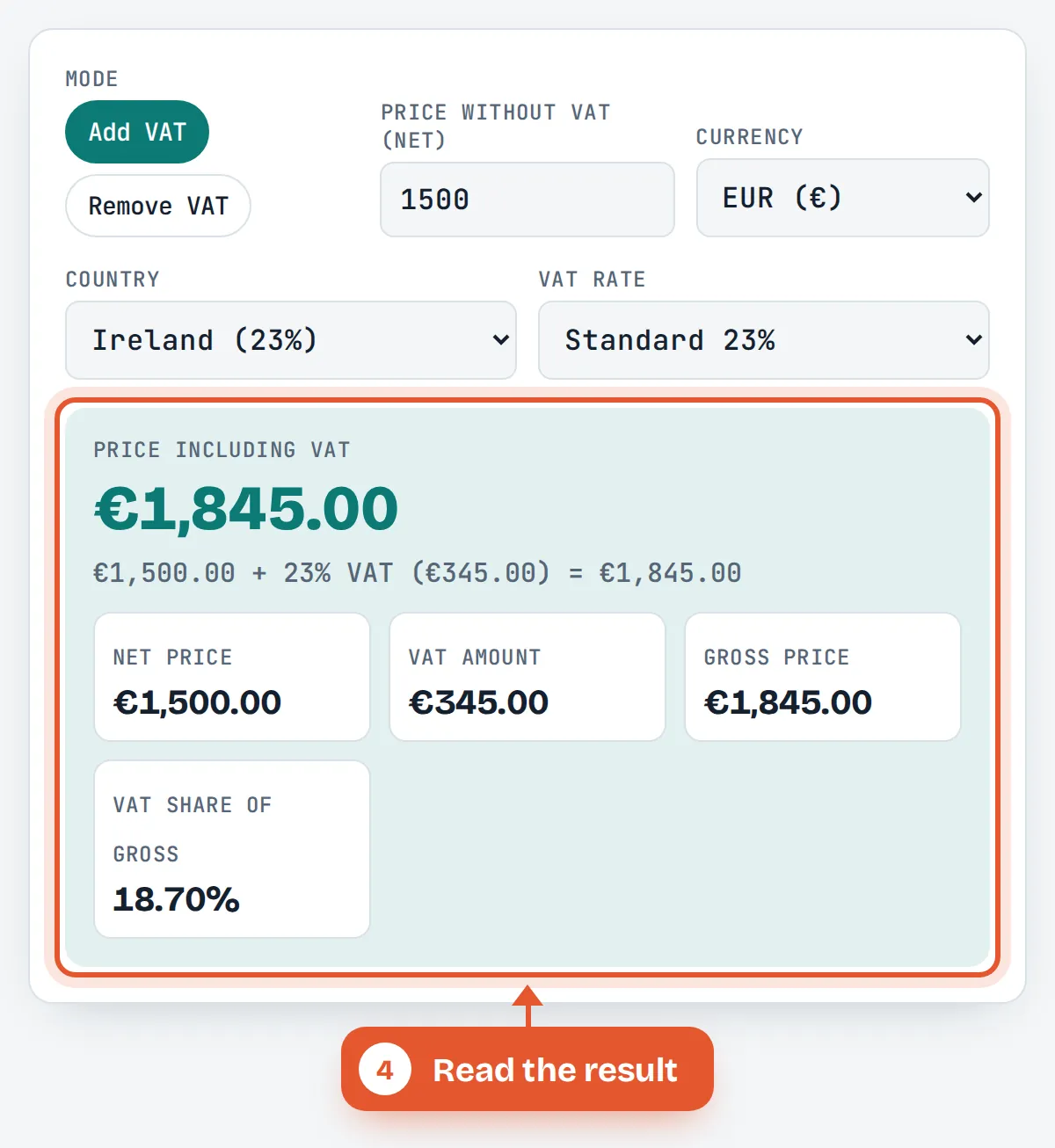
Aoife is a graphic designer in Dublin who charges €1,500 for a logo project. Design work is standard rated in Ireland, so she adds 23%: €1,500 × 0.23 = €345 VAT, and the invoice total is €1,845. Those are the default values in the calculator above.
Her UK client later sends a £240 receipt for printing that includes 20% VAT. Switching to Remove VAT and choosing the United Kingdom gives £240 ÷ 1.2 = £200 net and £40 VAT. A German supermarket receipt of €53.50 at the 7% reduced rate works the same way: €53.50 ÷ 1.07 = €50.00 net and €3.50 VAT.
What Are the VAT Rates in the EU and UK in 2026?
EU standard rates in 2026 run from 17% in Luxembourg to 27% in Hungary, and the UK standard rate is 20%. EU law sets the floor: the standard rate cannot be lower than 15% and reduced rates cannot normally be lower than 5%. Some countries also keep special rates for certain supplies: super reduced rates below 5%, zero rates and “parking” rates of at least 12%, arrangements that date back to before the Single Market. The table below uses the European Commission’s Your Europe list, last checked by the Commission on 13 July 2026, and GOV.UK for the UK.
| Country | Standard | Reduced | Super reduced | Parking |
|---|---|---|---|---|
| Austria | 20% | 10%, 13% | None | 13% |
| Belgium | 21% | 6%, 12% | None | 12% |
| Bulgaria | 20% | 9% | None | None |
| Croatia | 25% | 5%, 13% | None | None |
| Cyprus | 19% | 5%, 9% | 3% | None |
| Czechia | 21% | 12% | None | None |
| Denmark | 25% | None | None | None |
| Estonia | 24% | 9% | None | None |
| Finland | 25.5% | 10%, 13.5% | None | None |
| France | 20% | 5.5%, 10% | 2.1% | None |
| Germany | 19% | 7% | None | None |
| Greece | 24% | 6%, 13%, 17% | 4% | None |
| Hungary | 27% | 5%, 18% | None | None |
| Ireland | 23% | 9%, 13.5% | None | None |
| Italy | 22% | 5%, 10% | 4% | None |
| Latvia | 21% | 5%, 12% | None | None |
| Lithuania | 21% | 5%, 12% | None | None |
| Luxembourg | 17% | 8% | 3% | 14% |
| Malta | 18% | 5%, 7% | None | 12% |
| Netherlands | 21% | 9% | None | None |
| Poland | 23% | 5%, 8% | None | None |
| Portugal | 23% | 6%, 13% | None | 13% |
| Romania | 21% | 11% | None | None |
| Slovakia | 23% | 5%, 19% | None | None |
| Slovenia | 22% | 5%, 9.5% | None | None |
| Spain | 21% | 10% | 4% | None |
| Sweden | 25% | 6%, 12% | None | None |
| United Kingdom | 20% | 5% (plus 0% zero rate) | None | None |
Which reduced rate applies depends on the product: food, books, medicines, hotel stays and energy are the usual candidates, but every country chooses its own list. Ireland also has a 4.8% livestock rate, which Revenue lists alongside its 23%, 13.5% and 9% rates for 2026. Rates change through national budgets, so check your tax authority before filing a return, and use the custom rate if a new rate is announced.
When Do You Have to Charge VAT?
In the UK you must register for VAT once your taxable turnover goes over £90,000 in a rolling 12 months, or you expect it to pass £90,000 in the next 30 days. Inside the EU, each country sets its own registration threshold. For cross-border sales of goods and digital services to consumers in other EU countries, a single EU-wide threshold of €10,000 a year applies; above it you charge the customer’s country rate, which is exactly what the country picker in this tool is for.
When you price products, work out your margin on the net price, not the gross one, because the VAT belongs to the tax authority. The profit margin calculator handles that step once you have the net figure from this tool.
Does Rounding Change the VAT on an Invoice?
Rounding can change the VAT by a cent or a penny, depending on whether you round each line or only the invoice total. Three items of €0.99 at 23% give €0.68 of VAT if you round once on the €2.97 total, but €0.69 if you round €0.23 of VAT on each line. This calculator rounds to two decimals once per calculation. For long invoices, add up the net lines first and then apply the rate, unless your accounting software or tax authority asks for line by line rounding.
How Do You Use the VAT Calculator?
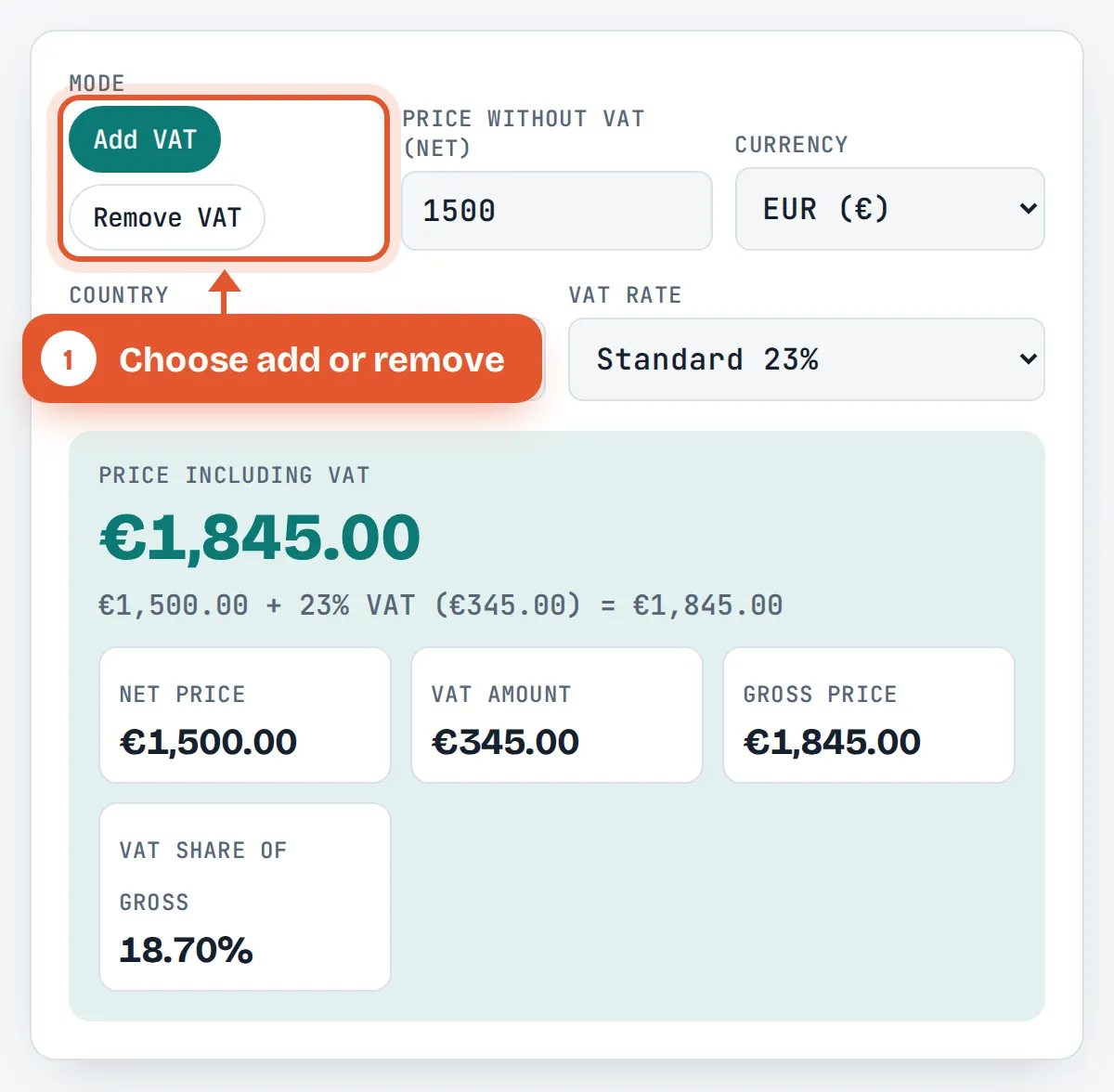
Choose add or remove
Pick Add VAT if your price is before tax, or Remove VAT if the price already includes it.

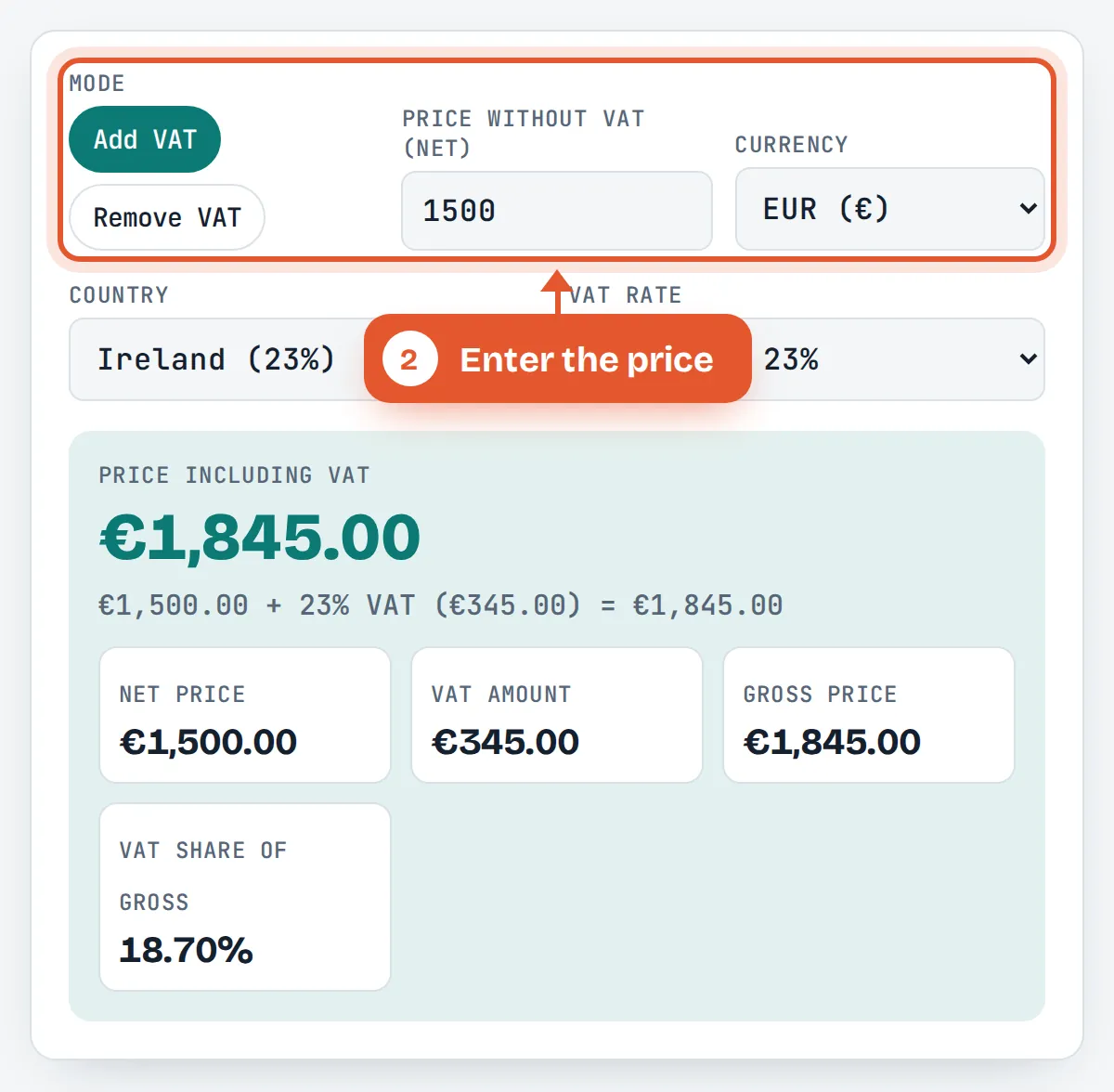
Enter the price
Type the amount and choose EUR, GBP or USD. The currency changes automatically when you pick the UK or an EU country.
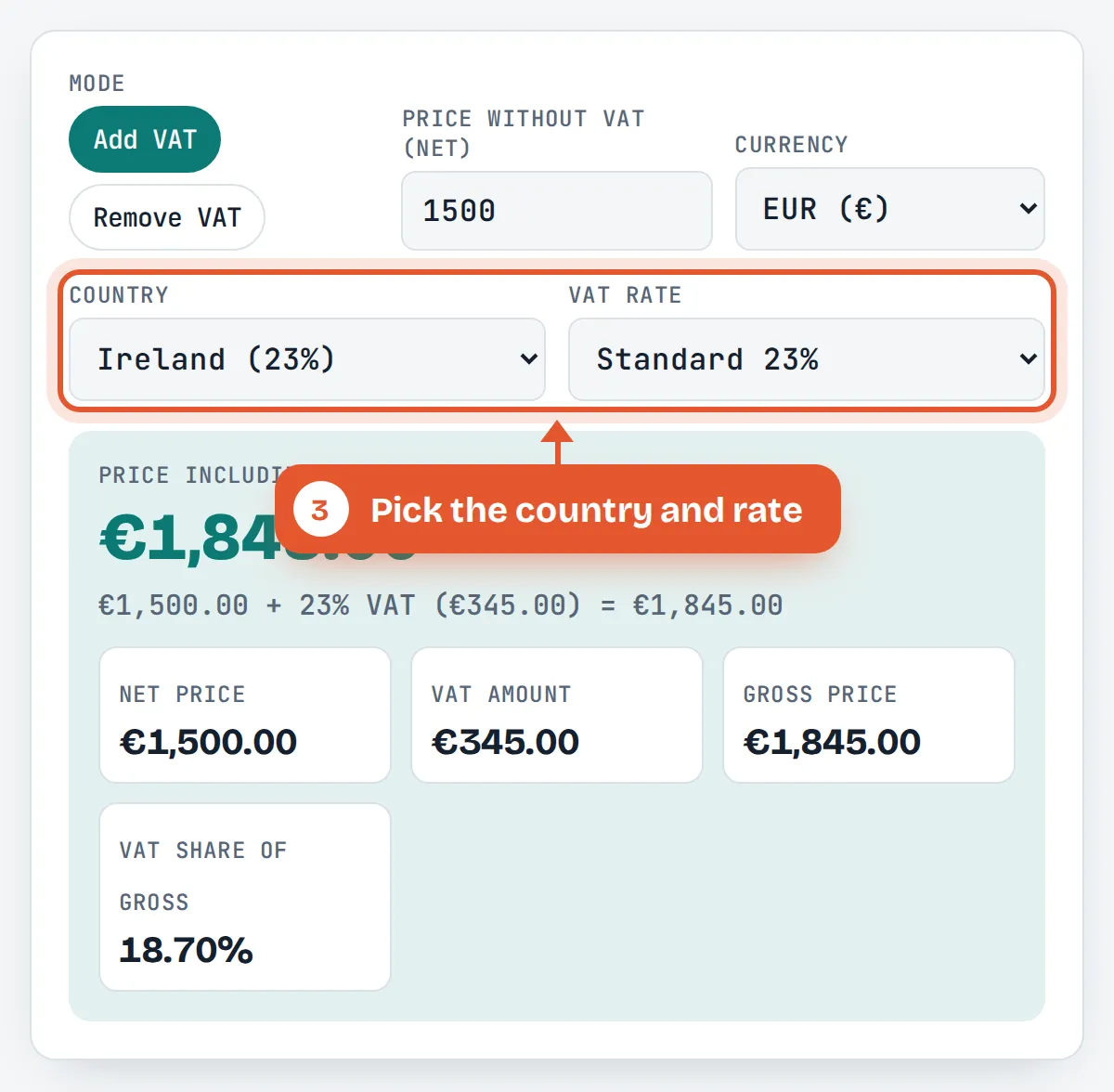
Pick the country and rate
Choose a country, then its standard, reduced, super reduced, parking or zero rate. Use Custom rate for anything else.
Read the result
The total or net price appears in large text, with the net price, VAT amount, gross price and VAT share listed below.
Frequently Asked Questions
How do I add 20% VAT to a price?
Multiply the net price by 1.2. A £250 net price becomes £300 including VAT, and the VAT is £50. For other rates use 1 plus the rate as a decimal, such as 1.23 for Ireland or 1.19 for Germany.
How do I work out the VAT from a total that includes VAT?
Divide the total by 1 plus the rate to get the net price, then subtract it from the total. At 20%, the VAT is one sixth of the gross price, so a £90 bill contains £15 of VAT and £75 net.
What is the VAT rate in Ireland in 2026?
Ireland’s standard VAT rate is 23% in 2026. Revenue also lists a 13.5% reduced rate, a 9% second reduced rate and a 4.8% livestock rate, with zero rating for items such as most food and children’s clothes.
Which EU country has the highest VAT rate?
Hungary has the highest standard VAT rate in the EU at 27%. Finland follows at 25.5%, then Denmark, Sweden and Croatia at 25%. Luxembourg has the lowest standard rate at 17%, followed by Malta at 18%.
Is VAT the same as sales tax?
No. VAT is charged at every stage of the supply chain and businesses reclaim the VAT they pay on costs, while US sales tax is usually charged once at the final sale. Prices in the UK and EU normally include VAT, while US shelf prices usually exclude sales tax.
Can I use this VAT calculator for reverse charge invoices?
Yes, partly. Under the reverse charge the supplier shows no VAT and the business customer accounts for it, so the invoice is net only. Use Add VAT with the customer’s country rate to see the VAT they will declare and usually reclaim.
Sources and Further Reading
- VAT rules and rates, Your Europe (European Commission)
- VAT rates, GOV.UK
- When to register for VAT, GOV.UK
Related Tools
Last reviewed: October 2026