
Turn any English date into its Islamic Hijri date, or a Hijri date back into the Gregorian calendar. Includes a moon-sighting adjustment for your country.

The Hijri calendar is a lunar calendar of 12 months, each 29 or 30 days long, so the Islamic year is about 11 days shorter than the Gregorian year. That’s why Ramadan and Eid move earlier every year. This converter uses the Umm al-Qura calendar for its calculation and lets you shift the result by one day, because countries such as Pakistan and India start months based on local moon sighting.
How do I convert a Gregorian date to Hijri?
Pick the English date in the tool above and the Hijri date appears instantly, with the weekday. If you live in Pakistan or India, choose −1 day when the local moon was sighted a day after Saudi Arabia. To go the other way, tap Hijri → Gregorian and enter the Islamic day, month and year.
The 12 Hijri months
| No. | Month | Known for |
|---|---|---|
| 1 | Muharram | Islamic New Year, Ashura on the 10th |
| 2 | Safar | |
| 3 | Rabi al-Awwal | Birth of the Prophet ﷺ (12th, observed in many countries) |
| 4 | Rabi al-Thani | |
| 5 | Jumada al-Ula | |
| 6 | Jumada al-Akhirah | |
| 7 | Rajab | A sacred month; Isra and Mi’raj observed on the 27th in many places |
| 8 | Shaban | Shab-e-Barat on the 15th night |
| 9 | Ramadan | Month of fasting |
| 10 | Shawwal | Eid al-Fitr on the 1st |
| 11 | Dhul Qadah | A sacred month |
| 12 | Dhul Hijjah | Hajj, and Eid al-Adha on the 10th |
Why your local Hijri date can differ by a day
Each Islamic month begins when the new crescent moon is seen. Saudi Arabia publishes the Umm al-Qura calendar in advance, based on astronomical calculation. Pakistan, India and Bangladesh usually wait for an actual sighting, and their date is often one day behind. Neither is wrong. They use different methods, so treat the converter’s result as accurate to within one day and check your local announcement for religious occasions.
How to use the Hijri Date Converter
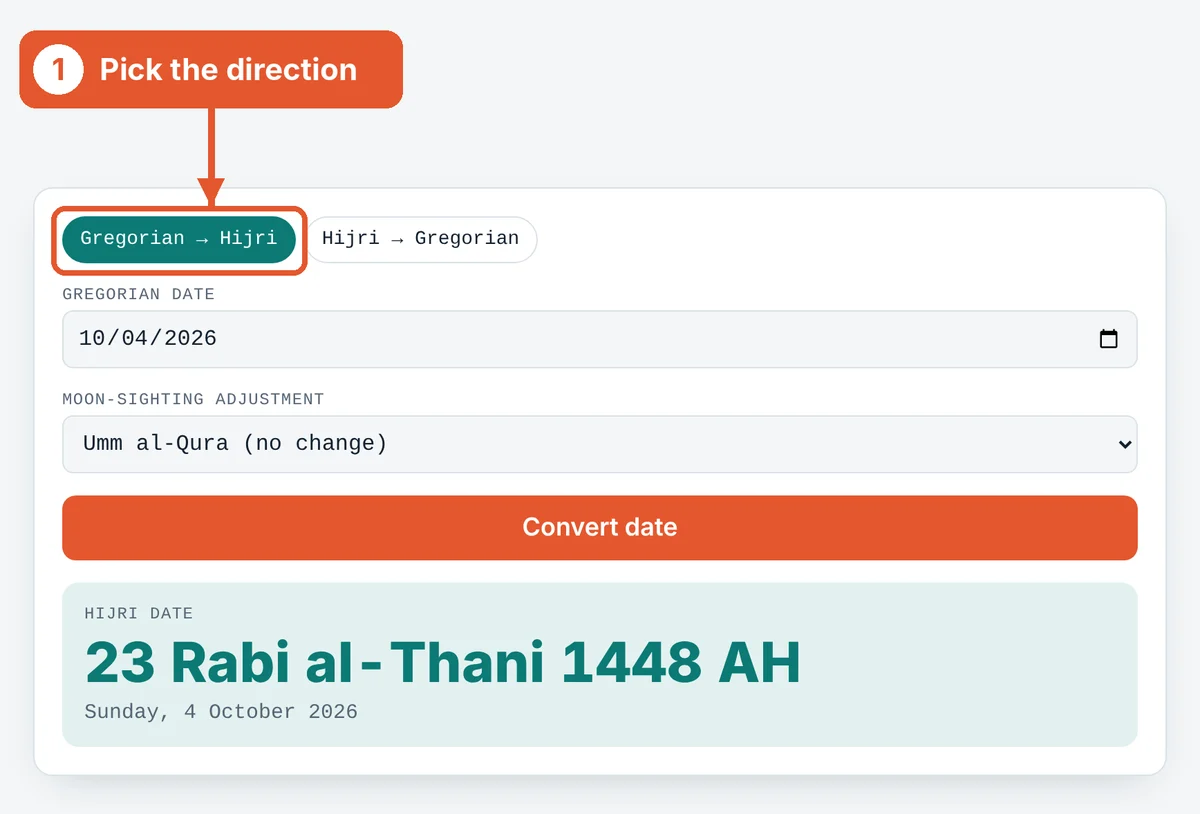
Choose the direction
Keep Gregorian → Hijri to find the Islamic date of an English date. Tap Hijri → Gregorian to go the other way.
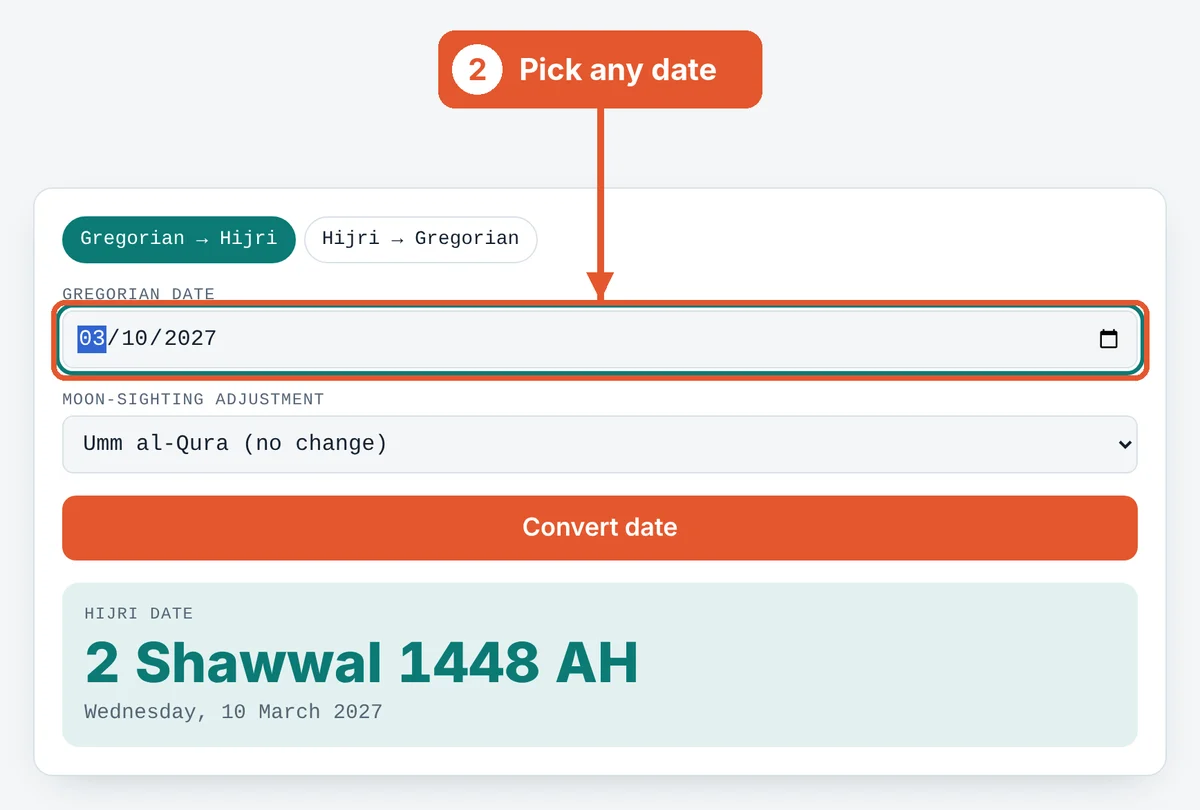
Enter the date
Pick the date from the calendar. Today’s date is filled in for you.
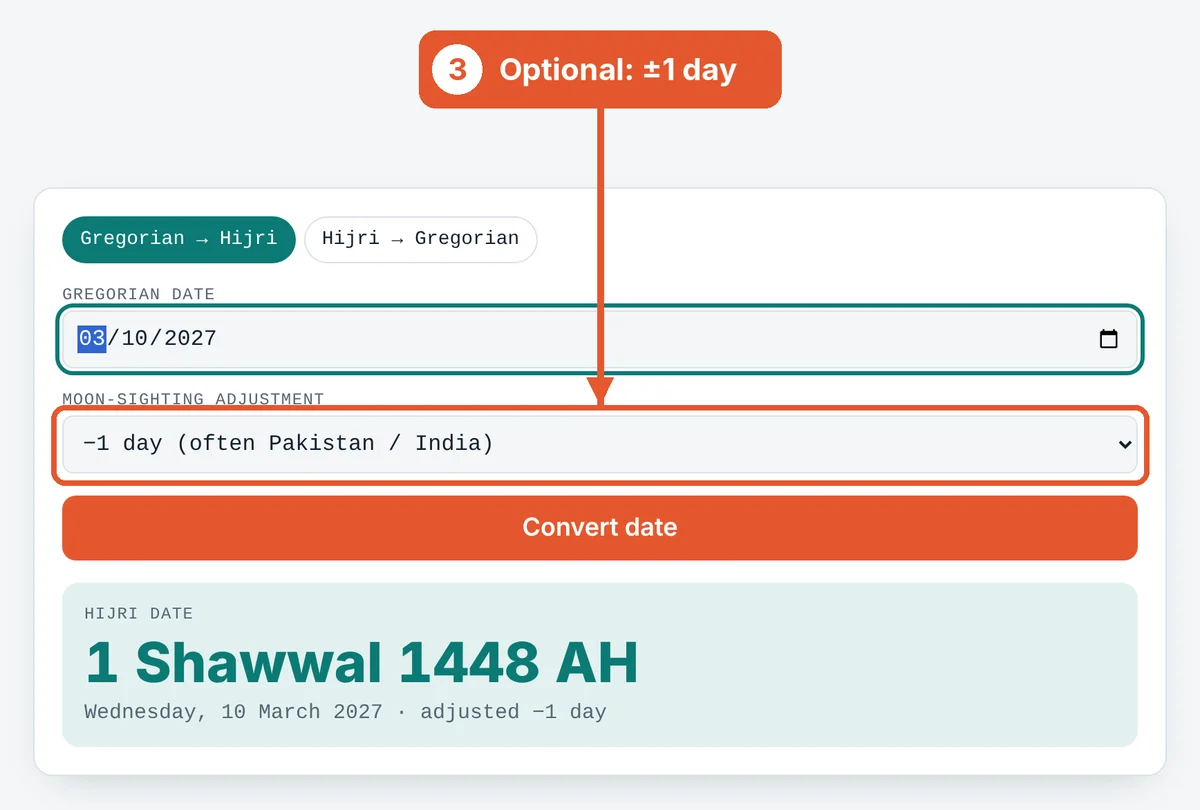
Adjust for moon sighting
Choose −1 day if your country started the month a day after Saudi Arabia. Leave it on Umm al-Qura otherwise.
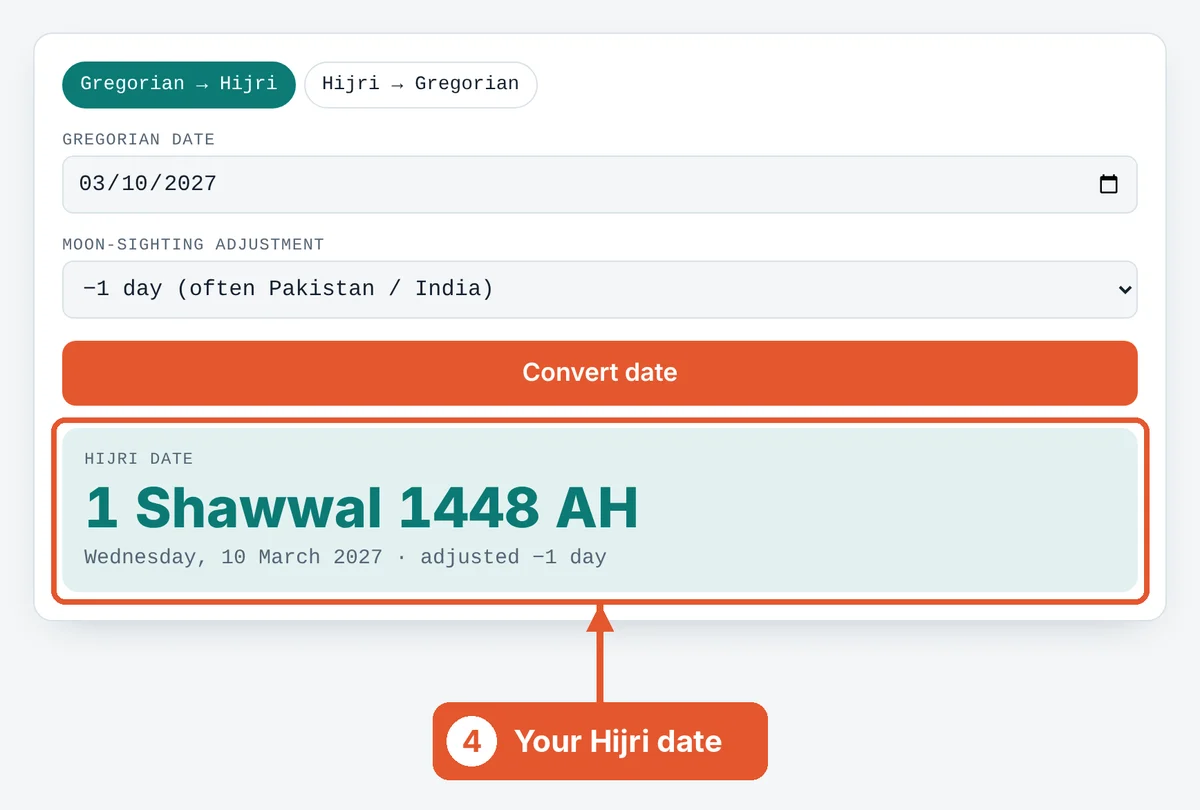
Read the result
The Hijri date shows in large text with the weekday and the original date underneath. It updates as soon as you change anything.
A quick way to estimate Hijri dates by hand
The Islamic year has about 354 days, so every Hijri date falls roughly 11 days earlier each Gregorian year. If Ramadan begins around 18 February in one year, expect it around 7 February the next. For exact dates, use the converter.
Frequently asked questions
What is today's Hijri date?
Open this page and the converter shows today’s Hijri date automatically. Use the adjustment if your country follows local moon sighting.
Which calendar does this converter use?
It uses the Umm al-Qura calendar, the official calculated Islamic calendar of Saudi Arabia, through your browser’s built-in calendar support.
Why is the Hijri date in Pakistan different from Saudi Arabia?
Pakistan starts each month after the crescent is sighted locally, which often happens a day later than the Umm al-Qura calculation. Select −1 day to match.
How many days are in a Hijri year?
A Hijri year has 354 or 355 days, about 11 days fewer than a Gregorian year.
Can I convert my birth date to Hijri?
Yes. Enter your date of birth in Gregorian → Hijri mode. Remember the result may be one day off from what was observed locally that year.
What does AH mean?
AH stands for Anno Hegirae, “in the year of the Hijra”. Year 1 AH began with the Prophet’s migration from Makkah to Madinah in 622 CE.
Sources and further reading
Related tools
Last reviewed: October 2026